The decision to repair, rebuild, or replace equipment should focus on total cost of ownership and production needs rather than repair estimates alone. Repairs work best for isolated failures, rebuilds suit machines with multiple system issues but significant remaining value, and replacement becomes necessary when repair costs and risks exceed the machine's remaining value.
- Repair makes sense when failure is isolated and the rest of the machine is in good condition without risk of cascading failures.
- Rebuild is appropriate when the machine has significant productive value but problems extend beyond a single component, addressing multiple systems at once.
- Replacement should be considered when repair and rebuild costs exceed remaining machine value, accounting for parts availability, lead times, and future reliability.
- Avoid parts hostage downtime by completing thorough inspections, identifying critical-path components, and coordinating parts delivery with the work schedule before disassembly begins.
- Successful equipment decisions balance acquisition cost, machine availability, maintenance history, and production revenue timing rather than focusing on invoice price alone.
Repair, rebuild or replace a machine should not begin with the repair estimate. It should begin with a broader question: Which option gives the contractor the most dependable production at an acceptable total cost and within the required timeframe?
A repair generally makes sense when the failure is isolated, the rest of the machine is in good condition and the work can restore it to dependable service without exposing the owner to a series of additional failures. If a pump, motor or other component can be repaired without contamination or damage spreading through the machine, a targeted repair may be the most economical option.
A rebuild becomes more appropriate when the machine still has significant productive value but its problems extend beyond one component. That value may come from the machine’s size, capabilities, configuration, availability or importance to a contractor’s operation. A rebuild can address multiple systems at once and provide a more predictable second life than a series of individual repairs.
Replacement should be considered when the cost and risk of putting the machine back to work are too high relative to its remaining value. Parts availability, repair lead time, future reliability, safety, technology requirements and the availability of a suitable replacement all factor into that decision. A lower repair estimate does not necessarily represent the lowest-cost option if the machine is likely to experience another major failure or miss months of production.
Look Beyond the Invoice
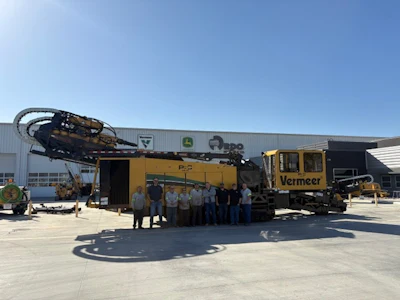
RDO Equipment Co.’s Riverside team recently applied this thinking to a Vermeer D330x500 horizontal directional drill. The machine weighs approximately 90,000 pounds, measures 53 feet long and is capable of producing 340,000 pounds of thrust and pullback. Following a catastrophic hydraulic system failure, the team completed a rebuild with a total invoice of approximately $772,000. RDO Equipment Co.
That is a substantial investment, but invoice price alone does not answer whether the decision was sound. The customer also had to consider what it would cost to acquire a comparable machine, how quickly one could be obtained and how much productive value the existing drill could retain after a comprehensive rebuild.
In this case, inspections and fluid samples confirmed that the failure affected the hydraulic system at a scale that ruled out a simple component repair. The scope ultimately included replacing the entire hydraulic system, including pump stacks, motors and hundreds of hoses. The goal was not to fix one failed part and hope the surrounding components would hold. It was to restore total system integrity and return a safer, more productive machine to the customer.
Build the Plan Before Turning a Wrench
The best way to avoid extended downtime is to make the repair, rebuild or replace decision early and with complete information. For the Riverside project, service leaders spent several weeks developing a detailed estimate before work began. They coordinated with the customer, technicians, the parts department, outside vendors and the manufacturer to determine the scope, ordering strategy and most efficient delivery process. Factory engineers were also scheduled to support the first startup and certify the completed repairs for warranty coverage.
That front-end work matters because teardown without a plan can expose a contractor to what I call “parts hostage” downtime. The machine is disassembled, one critical component is unavailable and every other decision has to wait. At that point, the owner has lost both production capacity and flexibility.
To reduce that risk, the team needs to answer several questions before disassembly:
- How complete is the inspection? Use fluid sampling, diagnostic data, service history and physical inspection to identify damage that may not be externally visible.
- Which parts are critical-path items? Identify the components that can stop the entire project and verify their availability or repair lead times.
- What can be completed in parallel? Divide the machine into systems or work segments so technicians are not waiting on one another.
- Which components require outside vendors? Establish transportation, repair and return schedules before those components leave the shop.
- What is the escalation process? Assign one person to monitor backorders and communicate with the manufacturer when a critical item needs attention.
- Where is the decision point? If inspections reveal more damage, the owner and dealer should know what cost or timeline would trigger a shift from rebuilding to replacement.
Keep Parts Flowing With the Work
On the Riverside rebuild, the parts strategy was designed around the repair sequence. Most parts were initially ordered by ground freight because the team knew significant teardown had to occur before every component would be needed. This reduced freight costs without delaying the technicians. Parts were then staged by machine segment so technicians could quickly locate what they needed for the portion of the job they were working on.
The parts team also tracked backorders closely, escalated several critical items and received almost daily updates from Vermeer. Weekly team meetings kept parts, service, management and other contributors aligned. That communication allowed the team to adjust the work plan instead of discovering a shortage only after a technician reached the next step
This is an important distinction. Ordering everything overnight does not necessarily prevent downtime. It can increase freight expenses while creating a large, unorganized inventory of parts that are not yet needed. The better approach is to connect the parts schedule to the work schedule, expedite only the components that affect the critical path and stage parts in a way that supports technician efficiency.
The machine arrived in two large sections, which created significant safety and handling challenges. At the same time, the team used that configuration to its advantage by treating each section as a separate project. Technicians could work on both sections simultaneously, while the shop foreman coordinated components moving to and from outside vendors.
Make Downtime Part of the Calculation
Repair versus rebuild versus replace is ultimately a business decision, not only a mechanical decision. Contractors should compare the complete expected cost of each option, including:
- Is this unit going to be needed for future projects?
- What’s the likelihood of another failure?
- What is the cost of the repair vs rebuild?
- Any warranty coverage that will offset the costs?
- How will the repair or rebuild affect the jobsite’s production hours?
The Riverside project shows what can happen when those considerations are supported by planning and teamwork. Technicians from different equipment disciplines contributed, the work was divided by priority, parts were staged by segment and issues were communicated through regular updates. The team completed the rebuild within the customer’s requested timeframe and under the established budget.
The lesson is not that every high-dollar machine should be rebuilt. It is that the right decision comes from understanding the machine’s total condition, productive value, replacement options and support network. Once rebuilding is selected, avoiding “parts hostage” downtime requires a complete estimate, early manufacturer involvement, critical-parts planning, segmented staging and continuous communication between service, parts, vendors and the customer.
Replacement should be considered when the cost and risk of returning the machine to service are too high relative to its remaining value. Parts availability, repair lead time, future reliability, safety and the availability of a suitable replacement all factor into that decision.
Replacement also does not automatically mean purchasing new equipment. A dealer-owned rental return may offer a practical middle ground when a contractor needs to restore capacity quickly. These machines are often already available, offer access to newer models and technology at a lower investment and can help fill an immediate fleet gap. Because the dealer managed the machine’s maintenance while it was in the rental fleet, the buyer may also have greater visibility into its service history and continued access to a team that already knows the answer.
As my colleague Si Hanna says, “Smart equipment decisions are often about balance.” That balance includes acquisition cost, machine availability, maintenance history and how quickly the equipment can begin producing revenue. A rental return will not match every application, particularly when a contractor needs a specialized configuration. But when availability and uptime matter more than customization, it may be an effective alternative to waiting on a lengthy repair or a new-machine order.