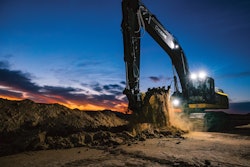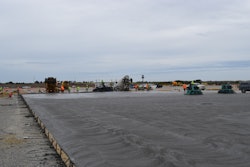

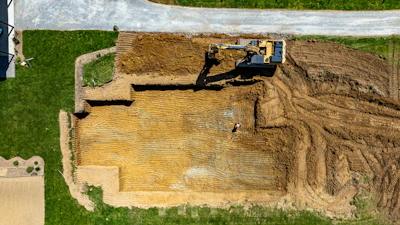
If trucks are waiting, people see it. If the pump is sitting, people see it. If finishers are chasing daylight or fighting a bad setup, people see it. What is easier to miss is the work that put the pour in that position before concrete ever showed up. A slab is only as good as the conditions it is placed on and around. That includes the subgrade, the base, the way water moves through the site, the access for trucks and equipment, and the material that was cleared or left behind before the concrete crew arrived.
I work on the site prep side. I don’t design slabs. I don’t write compaction specs. On engineered jobs, those requirements come from the plans, the civil engineer, the geotechnical engineer, the testing lab, or the inspector. But the field crew still has to build toward those requirements. That is where early decisions can either help the concrete contractor or make the job harder than it needs to be.
A Site Can Look Open and Still Not Be Ready
Clearing brush is one part of the job. Getting a site ready for the next trade is another.
Concrete crews need a site that lets them work.
From a distance, a pad area may look fine. The trees are down, the brush is gone, and the owner can finally see the ground. But a closer look may show roots, stumps cut low, topsoil in the work area, soft pockets, standing water, or an access route that will not carry loaded trucks.
Concrete crews need a site that lets them work. The work area needs to be shaped correctly. The subgrade and base need to match the project requirements. Trucks need to get in and out. Water cannot be running through the area. The site has to be ready for the weight and timing of the pour.
When that is not settled early, the concrete crew ends up solving problems at the most expensive point in the schedule.
What Gets Missed Before the Pour
Most of the issues that delay concrete are practical jobsite problems. A truck can get in but cannot turn around. A pump has no firm setup area. A low spot holds water after every rain. A pad looks ready until equipment crosses it and the subgrade starts moving. A base is placed over material that should have been removed first.
Those conditions create downtime, rework, and confusion over who owns the fix.
None of these are unusual…The problem is finding them after the concrete crew is already on the calendar.
Common problems:
Roots, stumps, or brush material left inside the work area
Topsoil or organic material where cleaner subgrade is needed
Soft or pumping areas that were not corrected early
Drainage crossing the future slab area
Access routes built for pickup traffic, not loaded concrete trucks
Unclear responsibility for grading, base placement, or compaction
Testing or inspection steps that were not scheduled before the pour
None of these are unusual; they are the kinds of things contractors run into all the time. The problem is finding them after the concrete crew is already on the calendar.
Organic Material Is Not Just a Cleanup Item
Roots, stumps, brush, and topsoil are easy to treat like surface cleanup, but in slab areas, they can become support problems.
Good prep relies on an understanding of which areas matter most.
Organic material can hold moisture, break down, shift, and leave inconsistent support. If roots or debris are still in the work area, the issue may not be obvious once base material is spread, but that does not mean it is gone.
Good prep relies on an understanding of which areas matter most. The slab area, truck routes, pump setup, and any load-bearing work zones need a harder look than the rest of the property. Some vegetation can often remain outside the critical work area, but material inside the future slab limits is a different discussion.
That is where site prep teams need to coordinate with the general contractor, engineer, and concrete crew early. What has to come out? What can stay? What needs testing or inspection before it gets covered?
Those answers matter more before base goes down than after.
 Both heavy and compact land clearing equipment and attachments make the job easier.5K Land Management LLC
What 'Ready' Should Mean
On an engineered project, ready means the site meets the project documents and the required approvals are complete. That may involve proof rolling, density testing, moisture checks, base verification, or inspection.
From the field side, I wouldn’t want to hand off a site until these basics are addressed:
The work area is clear of vegetation, roots, stumps, debris, and organics that don’t belong there.
The subgrade is shaped to the required elevations.
Soft spots have been identified and corrected.
Drainage is not running through or undermining the slab area.
Access routes can carry the equipment and delivery traffic expected on pour day.
Base or subbase material is installed according to the project requirements.
Compaction is complete and verified when the job calls for it.
Trucks, pumps, crews, and equipment have room to enter, stage, work, and exit.
That last point is easy to overlook. A site can be technically close and still be a poor place to pour if access and staging were not planned.
Concrete is time-sensitive. The site should not force the crew to figure out truck movement, pump placement, or water problems while trucks are already rolling.
Compaction Is Not a Field Guess
There is no single compaction number for every slab. The right requirement depends on soil type, moisture, slab design, expected loads, base material, and the project specifications. On many engineered jobs, compaction is written as a percentage of maximum dry density using a specific test method. Other jobs may call for proof rolling, field density testing, or inspector approval.
This requirement belongs in the project documents. It shouldn’t be invented by the site prep crew, the concrete crew, or whoever happens to be standing on the pad that day.
Poor site prep can put the project behind before the first truck arrives.
What field crews can control is whether the work is being prepared in a way that gives the site a chance to meet the spec. That includes moisture. Soil that is too wet may pump or rut under equipment. Soil that is too dry may not compact properly. Running more equipment over the wrong moisture condition can make the problem worse.
If the ground is moving under load, that’s important information to communicate and act on. Ignoring it because the schedule is tight usually just costs more later.
Access Is Part of the Pour Plan
Access can make a good plan fall apart.
A pickup can cross a site that a concrete truck cannot. A route that worked in dry weather may fail after rain. A narrow path may get trucks in but give them no place to turn. A pump may have access to the slab but no firm place to set up.
On rural, commercial, and large-acreage jobs, this deserves attention early because the slab area may be far from a paved road.
Before concrete is scheduled, somebody needs to think through:
Where trucks enter and exit.
Whether the route can carry loaded trucks.
Where trucks can turn around.
Where the pump will set up.
Where crews will stage.
How weather changes the access route.
What the backup plan is if the route gets soft.
If access is treated as an afterthought, it becomes a pour-day problem.
The Expensive Problems Are Usually the Late Ones
A soft spot found early is a manageable issue. A soft spot found after trucks are ordered and crews are standing by is a schedule problem.
The same applies to drainage, base correction, and compaction verification. When those items are handled early, the team has options. When they are discovered late, everyone is working under pressure.
Late fixes lead to familiar problems:
Crews waiting
Equipment remobilization
Missed pour windows
Truck delays
Rework after weather
Last-minute base corrections
Arguments over who owns the issue
The cost is the repair plus lost time, rescheduling, and disruption to every trade tied to the pour.
Questions to Answer Before Concrete Is Scheduled
A better handoff usually comes down to fewer assumptions. Before the pour is put on the calendar, the project team should be clear on the basics:
Who owns final grade?
Who owns base or subbase placement?
Who owns compaction?
What compaction standard applies?
Has the geotechnical report been reviewed?
Are proof rolls, density tests, or inspections required?
Which areas must be free of roots, stumps, topsoil, and other organics?
Where will trucks enter, turn, stage, and exit?
Where will the pump sit?
What happens if unsuitable soil is found?
What is the rain plan?
Who signs off before the concrete crew mobilizes?
These are simple questions, but they are also the questions that keep a site from being “almost ready” when the concrete crew needs it to be ready.
The Ground Should Not Be the Surprise
Site prep does not guarantee slab performance. Concrete still depends on design, mix, placement, finishing, curing, joints, loading, and plenty of other factors. But poor site prep can put the project behind before the first truck arrives.
The best concrete jobs usually have a clean handoff. The critical work areas are clear, the access is stable, drainage is understood, the subgrade and base meet the project requirements, compaction is verified when required, and everybody knows who is responsible for the next step.
That’s better for the site prep contractor, the concrete crew, the general contractor, and the owner.
Pour day is hard enough. The ground shouldn’t be the thing nobody planned for.