
In the climate of today’s construction and infrastructure construction industries, “early-stage construction” has become more critical than ever to lay the foundation for a successful exaction. Navigating and delivering on these crucial phases requires a combination of expertise, precision and adaptability to effectively address challenges as they emerge.
In this episode of the For Construction Pros Digging Deeper podcast, join Christina Edgerton, who leads commercial development and growth for CMC’s early stage construction segment, to discover the company and what they can do for construction projects before problems snowball later in the schedule.
Digging Deeper is a podcast series highlighting various aspects of the construction industry, including the equipment, people, companies and associations making it all happen. CLICK HERE to find more episodes of the Digging Deeper podcast.
Before a building is built, it needs a solid foundation. CMC, a leader in early stage construction, has all the expertise, solutions and products you need to give your projects the best start. With over 100 years of experience, CMC is the right partner to help you deliver builds that stand the test of time. Visit CMC.com to learn more.
Hello, and welcome to the Digging Deeper podcast hosted by For Construction Pros covering various aspects of the construction industry, including the equipment, people, companies and associations making it all happen.
Hi, I'm Jonathan, and this episode, sponsored by CMC, features my interview with Christina Edgerton, who leads commercial development and growth for the company's early stage construction segment, as they describe on their website. CMC was founded over 100 years ago as a single-site recycling business. Today, they've grown into one of the leading domestic suppliers of early stage construction solutions that span several critical areas of today's construction site.
It's that portion of the project that we're talking about today, early stage construction — what that means, and how CMC can help contractors ensure jobs can go smoothly and possible, and on schedule. Here's my interview.
Concrete Contractor: All right, Christina, thank you for joining us today.
Christina Edgerton: Thanks for having me excited to be here.
Concrete Contractor: It's always good to know what that person you know, somebody's role in at the company. So, what do you do at CMC, and what responsibilities does that entail?
Edgerton: I recently transitioned to a new role. So, I lead our commercial development and growth for CMCs, early stage construction segment. It really means I sit at the intersection of business strategy, market development and customer relationships, really focusing on market trends and where we're going, not necessarily where we are today.
Think about a lot of these new market opportunities, which I'm sure we'll talk about today, in construction, where construction demand is heading, whether that's energy infrastructure, utilities, data centers, nuclear, other things, just making sure that CMC is really positioned to capture that growth ahead of the curve.
Concrete Contractor: Are you working directly with contractors, or general contractors?
Edgerton: It's a combination of both. Certainly we've got local teams and local sales teams that are managing those relationships with the contractors, but a key part of the role is acting as a point of contact for some of our key strategic accounts. If you think about some of these larger EPC firms or GC firms, where there's a lot of complexities related to their jobsite, oftentimes, one of the things that they cite is wanting a single point of contact to help or support. I would enable that for them.
Concrete Contractor: That's cool. In preparing for this chat, I read a recent interview that where you mentioned that you had a double major in business and Spanish. So that's awesome, by the way. I tried Spanish and I failed miserably.
Edgerton: I love Spanish. I had a great Spanish teacher in high school, and I wanted to continue and make her proud, so I majored it in college.
Concrete Contractor: That's awesome. You also have a master's in finance from Tulane University, which is even more awesome.
Edgerton: Thank you.
Concrete Contractor: In that same interview, you also mentioned that you found a strong foundation in customer service through waiting tables. And I think that's where a lot of people get that foundation of customer service. How have you noticed that customer service mentality come through in your role at CMC?
Edgerton: Oftentimes, when people ask me about my career, it's one of the first things I cite. It was really foundational. I started waiting tables in high school, and I did that through college, I'm sure, like most people did. What I learned really quickly is it's not about just taking an order. It's a really dynamic role. You've got to be able to anticipate when customers want water before they even ask you for water. You've got to make sure that you're being responsive to their request. That you're listening to what they want. That you're over communicating in terms of service.
At the end of the day, people just want to feel like they've been heard. They want you to follow through on the things that you say you're going to do, and they want to know that you actually care. That's true whether you're bringing food to a table or you're selling products to a jobsite.
The other piece that's really relevant is the hustle. Think about the service industry and being a waitress or a waiter, or whatever role that you might serve — you're constantly triaging. You got to figure out what needs attention right now. You've got multiple tables that you're trying to serve and support. You're trying to figure out what can wait, what's about to go sideways. What do I need to prioritize. That instinct for staying calm and prioritizing under pressure is a skill that I use every single day.
Concrete Contractor: Never thought like waitressing and construction would suddenly marry so well together. And for me, I came in from the kitchen side of things. I couldn't do the waitressing. I couldn't do that. I don't have the mentality to manage all of the needs.
Edgerton: That's just as important of a role I couldn't be able to manage the kitchen. Every role is important.
Concrete Contractor: It's all customer service though. Even to this day, if somebody needs something in my email, if somebody asks me a question, I'm going to go over, above and beyond, just because of that customer service foundation.
Edgerton: It's key, and it's important. It's really pivotal. And there's, there's a lot of overlap too. There's a lot of competing pressures. If you think about a jobsite, a lot of competing demands. You're trying to triage, constantly, manage, timelines, pressures, budget, cost, all of the things. It's really similar in that you're constantly having to prioritize what's important and keeping the customer at the center.
Concrete Contractor: I do want to draw that link there between your career in the education and in finance and now at CMC. How did you find yourself in the construction industry? Because that is an unusual story.
Edgerton: My background was finance and accounting, as you referenced. I started early in my career in finance and accounting roles. I was a controller at a manufacturing plant. I did FPNA, and then eventually I transitioned to sales, which was pivotal for me.
I was managing a sales team for an industrial gas company, and then I eventually progressed to a PNL. But, I came to the construction industry by accident, which I think is true for a lot of people in construction. I was working for an industrial gas company, I got a call from a recruiter about a role in building materials. This was before I was at CMC. I wasn't looking but the opportunity was interesting enough that I took the conversation and that was basically it.
What I didn't expect was how much I was going to love the construction industry. I ended up, at that time, managing quarries, asphalt plants, ready mix plants and paving crews like real boots on the ground type stuff for a large building materials company in Pennsylvania.
I was new to industry. I didn't know anything about the construction industry. In my first few months, I really just tried to absorb as much as possible. I was doing ride-alongs with mixer drivers, spending time with QC techs in the lab, visiting paving crews on the jobsites, shadowing quarry superintendents, spending time with customers, etc. All of those experiences were really invaluable and you really start to understand the perspective of the contractor, because you're dealing with weather, equipment breakdowns, customer deadlines, quality issues, all at the same time, as we referenced earlier. It's chaotic in the best way, but it really gives you a good perspective.
While I got here by accident, I have loved the time that I've spent here.
Concrete Contractor: I like to say once you hit into concrete, you get stuck in it, so I hope you're here for a long time.
Edgerton: Thank you. I will be, but I appreciate that.
About CMC
Concrete Contractor: I'd also love to get a little background on CMC itself. My bet is a lot of listeners will probably be more familiar with the company through the metals recycling and maybe even as a rebar supplier, but CMC, as I understand it, is so much more. Can you give us a good overview at what CMC does for the construction industry?
Edgerton: CMC is one of those businesses that's literally underneath everything you build. But most people, as you referenced, may not have heard of us or only know us through specific products. Most people know us as a steel company, which is fair, because we are the largest manufacturer of rebar in North America. That's the steel that's virtually inside every highway bridge building, hospital and stadium you've ever been in. I always like to give some examples that CMC was involved with. We did the AT&T Stadium. We've done buildings like the Pentagon. We did high rises like the Four Seasons of Miami. We're in a lot of a lot of things that everybody likely steps into every day.
What's really exciting about where CMC is today is what we've grown beyond steel into full early stage construction solutions platform.
When you think about it, everything has to happen before a structure goes vertical, and CMC has a product or solution for almost every phase of it. We have tensor geogrids or geopier ground improvement — that stabilizes and reinforces soil conditions that would otherwise make a project pretty expensive or unfeasible.
We've got our construction services business, which handles distribution and on site support so contractors can have what they need and when they need it. And then there's precast. CMC has made some recent moves with two major acquisitions of CPMP and Foley, which really established CMC as the third largest precast supplier of precast and concrete pipe products. The reason that's important is, as you know, precast solves one of one of construction's biggest pain points, which is labor shortages, and provides products that are ready to install.
When you step back and you look at CMC, we are rebar, we are performance steel, we're ground improvement, geosynthetics, anchoring systems, prefabricated bridges, precast concrete, distribution and a lot of other things.
We've quietly assembled a portfolio that touches almost every phase of construction and how this country gets built, and it's really been very intentional on our part to really ensure that we're partnering with contractors before the shovel hits the ground.
Defining Early Stage Construction
Concrete Contractor: That's a quite a tongue twister. Is there a bigger strategy that you're aware of behind all of these brands coming together? What does CMC kind of look like years from now?
Edgerton: The first step is really defining what is early stage construction. It's one that we've been really intentional around defining.
When we say early stage construction at CMC, what that means is everything that happens on a jobsite before the structure goes vertical, underground work, foundation systems, site prep, drainage and pipe infrastructure. Historically, CMC has showed up when it was time to pour and reinforce. Now, we want to show up at the very beginning. Before the walls go up. Before the structure is visible. Before most of the trades even show up.
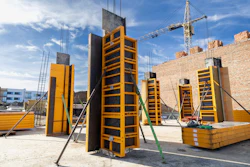
What that means in practice is our Tensar geogrid solutions stabilize the ground. Our precast pipe handles drainage and utilities. Our rebar goes into the foundation of the structure, and our construction services distribution supports the whole process with forming and shoring, tilt wall solutions, etc. That's really who we are and where we're going from an early stage construction solution standpoint.
Concrete Contractor: Can you add what is it not? Because I think that'll be a really good definition there.
Edgerton: Equally as important is what it isn't. When we think about early stage construction, it's not the vertical structure, it's not the mechanical, electrical and plumbing systems. It's not the exterior facade. It's not the interior build out.
CMC isn't trying to be everything to everyone across the entire construction life cycle. The focus is really intentional: owning the face at the very beginning that has the biggest impact as to whether a project succeeds or fails.
Concrete Contractor: Is there a common misunderstanding about early stage construction from contractors? Where do you think that misconception comes from?
Edgerton: Honestly, the most common misunderstanding is just that people don't know what it really means, and it's fair, because it's a relatively new term that CMC has introduced to the market in the past few months. A lot of the work right now has been just around education. Helping customers understand what do we mean when we say early stage construction, what's included, why it matters, and when you explain it as everything that happens before the structure goes vertical. People get it fairly quickly. They just hadn't heard it framed that way before.
I also think part of the misunderstanding comes from the fact that historically, these products and solutions went to market very individually. You had a rebar supplier over here, a ground improvement company over there, a precast supplier somewhere else, and nobody was really connecting the dots for the customer. There was never really a reason for the market to have a shared language around what early stage construction means. It's one of the things I actually find most exciting about what CMC is building is we're not just assembling a portfolio of products, we're really helping define a category. And when you get to define the category, you really get to help shape how the market thinks about it.
Concrete Contractor: In the preparation for this episode, I was digging around on social media, and I saw on CMC's LinkedIn that they're calling early stage contributors to rethink their roles. Can you elaborate this on a little bit more? What about these roles do we need to kind of rethink?
Edgerton: Think the post is really about an opportunity for people in this space to reimagine what it could be or what it could look like in the future.
When we say early stage contributors, we're talking about the geotechnical engineers, the foundation contractors, the site prep crews, the detailers. These are incredibly skilled people who have traditionally been very focused on their specific scope, and they're great at it. They're really good at what they do, but the industry is at a point now where the value that they can bring is so much bigger than any single scope of work.
Rethinking the role really just means shifting from a mindset of scope completion to one of project outcomes. It means getting involved earlier in the design process, speaking up when decisions are being made that will create problems two phases down the road and really just being able to collaborate and willing to collaborate across traditional boundaries.
Concrete Contractor: I see a lot of stories that actually mention that collaboration is a major part of everything going smoother down the way. I feel a lot of times, people get stopped and they don't want to communicate. I think you're pointing out that, raise your voice, mention something. If you see something wrong, say, "Hey, I have some education here, this needs to be addressed right now."
Edgerton: I think that's a piece of it, or be curious. I think oftentimes people may not know, or may not have an understanding around maybe the items that they're designing or the things that they're responsible over are going to have some implication downstream from a project standpoint. I think it's really shifting away from a scope of work, completion and having sort of a more holistic look on the project.
Part of that, to your point, is being comfortable speaking up if they feel that there's some sort of risk or implication related to how the project is being designed. The other part of that is really being curious around what alternatives are out there, or how could we make the project better or completed quicker, faster, or look at it from a total cost standpoint versus maybe a direct cost standpoint.
Concrete Contractor: That's a dangerous position to be in, because if it's a person like me, I'm going to be curious about every single detail.
Edgerton: Yeah, it's dangerous, but I think it's where the value is. If we've got people earlier in the process when we're designing the projects, asking more questions and being more open minded and curious around what alternative solutions could be, I think ultimately it makes for a better outcome related to the project itself.
Concrete Contractor: So much in the construction industry has changed in the last 5, 10, 20 years, specifically with a lot of technology, but a lot of different ways and codes and methods to being getting the job done. In your perspective, how has early stage construction changed recently? How has technology affected things?
Edgerton: It's changed dramatically, and it's really an exciting time to be in the industry. I think oftentimes there's this misunderstanding that construction is low tech. I think that comes from the fact that it's been slow to innovate historically or slow to adopt technology historically. But I do see that changing pretty quickly, at least in the near term or midterm.
If you look at it strictly from a CMC standpoint, within our portfolio, you can see that playing out really clearly. ChromX is a rebar that's engineered for 100 year service life. You have Tensars geosynthetic systems that can make previously what was considered unbuildable sites viable. You've got Geopier's ground improvement that can stabilize soil conditions, which would have required massive over engineering just a generation ago. And then there's InQuik which is one of my favorite examples of genuine construction innovation. It's a prefabricated short span bridge that can be installed in less than a week.
All of these are examples of serious technology that's embedded in early stage construction.
If you take a step back outside of CMC, and you look at the industry as a whole, there's a few trends that are that are shaping the industry. You see a trend towards prefabrication and modular. A lot of that's driven by labor shortages, which we talked about earlier. We also see the internet of things. There's some early trends, whether that's in sensing technology, so embedding sensors and foundations or soil monitoring systems, etc, as well as delivery tracking. And then you also see distribution, and the rise of distribution. While that might not be seen as maybe innovative or technology driven, it is a strategic capability, and you do need technology to enable that.
Ultimately, at the end of the day, the best product doesn't create value if it doesn't show up at the jobsite at the right time and in the right quantity. That's where you see this trend, or this rise of distribution taking place.
Concrete Contractor: We mentioned to get more collaboration, more communication early on, because we're talking about early stage construction. That's all those meetings, that's the design phase. What can contractors do differently in in this stage, this early stage of construction?
Edgerton: I think that the single biggest thing that they can do differently is just get involved earlier, much earlier than maybe traditionally, they would have done so. The best contractors, in my view, are the ones that are at the table during the design phase, having conversations with geotechnical engineers, the foundation design, the civil engineers before the documents are even issued. That's where you can really influence outcomes. You can recommend better solutions, and you can identify opportunities to save time and money before they're in the final plans.
The second thing a contractor can do is really expand their toolkit. As we referenced earlier, a lot of contractors are still defaulting to the same solutions that they've always used when there are genuinely better options or alternatives out there. We talked about geosynthetic reinforcement systems, high performance steel like ChromX and Galva bar prefabricated solutions like InQuik — there's a lot of proven technologies that, in many cases, are more cost effective when you factor in labor and schedule but aren't necessarily the default
Next, I would say, is just building supplier relationships and not just transactional vendor relationships. The contractors who are set up to win in early stage construction are the ones who treat their suppliers as an extension of their team.
Concrete Contractor: How does a contractor get involved? Where do they find that seat at that table to make sure their voice can be heard?
Edgerton: It's going to depend on where they sit within the company and their role. But a lot of a lot of contractors, they're typically thinking, they know the projects they're going to bid on. They have visibility in line of sight related to their pipeline. They have visibility related to their backlog. It's really just ensuring that they're getting involved and involving their suppliers, most importantly, early, when they're in the design phases of some of these projects that they're considering or evaluating to bid on.
Concrete Contractor: How can CMC help? What's CMCS role in early stage construction? What are, what are the challenges that we're addressing?
Edgerton: From our standpoint, I would say there's three main things that CMC is helping support or bring value to contractors. It's really simple. It's speed, simplicity and scale.
When you think about speed, a lot of the contractors have a lot of pressure related to project timelines and making sure that they finish their jobs or their bids on on time and on budget. When we talk about speed, there's a lot of prefabricated solutions. We referenced in terms of precast pipe in products or in quick that are manufactured off site, and they arrive ready to install. That really helps compress project timelines, which matters really enormously when customers are racing to meet some of those deadlines of their customers.
When we say simplicity, it just means that they can work with a single partner across more of the jobsite with CMC. Instead of managing multiple vendors for underground pipes, site reinforcement and structural steel, CMC can be the single source of solutions and expertise for the job. That really reduces coordination and risk.
When we say scale, we've got a lot of local knowledge and proven expertise, but we're backed by a national company. We've got over 80 different locations across the US to support different project needs. It means that we can provide flexibility and supply chain with less disruption to our customers.
Concrete Contractor: That's awesome. It's not like 60 offices over on the West Coast and then like five in the Midwest. Are those 80 locations spread out?
Edgerton: They are spread out. I don't know the exact number of states that we're in, I would venture to say it's over 30 different states. That's pretty evenly distributed. We've got a pretty heavy concentration in the southeast from Texas to Florida. With these recent acquisitions and some of the steel mills that we're building in West Virginia, we've increased our presence in the mid-Atlantic, and then we go as far west as well. We are all over the US, in a variety of different locations and markets.
Concrete Contractor: It sounds like you are having a ton of conversations with a ton of different contractors in a ton of different situations, because they're all different working on different projects. Do you have any favorite stories that you can share?
Edgerton: There are a lot of great stories around projects that we're helping support. The most recent one that comes to mind is we're actually involved in one of the largest LNG export facilities. The facility was set to be built on the marsh lands in Louisiana. If you think about that, it's really unfavorable ground conditions that could have caused major delays in the project and transportation and really unsafe working conditions, to be honest. But CMCs ground improvement solutions allowed for a safer and more efficient transfer of equipment during the project. We provided both rebar and geogrid to the project. It was a massive project covering thousands of acres, and we really allowed the customer to save on construction costs and also simplify their supply chain.
It's a really inspiring project to go to and to walk the jobsite and to see the impact that CMC has had and how we've been able to support them by supplying them with what they need when they need it.
Concrete Contractor: It's engineering and creativity like that kind of makes you, like astronomically boggled about how they were able to do this back in the day when we were creating all this infrastructure for the very first time. Let's think of like the Hoover Dam. The engineering in there just is astounding.
Edgerton: It's impressive. At our core, the US has had really strong engineering capabilities for a very long time. To your point, there's some really large milestone, signature projects that have been around forever. But we're also evolving as an industry, we've got really cool, innovative solutions or services that can help enable us to build faster, to build more efficiently, to really be more efficient in how we do things. But the engineering is always really impressive in a lot of these job sites.
Concrete Contractor: It's that mentality of we're going to figure it out and just keep trying until we do.
Edgerton: Yeah.
Concrete Contractor: We're talking about how things have changing. In my role, I've seen a lot of innovation come out. It might not actually be groundbreaking to use a pun, but there is a ton of innovation in the construction industry, and now we're seeing AI be integrated in a lot of different areas. What do you think this kind of means for the future of construction? Where do you think this trend is going to take us in early stage construction?
Edgerton: I think AI is really shifting where value gets created. We talked about the Internet of Things and what that actually means from a services standpoint, I believe AI is going to be an enabler for that. It'll provide real time visibility to projects that historically we may not have had access to. Whether that's through the sensing technology that I referenced, whether that's asset tracking, whether that's delivery tracking, there'll be much more visibility real time, with access to data that we've historically not had, that ultimately will enable better decision making in the field.
I think there's also opportunities, from an AI standpoint, around how we bid and what that can do to help enable our bidding process, or we think about design and engineering, there's a lot of ways that you can incorporate AI into our into our processes or into our workflows that could be pretty transformative and potentially disruptive, if we can find a way to leverage AI in a way that brings value to the customer, to ourselves.
Concrete Contractor: Well, we're building the data centers. You might as well use it, right?
Edgerton: That's a key piece of it. We are definitely enabling it by a from a construction standpoint, because we're building the data centers and the infrastructure that goes around it: energy, utilities, etc.
Concrete Contractor: One final question, because I was clicking around, like I said on social media, who's Florek? What's the story there?
Edgerton: One of the best features related to CMC and CMC's culture, it is a plushie stuffed billet. Quite literally, that was invented from our polling team. It's really seen as an endearing mascot that travels to different jobsites or trade shows or conferences or even internal events, employee events, and makes cameos and takes photos and images with our employees, our customers, et cetera, and pops up on our social media. It's a pretty endearing part of our culture and one that we really enjoy and we follow. It's always fun to see where he shows up.
Concrete Contractor: I like that idea of just having that culture and having a little fun with it.
Edgerton: It's all it's all about having fun at the end of the day.
Concrete Contractor: Well, Christina, I think we're out of questions and a little bit out of time. Thank you very much for joining us.
Edgerton: All right. Appreciate it. Thanks for having me.
Concrete Contractor: That about does it for this episode, I'd like to thank Christina once again for taking the time to talk with us. Thank you to CMC for sponsoring this episode. And a special thank you to you for listening.
This has been the Digging Deeper podcast by For Construction Pros. You can find this episode and more on Stitcher, Apple podcast, Megaphone, or your favorite podcast app. Until next time, if you keep listening, we'll keep digging.