
Striping projects rarely get the luxury of ideal conditions. They happen in traffic. They happen under deadlines. They happen after design revisions, public debate, and construction fatigue have already worn everyone down.
That is exactly why Big Apple Services’ work on the City of Decatur, Georgia’s ongoing bike and pedestrian initiative stood out to the Pavement Maintenance advisory board and earned the company the 2026 Superior Striper Award.
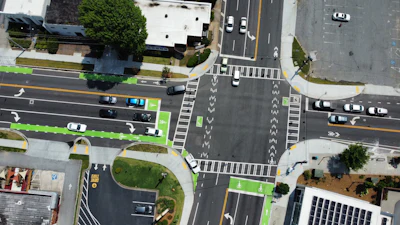
The project transformed a busy arterial corridor into a reconfigured, multimodal roadway. A former four-lane section was condensed into two travel lanes with bike lanes added on both sides. The work took place along one of the most heavily traveled routes feeding into downtown Decatur, a city known for its walkability and strong public support for pedestrian and cycling infrastructure.
By the time Big Apple was called in, the project was already two years behind schedule.
“There were constant design changes, both from the engineering side and from seeing how things worked in the field,” said Clint Anderson, Co-CEO, Operations at Big Apple Services.
Their first order of business was to work with the city engineers, civil engineers and general contractors to bring the requirements of the design together with the realities of the project location
Managing Safety Before Final Striping Ever Began
One of the defining elements of Big Apple’s role was how early they became involved. Rather than waiting until final paving was complete, the company applied temporary markings through multiple paving phases to maintain safe traffic flow for crews and the public.
That approach required flexibility, patience, and daily coordination with professional traffic control teams. Every phase of the project demanded lane shifts, signage adjustments, and re-layouts as conditions evolved.
“Being on one of the busiest roads in Decatur, professional traffic control was a necessity for every phase of the project,” Anderson said.
Once final paving was complete, Big Apple laid out the entire corridor using marking paint so engineers could review lane geometry, bike placement, and intersection movements before permanent materials were installed. That step proved critical, especially since the real-world traffic behavior revealed issues with the city's plan that drawings alone could not have predicted.
When Rubber Meets The Road
At Church Street and East Ponce de Leon Avenue, the team completed full thermoplastic striping and signage before city engineers asked to revisit the layout.
“They saw how it was operating in the field and decided changes needed to be made,” Anderson said.
Originally, the bike lane was placed between a through lane and a right-turn deceleration lane. After observing traffic movements, the city determined that configuration created unnecessary conflict points for cyclists. The solution required removing newly installed thermoplastic and MMA markings and re-striping the intersection entirely.
Was it a headache? Sure. But it's a lot less of one when the changes aren't your fault, and you're just one helping the customer make it right. To that end, Big Apple used hydroblasting to remove the materials without damaging the new asphalt underneath, avoiding what would have otherwise required milling and repaving.
“That would have been triple the cost, and we wanted to avoid that,” Anderson said.
The ability to adapt without compromising quality or schedule became a defining characteristic of the project.
The Decatur initiative called for a wide range of striping materials and application methods across asphalt and concrete surfaces. Big Apple installed hot-applied thermoplastic, preformed thermoplastic, Rollplast MMA, and cold-spray MMA, depending on location, color requirements, and durability needs.
Preformed thermoplastic played a significant role, especially for bike symbols, legends, arrows, and decorative elements. These materials arrive in puzzle-like sections that are assembled and heat-bonded directly to the pavement.
“Anytime somebody wants anything other than traffic white or traffic yellow, it’s going to be preformed thermoplastic,” Anderson said. “Bike graphics, arrows, legends. It’s the cleanest way to get consistent color and shape.”
Rollplast MMA was used in high-traffic areas where skid resistance was critical. Unlike reflective glass beads, rollplast incorporates aggressive anti-skid directly into the material.
“If you slide your foot on it, even when it’s wet, it’s not sliding at all,” Anderson said.
The diversity of materials required crews who were cross-trained and comfortable switching between systems depending on the day’s scope and weather conditions.
A Reputation Built On Showing Up
At the conclusion of the project, Big Apple was invited to bid on additional thermoplastic and MMA striping work directly with the City of Decatur. The award was not just about finished markings. It was about how the company handled a complex, evolving project from start to finish. For a municipality, or any public sector client, that can mean more than anything.
Big Apple Services was founded in the early 2010s by Steve Epstein. He was frustrated by inconsistent subcontracted striping quality and decided to take control of the work in-house. Co-Owners Josh Cagliani and Clint Anderson continue to push an emphasis on quality and accountability that still defines the company today.
“We return phone calls. We return emails,” Ty Ansley, project manager and sales, said. “We get calls all the time from general contractors saying another company won’t answer anymore.”
Today, Big Apple employs roughly 25 in-house staff and scales higher with subcontractors as needed. The company balances commercial and public work throughout Georgia and the Southeast, often serving as a specialty partner on complex urban projects.
“Multiple customers tell us, ‘You’re not the cheapest, but we’re going with you because we know your work and we know you’ll do what you say,’” Anderson said.
Urban striping projects like Decatur’s bike initiative leave little room for error. Lane widths, turning radii, and bike placement all affect safety long after the crews leave the site.
One thing the team at Big Apple wanted to include was a recognition of their supplier Geveko Markings out of Gainesvill, GA, who provides all their MMA, thermo, and preforms.
"They help us out a ton, and are always willing to give our name out to companies that need our type of services," said Ty Ansley, sales and estimating at Big Apple.
Big Apple’s Superior Striper Award, only the second ever bestowed, isn't just for their clean lines and striping excellence. It represents their overall commitment to quality work and an amazing client experience wherever and whenever they are called upon. On one of Decatur’s busiest corridors, Big Apple Services proved that striping is not the final step in a project. It is the step that makes everything else work.