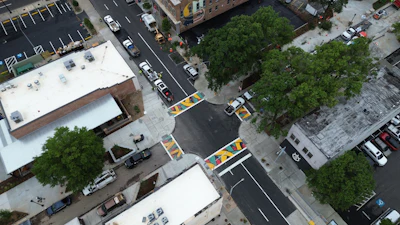
When the biggest sporting event on the planet comes to town, everything becomes a potential canvas for the cause, even crosswalks. Ahead of hosting World Cup matches this summer, the City of Atlanta commissioned artists to design crosswalk murals for the intersections surrounding Centennial Olympic Park, Downtown and the stadium district.
All the city needed was somebody who could take them from a design on paper to a functional piece of city infrastructure. The success of this project revolved around an award-winning contractor, recognized at PAVE/X as the Superior Striper of 2026: Big Apple Services
“Precision 2000 (P2K), the general contractor reached out to us, and two other contractors as well that do the same type of work,” said Ty Ansley, Salesman and Estimator at Big Apple Services. “But the other two didn’t have the capacity for this type of project with its timeline.”
The first call with P2K and the city came on April 6, and the expectations were ambitious: 16 decorative intersections spread across the city, all wrapped before kickoff.
“We told them we’d be realistic, because it didn’t seem feasible in their timeline,” Ansley said. “So we said, ‘Which ones are your priorities?’”
The city pared the list to its eight must-haves, all clustered around Centennial Olympic Park and the stadium, still a large undertaking, and the deadline didn’t move an inch.
“The biggest constraint for us was the time,” Ansley said. “We had our first call about it on April 6, and they wanted us to be done by June 10 at midnight.”
Even that undersells the crunch this put them in. Proofing and material production didn’t begin until April 20, and the purchase order didn’t land until mid-May. “When it was all said and done, after we got the PO, it was a legitimate three weeks running around like a chicken with your head cut off,” said Clint Anderson, Co-CEO at Big Apple Services. The first install went down May 19.
For the material itself, Big Apple turned to its preformed thermoplastic supplier, Geveko Markings. “They’re the leading manufacturer of preform in the world, but also their plant is in Gainesville, Georgia,” Ansley said. “When a crosswalk was done, we just went up and got it or they delivered it the same day.”
P2K’s project team, Nicolas Perea and Cristhian Moreno, handled all communications with City Managers while managing submittal approvals, permitting, safety, and construction sequencing with the City of Atlanta and multiple stakeholders. Coordinating four specialty contractors, P2K kept the project on schedule, allowing Big Apple to focus on field execution ahead of the City’s deadline. “They dealt with Atlanta so we could focus on the installation,” Ansley said.
Painting By Numbers In The Dark
Once the artists’ renderings were flattened, scaled and matched against Geveko’s library of roughly forty colors, proofs went to the city for sign-off and the material started rolling off the line.
“It’s basically almost like a really complicated paint by numbers,” Ansley said. The designs arrive ready to be water-jet cut into 2-ft. x 3-ft. sheets, pre-assembled at the factory and boxed in the order the crew will need them, each box with a printout showing which numbered pieces it holds and where they land. On the most intricate crosswalks, the piece count ran as high as 231.
“The numbers are stamped into the preform — they go away when you heat it up,” Ansley said. “That also helps us know when the preform is sufficiently melted.”
Before anybody lit a torch, every piece got laid out, checked and centered in its final location.
“We don’t want to get started heating at the beginning of the crosswalk, get halfway through and be like, ‘Oh crap, we’re short this,’ or ‘This needs to shift,’” Anderson said. “Everything initially gets completely laid out, and then melted in once it gets the final okay.”
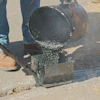
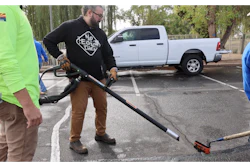
Fusing the material to the asphalt with an infrared heater and high-BTU torches is where the specialists separate themselves.
“One of the most challenging things is one color that’s really easy to burn down butted up right next to a really dark color that’s very difficult to burn down,” Anderson said. “You can’t just get out there and willy-nilly get after it. You really have to finesse the process.”
Anderson has also learned to plan for the inevitable. “The first handful of decorative projects we did, I always found myself saying, ‘Geez, I wish I had more of this color,’” he said. “So I got with our manufacturer, and they now ship a spares package with every decorative crosswalk.”
The rhythm of installation worked like this: hydro-blast the old thermoplastic off an intersection one night, install the artistic pre-forms the next, resulting in one full intersection per night, inside full closures where the crew owned the whole roadway. H3B Traffic Control did an outstanding job providing Traffic Control Plans for permit approval and keeping our guys safe during installation inside the closures.
“Weather was absolutely insane,” Anderson said. “We did the first two without any weather issues, but after that, it was like every single time we’d go to mobilize, we’d get a crazy torrential downpour. Weather was probably our biggest problem.”
But other surprises still popped up. Midway through the entire project, the city added a ninth intersection at the iconic corner of Andrew Young International Boulevard and Peachtree Street, and it was the most complicated of them all: four crosswalks joined by a decorated radius.
“It turned out to be the best-looking crosswalk we did,” Ansley said. “They did their homework and got all the radiuses correct, plotted the stopbars correctly, which ended up saving us — we had laid out one whole crosswalk, and it turns out we were about seven feet away from where it needed to be.”
It came down to the final morning. Running a short-handed graveyard crew on June 10, Anderson was finishing the last “do not block” box when the phone rang: 90 charter buses were inbound to AmericasMart, held up by his closure. He needed 20 minutes. The crew stayed in, got it striped and got off site about 15 minutes past the promised time — with all nine intersections complete.
“It literally went down to the last wire,” Anderson said. “Coordination-wise, it was our single biggest project, easily,” Ansley added. “We did all this in two months.”
The Product Behind The Puzzle
None of it happens if the material doesn’t show up — and that story belongs to Geveko. The Danish company invented preformed thermoplastic decades ago, and its Gainesville plant — an hour north of Big Apple — threw virtually all 85 of its people at the Atlanta push.
“We take a bunch of raw materials — specific pigments, plastics, resins, polyamides — in a formula that we formulate in our lab,” said James Hunt, Commercial Director, Geveko Markings. “We put it all together in a big kettle, melt it to a liquid form, and extrude that kettle into big sheets of that color. Those sheets get cut with a water jet, and then we interconnect all those shapes like a puzzle.”
Every crosswalk is laid out on the factory floor for fit and color checks before it ships — the same numbered sheets and box-by-box legends Big Apple’s crews worked from at 2 a.m. If adjacent pieces don’t match pigment, the material is rejected and cut again.
Because the designs were commissioned art, Geveko’s design team handled them accordingly. “We typically treat them with a white-glove approach, because you’re taking something someone’s been working on for sometimes years,” said David Callahan, Design Manager at Geveko Markings. “There’s so much human element: interpreting intent, interpreting color. We give that little bit extra so that in the field you can make adjustments and make it as perfect from paper to pavement as possible.”
To hit the timeline, the kettles, water jets and layout tables ran six and seven days a week from the May 13 kickoff, shipping roughly one intersection every three days at 25 to 50 boxes of material per crosswalk. “When the production guys and the design team were sleeping in the U.S., the guys over in Europe would pick up where they left off,” Anderson said. “It really was 24/7 nonstop for them.”
With a local courier running material straight from the plant to the crew, Hunt said, “literally, from production to install could have been 10 to 12 hours from start to finish.”
Preform is one of three product lines Geveko makes in Georgia, alongside hot-applied thermoplastic for long-line striping and MMA cold plastic for markings like bike-lane green. The regulatory work — interstate shields, stop bars, turn arrows — pays the bills, but decorative is where Hunt sees the market heading. Geveko is analyzing two years of accident statistics at the nine intersections to measure whether the colorful crosswalks change driver behavior.
“Not only is it beautiful, but it actually enhances and makes people safer,” Hunt said. “We say safe roads save lives.”
The tidiest endorsement came from the market itself. Midway through the project, a competing manufacturer convinced the city it could take over four of the intersections. “By the time we had finished, they had yet to provide a price,” Hunt said. “Nobody can do what we do.”
Some of those intersections have since come back around — four more are approved for Big Apple, P2K and Geveko after the tournament wraps, installation will be in August. In the meantime, the two companies rented out a restaurant, invited every single employee, put the Atlanta match on the TVs and celebrated the summer they put art under the world’s feet.