It was after dark on Highway 11, about an hour outside of Knoxville, Tennessee. The mountains pressed in close on both sides of the road, and the air, which spent the late afternoon cooking us alive, finally shows us a little mercy as the sun drops away. Traffic still moves just a few feet off the shoulder, headlights cutting the dark, drivers who don't really register that there are people out here.
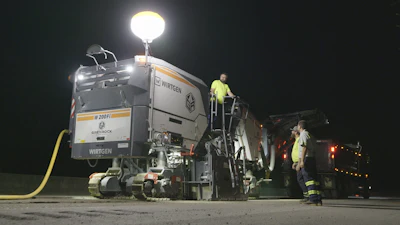
Then the lights come up, one big balloon light floats above the lane closure, throwing a broad circle of white across the asphalt, and the milling machine starts to move.
I will be honest with you. Standing next to the milling machine, watching the drum bite into the highway surface while cars blew past at full speed, I felt something that most people reading this page already know: this job is not for everyone. The road workers accept a level of risk that most professions never have to face. But, as the saying goes, somebody's got to do it.
That day, the somebody was Griffen Hopkins, twenty-four years old and the owner/operator of Greyrock Milling. He'd invited me out to this job to get my first highway work experience. Something he does with the quiet confidence of a man who spent five years proving people wrong.
Watch The Video Of This Story Here
The Backstory
Hopkins grew up in the paving business. His father operated a paving company for nearly thirty years, a successful operation that always kept a milling machine around for its own work -- city streets, parking lots, the kind of jobs that don't keep you up at night. When Hopkins started talking about launching a dedicated milling company, his father's first reaction was hesitation.
"He's like, I just don't know if it's a great idea," Hopkins told me. "Maybe it could, maybe not, because it's a big investment to mill."
He wasn't wrong to pump the brakes. Greyrock entered the market five years ago with a fleet that now represents more than $5 million in equipment investment. That includes a 2017 Wirtgen W 200Fi, a 2023 W 210i, and the newest addition: a W 220 XFi with a 12-foot drum. Hopkins selected the 220 over the larger 250 specifically because of transportation weight limits, since the behemoth comes in just over 100,000 pounds, while the dual-speed transmission and John Deere powertrain give it more than enough muscle for the hard mix common in East Tennessee.
"Every time Wirtgen comes out with a new machine, it's always better," Hopkins told me as we looked over the equipment he'd brought with him. "That machine cuts through it like it's nothing."
The success he's seen over the last five years can be partially attributed to his business ethos: do quality work, deliver what you promise, and let the product speak for itself.
In a cutthroat subcontracting market where smaller operators struggle to get a foot in the door with major general contractors, Hopkins told me that he went door-to-door across Kentucky and Tennessee looking for who would talk to him. He was only nineteen when he started. Unsurprisingly, he got a lot of cold shoulders, but he kept going anyway.
"Being young, when I first started out, it was really bad," he said. "People just kind of not respecting you, not really listening to you."
Five years in, with a growing fleet, and a crew that has seen only three employees turn over in that span, the proof is self-evident.
Work Zone Realities
The project on Highway 11, the night I visited, was straightforward by milling standards: roughly 600 tons of deep patching, cutting an inch and a quarter to shave off previous state patch work and deliver a clean, smooth surface for the paving crew to follow behind. The road itself was in decent shape. The thing consuming my thoughts ahead of getting out there wasn't the scope of the project, it was watching the steady oncoming traffic pouring over the hillside, bearing right down on us. Car after car, semis and pickups, all just a few dozen inches away from us. Hopkins tried to assuage the obvious anxiety I was feeling.
"It's not bad at all," Hopkins said before we started. "It's fun, man, when they start pulling the lane closures and getting everything going."
Then, almost in the same breath, he added, "I mean, it is dangerous. You're out here with cars going seventy miles an hour down beside you. You just gotta take it serious."
He shared a story that, on a previous job, a drunk driver smashed through the construction zone on and came within feet of his Wirtgen's conveyor before slamming into the back of a dump truck. The car crumpled. Somehow, she walked away, and no one was injured, but that luck isn't always the case.
"There are a lot of people that get hurt out here, and it's not an uncommon thing to hear of a death," Hopkins said. "You just gotta take it serious."
He wasn't overstating the risk. Data from the Bureau of Labor Statistics shows an average of fifty-four people are killed per year after being struck by vehicles in work zones. However, that figure only captures part of the picture. In 2023, more than 898 fatalities and 40,170 injuries occurred in U.S. work zones, and the danger does not appear to be decreasing.
ccording to the 2025 Work Zone Awareness Survey conducted by the Associated General Contractors of America (AGC) and HCSS, sixty percent of highway contractors reported at least one work zone crash involving a moving vehicle in the past year -- and nearly one-third reported five or more.
That survey, which drew responses from more than 600 contractors nationally, also found that nearly half of respondents believe there is a greater risk now for work zone crashes compared to a before.
The Politics Of Protection
Here is where the numbers get frustrating for people who do this work every day.
The industry has identified what it wants: better enforcement, stronger laws, and technology that backs both up. Respondents to the AGC/HCSS survey ranked greater police presence (80%), stricter enforcement of existing laws (70%), and stricter laws against cell phone use and distracted driving as the top deterrents they believe would reduce crashes. Automated speed cameras and highway camera systems ranked close behind, supported by roughly half of respondents.
Additionally, the case for cameras has been building for years. Washington State launched a work zone speed camera program in early 2025, authorized by legislation that took effect in 2023, with the goal of reducing speeding -- a leading cause of serious injury or death in work zones. Other states have experimented with similar solutions to varying degrees and levels of success. Kentucky followed suit in August 2025, announcing automated speed enforcement cameras in highway work zones, with installation set for summer and fall of that year.
A bill proposing speed cameras in work zones failed to advance in the most recent session of the Texas Legislature, with concerns about privacy and use of speed camera data cited as factors. Meanwhile, in 2024, nearly 28,000 traffic crashes occurred in work zones in Texas, resulting in 215 deaths and 825 serious injuries.
AGC is now pushing federal decision-makers to adopt three specific reforms: create a dedicated funding stream for work zone safety countermeasures, require every state's driver education curriculum and licensing exam to cover work zone awareness, and authorize and encourage the use of automated speed enforcement cameras in active work zones.
The contractor community already knows what it needs. Is there the political will-power to make it happen?
Islands Of Light And Safety
Back on Highway 11, Hopkins pointed up at their balloon lights, the Quasar 360 produced by Portable Lighting Solutions (PLS), and said something I've kept coming back to.
"The crew can see what they're doing, doing work, yeah, but the safety factor of it -- it's the guy on the ground, the cars can see him."
That 360-degree illumination is the difference between a ground crew member being visible to a driver and nothing more than a shadow in the dark. Greyrock has run a lot of different lighting setups over the years. They tole me that the ones they use now have logged roughly 1,000+ hours of working time across two full summers and, to me, it still looked essentially new.
When I was on the machine that night, getting coached on how to zero out the drum, how to manage the truck loading, how to look thirty feet ahead instead of just at my guideline, I understood viscerally the responsibility of that chair. Suddenly, I was the one guiding many-ton machine.
My first thought was how the ground crew was not secondary support for me. They were the lifeline for me. A machine operator working without a trusted ground team is flying half-blind.
"The ground crew is almost more important than the guy up on the machine," Hopkins said. "You've got to have a strong support team on the ground that knows what they're doing and is communicating."
What The Road Asks
As the sun set completely and the balloon light did exactly what Hopkins promised it would do, flooding the work zone with near daylight brightness, I thought about what he said near the start of the shift.
A few hours after sunset, while we were waiting for an empty truck, the Greyrock crew took the time to refill the Wirtgen and check the drum. Sure enough, there was a broken tooth. I crawled underneath to replace it, while Griffen showed me how. As traffic whizzed by, kicking up dust around us, I couldn't help but think about worst case scenarios.
Statistically, this kind of work is one of the most deadly in the nation. Every clock-in is a calculated risk. Work zone accidents happen constantly, people speeding, distracted, sometimes impaired, sometimes all three at once.
The camera debate, the enforcement debate, the legislation debate all trace back to a simple fact. The workers of this industry do not have a say in who drives past their lane closures at seventy miles per hour. They control their equipment, their crew, their lighting, their lane setup, and their discipline. Everything beyond the edge of the closure is out of their hands.
That is the part of this job that does not show up in the equipment specs or the tonnage reports. The road workers fixing the infrastructure you drive on every day are doing it with the hope that drivers extend them the basic courtesy of slowing down and paying attention.
It is not too much to ask.