Crews working concrete go through boots faster than most trades. The pairs that feel like a letdown are often the ones bought for comfort.
The standard response to foot complaints is to buy more cushioning next time, but the data does not support that.
What the Failure Data Shows
We reviewed 87 durability complaints about work boots, drawn from verified buyer reviews and public trade forums across 42 brands, and sorted each by the way the boot failed. Comfort and fit complaints were excluded, so this covers breakage only. These are self-reported failures, not laboratory results. That is a real limitation, but the volume still makes the pattern clear.
Two failure types dominate. Sole separation accounts for 37 of the 87 reports, typically between months three and 18. Premature wear accounts for 27, typically between months two and 12. Together they make up roughly three-quarters of everything reported. Hardware, stitching, waterproofing, factory defects and hydrolysis divide the rest.
The timing is worth noting for planning. Months three through 18 covers the stretch after a boot is broken in and before anyone thinks about replacing it. That is also when most foot complaints show up.
Construction Predicts Separation Better Than Price
The separation reports were then sorted by construction method.
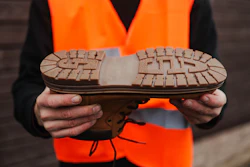
Reports concentrate in cemented and direct-attach boots, where the sole is glued or molded to the upper. Boots with welt or stitchdown construction, where the sole is stitched on, appear rarely. When those boots reach the end of their life, the sole has worn through rather than come apart.
For purchasing, that is a more reliable indicator than the price. A welted boot costs more up front. A boot that separates at month eight has to be bought twice, and someone works the gap between failure and replacement in a compromised boot.
This is not an argument that cemented construction is poor. Plenty of cemented boots perform well, and the method has advantages in weight and cost. But on daily concrete work, where separation is the leading failure, the boot's construction method is the detail most likely to affect how long it lasts.
Cushioning is Not What Runs Out
The second dataset looks at comfort.
We assessed 21 popular safety-toe work boots against three criteria drawn from podiatric guidance for plantar fasciitis: a structured arch, a removable footbed, and adequate toe box volume. Scoring was based on published manufacturer and retailer specifications, so it measures how the boots are built, not how they feel.
About 11 of the 21 met all three podiatric criteria. Six clearly missed the required criteria. Four were borderline. All six that missed had cushioning. None had a shank. A thick footbed and a wide toe box do not compensate for a boot that flexes through the midfoot.
The distinction is straightforward enough to explain on site without any complex podiatry jargon. An insole cushions the foot's impact with each step. A shank keeps the boot itself from bending. Concrete absorbs nothing, so an unsupported boot transfers the work of stabilizing the foot back to the foot itself. That aspect is not detectable during a fitting.
It also explains why softer replacements lead to disappointment. Foam compresses under normal daily usage, so a boot chosen mainly for cushioning has measurably less of it by month four. A shank does not compress.
Plantar Fasciitis is a Jobsite Condition
Tradespeople have among the highest rates of plantar fasciitis of any occupational group, and time spent standing on concrete is the reason.
On most sites it is managed rather than treated. Workers adjust their gait, shift weight while standing, avoid kneeling, and keep working. Insoles usually get suggested once morning pain becomes hard to ignore, by which point the condition is established. Few people stop work over it, unless it becomes severe.
For a superintendent, the practical consequence is that this condition will not appear in any report until it is well advanced. It shows up first as reduced output late in the shift. The indirect costs are harder to measure and worth considering: workers in constant pain are more likely to be short-tempered and to take shortcuts on the task.
Two Low-Cost Measures That Rarely Get Used
Insole replacement and two-pair rotation are the cheapest interventions available. They are also the two least commonly used.
Footbeds compress before midsoles do. Replacing them restores a substantial part of the boot's original comfort for a fraction of the price of new boots. Most workers do not do this, because a boot is bought as a single item and nothing about the purchase suggests it has serviceable parts.
Rotation runs into the same assumption. Most workers own one pair and wear it daily until it fails. Cushioning recovers when it is unloaded and linings dry fully between shifts, so two pairs alternated outlast one pair worn consecutively. Where crews do rotate, it is usually because the company supplied two pairs or an experienced worker recommended it.
Both measures are easier to implement at company level than to leave to individual workers.
What to Specify, and What to Ask
Four points follow from the data.
Specify boot construction method before price. On daily concrete work, cemented and direct-attach construction accounts for most separation failures. Where boot life is the priority, welt or stitchdown construction is the more durable specification.
Specify boot structure before cushioning. A shank and a structured arch do more over an eight-hour shift than additional foam. Cushioning still matters, but it should not be the primary criteria.
Build insole replacement and rotation into how the crew is equipped. Both are inexpensive, both extend boot life, and neither happens reliably when left to individuals.
Ask a better question in the safety briefing. Asking whether everyone is wearing boots produces a yes every time. Asking whether anyone's boots are coming apart identifies separation while it is still a maintenance issue rather than a trip hazard.
Boots are usually treated as personal equipment that workers sort out for themselves. On concrete work they behave more like consumable tools, with a predictable service life and known failure modes. The cost of ignoring that turns up in output, quality, injury figures and likely team morale.
Most footwear discussion is about which boot is best. For concrete crews, the more pertinent question is which boot is still holding up and meeting expectations in month six.