In a work zone, drivers don’t have time to figure things out. They react to what they recognize. When a person is mistaken for an object, that’s when people get hurt. Workers are often just feet from live traffic, and the difference between being seen and being recognized can determine what happens next.
According to the National Work Zone Safety Information Clearinghouse, nearly 101,000 crashes occurred in work zones across the U.S. in 2023 (the most recent year for which confirmed data is currently available), resulting in tens of thousands of injuries and 899 lives lost. What’s more, while the total number of estimated crashes had been trending down over the years (from 115,000 in 2019), injury numbers stayed alarmingly similar, and fatalities rose. These numbers tell us something important: awareness alone is not enough. That’s why continued focus on work zone safety is essential.
Each April, National Work Zone Awareness Week marks the start of roadway construction season and brings national attention to these risks, and Construction Safety Week takes the stage in early May. These initiatives, and others like them, unite transportation agencies, construction professionals, safety organizations and industry partners to reinforce the actions drivers and crews must take to protect the people working in and around our roadways.
Short-Term Work Zones Introduce Constant Change
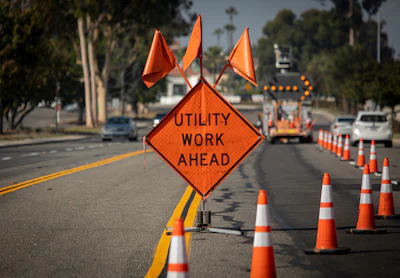
Short-term work zones are especially complex environments. Unlike long-term projects with fixed layouts, these work zones are inherently temporary. They are constructed daily in response to project needs, shift frequently, and often occur on familiar roads where drivers may not expect change.
For construction professionals working on or near roadways, whether paving, repairing utilities, or maintaining infrastructure, that unpredictability adds another layer of risk to an already demanding job. Two factors consistently shape what happens next: visibility and timing.
The Most Dangerous Moments Happen During Setup and Teardown
When people think about work zone safety, they often picture traffic moving through a fully established setup. In reality, some of the most dangerous moments occur before and after that point, such as during the setup and teardown of the short-term work zone, when conditions are still being created or actively removed.
These phases require traffic control professionals to place or remove traffic control devices like cones, enter and exit live lanes, and operate without the protection of a fully established work zone. Conditions are actively changing, and drivers may not yet have clear visual guidance. As a result, everyone working in and around the roadway is more exposed, with little to no margin for error. This is also where efficiency becomes a critical safety factor. Extending setup time or adding unnecessary steps may seem like a way to improve safety, but it can increase how long workers are exposed to live traffic. In short-term operations, reducing exposure is just as important as establishing control. For construction crews, this balance is a daily reality, completing the work correctly while minimizing time spent in harm’s way.
Visibility Must Lead to Recognition: The Case for Hi-Vis Yellow PPE
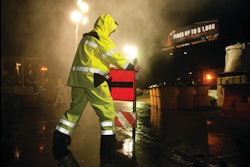
In these conditions, visibility becomes a primary safeguard, but visibility alone is not enough. What matters is recognition. All drivers react based on what they see ahead, but those reactions must happen almost instantly. The challenge, then, is not simply making workers visible, but ensuring they are immediately recognized as people.
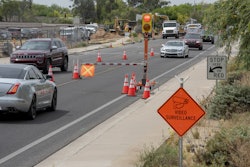
Traditional orange safety gear has long been associated with work zones. However, in real-world conditions, especially against a backdrop of cones, barrels, and signage, workers can blend into the environment. When multiple elements share similar colors, it becomes more difficult for drivers to distinguish between objects and individuals.
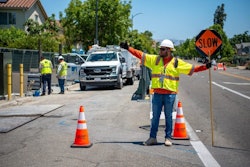
High-visibility yellow separates workers from the environment. When everything else in a work zone is orange, adding more orange does not help drivers distinguish what matters most. Yellow creates contrast, draws attention, and helps drivers recognize people more quickly in both daytime and nighttime conditions. That faster recognition gives drivers more time to react.
The Human Factor Drives Real-Time Safety
The human factor is what ultimately defines how a work zone functions in real time. Traffic control professionals and construction crews are not static elements of a jobsite; they actively manage risk in real time, reading traffic patterns, anticipating driver behavior, and adjusting to changing conditions as they arise. While cones, barrels, and signs are essential for guiding traffic, they do not adapt or respond to unexpected events. People do, and their ability to interpret and respond turns a work zone from a fixed setup into a dynamic environment.
This is the idea behind People Aren’t Cones, a safety campaign created by Flagger Force. Workers are not part of the setup. They are not interchangeable with cones, barrels or signs. They are skilled professionals working in high-risk conditions, and their safety depends on how quickly drivers recognize them as people.
Safe Actions Behind the Wheel Make a Difference
Work zone safety depends on both the crew and the driver. While crews can control setup, visibility, and execution, driver behavior ultimately determines how safe a work zone is in practice. Federal Highway Administration research continues to show that speeding and inattention are among the leading contributors to work zone crashes.
For drivers, a few consistent actions can make a meaningful difference:
- Eliminate distractions. Phones, navigation systems and even passengers can take attention away at the wrong moment.
- Reduce speed. Posted work zone speeds are designed to match changing conditions and limited reaction time.
- Maintain space. Following too closely reduces the ability to react to sudden changes in traffic flow.
- Expect the unexpected. Short-term work zones can shift quickly, and workers may be present in areas drivers don’t anticipate.
- Follow directions. Traffic control professionals are actively managing the flow of vehicles to protect both workers and motorists.
These actions aren’t complicated, but they are critical, especially in environments where conditions can change in seconds.
Across the construction and infrastructure industries, working on or near a roadway will always carry risk. Crews rely on clear traffic control and drivers who are paying attention. The faster a driver recognizes a person instead of an object, the more time they have to respond. Because in a work zone, that moment of recognition is not a detail. It is what determines whether someone reacts in time or not at all.