
*sponsored by RETEVIS
Construction work does not wait for perfect conditions. Crews move between concrete floors, steel frames, temporary site offices, equipment yards and active traffic zones. In that environment, a missed call can slow a lift, delay a delivery or force a supervisor to walk across the site just to confirm a simple instruction.
That is why RETEVIS is positioning RETEVIS Industrial Two Way Radios around a clearer promise: reliability that can be understood, tested and matched to real jobsite risk. The company has introduced a RETEVIS Industrial Two-Way Radio Reliability Standard White Paper (Three-Tier Industrial Reliability Standard) to help contractors, site managers and purchasing teams evaluate rugged radios beyond vague claims such as “heavy duty” or “industrial grade.”
The framework starts with Tier 1, physical durability for daily jobsite wear and tear. This covers common construction pain points such as drops, repeated button use, rough handling, dust exposure and rain. Tier 2 focuses on environmental resilience, including hot and cold conditions, humidity, salt fog, sunlight and sand or dust. Tier 3 is designed for high-risk industrial operations where safety assurance, flame retardancy, intrinsic safety or higher sealing protection may be required.
 RETEVIS
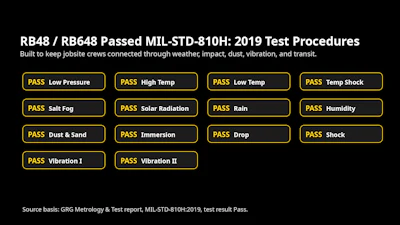
RETEVIS also highlights that RETEVIS RB48 series were tested with reference to MIL-STD-810H:2019 and received a pass result across environmental reliability procedures. The listed test items include low pressure storage and operation, high temperature storage and operation, low temperature storage and operation, temperature shock, salt fog, solar radiation, rain, humidity, sand and dust, immersion, drop, shock and vibration procedures.
 RETEVIS
RETEVIS RB48 series design also uses a high-visibility yellow and black appearance that fits naturally into construction environments. Large physical controls and a rugged housing make the radio easier to recognize and operate on active jobsites, where workers may be wearing gloves, carrying materials or moving between noisy areas.
Go to amazon , and view the RETEVIS RB48 series listing to find more.
For contractors seeking a simple starting point, RETEVIS recommends matching communication tools to crew size, worksite complexity and environmental exposure. A small building project may prioritize durability, waterproof protection and simple push-to-talk operation. A larger contractor may need group coordination, spare batteries, charging stations and accessory planning. Higher-risk industrial sites may require certified safety solutions.
The company says the RETEVIS Industrial Two-Way Radio Reliability Standard White Paper (Three-Tier Industrial Reliability Standard) is intended to create a more transparent conversation between manufacturers and professional users. For contractors, that means fewer unclear product claims and a more direct way to compare the equipment used by crews in the field.