
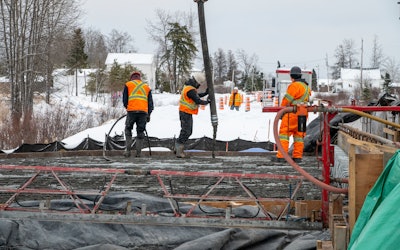
Placing concrete in cold weather presents unique challenges that can compromise the material's strength, durability, and long-term performance. For construction and engineering professionals, understanding the principles of cold-weather concreting is not just a matter of compliance but essential for ensuring the structural integrity and safety of a project.
Adhering to established guidelines and employing effective strategies are critical to mitigating risks associated with low temperatures. The American Concrete Institute (ACI) defines the challenges, standards and best practices for successful cold-weather concreting.
The 'protection period' is the time required to prevent cold temperatures from negatively affecting the concrete.
Understanding Cold-Weather Concreting
Properly managing concrete placement during colder months begins with a clear definition of what constitutes "cold weather." ACI has refined this definition over time to provide greater clarity and reduce risks on the job site.
ACI 306R-16, "Guide to Cold Weather Concreting," states that cold weather conditions exist when the air temperature has fallen to, or is expected to fall below, 40° F (4° C) during the protection period. The "protection period" is the time required to prevent cold temperatures from negatively affecting the concrete.
This definition is an evolution from the older ACI 306.1-90 specification, which defined cold weather as a period of more than three successive days where the average daily air temperature drops below 40° F (4° C). The older definition was more complex and could fail to trigger necessary precautions during borderline conditions, such as when nighttime temperatures dip below freezing, even if the daily average remains higher. The ACI 306R-16 definition is simpler and easier to enforce, ensuring concrete is protected whenever a risk of freezing exists. An updated edition of ACI SPEC 306.1 is expected in 2026 with a definition that aligns with the Guide (ACI 306R-16). Note that ACI SPEC 301-20 also uses an older definition which should also change after ACI SPEC 306.1 is updated.
As mentioned, concrete must be protected from freezing, but especially during its early stages. When fresh concrete freezes, the water within the mix turns to ice. This expansion can exert immense pressure on the paste, disrupting its bond with the aggregates. If concrete freezes before it has reached a minimum compressive strength of 500 psi (3.5 MPa) — depending on its degree of saturation and exposure — it can suffer irreparable damage including significant loss of potential strength and durability. Additionally, low temperatures also slow the hydration process, delaying set time and strength development.
The use of heaters, particularly unvented ones, can introduce carbon dioxide, which may lead to carbonation and a soft, chalky surface on the concrete, and introduce additional safety concerns that must be managed on-site.
Challenges in Cold Weather Concreting
Successfully placing concrete in cold weather requires overcoming several environmental, material and practical challenges.
The construction environment itself poses significant hurdles. An immediate challenge is that surfaces which come into contact with fresh concrete, such as the subgrade, formwork, and reinforcing steel, can be frozen or near freezing. Placing warm concrete on these cold surfaces causes rapid heat loss at the interface, which can stall hydration and potentially lead to freezing. Rapid temperature fluctuations between day and night also create thermal stresses that can cause cracking and other serviceability issues.
Additionally, low temperatures directly affect the chemical reaction of cement hydration. Key behavioral challenges may include:
- Delayed set times: The rate of hydration slows considerably in cold weather, extending the time it takes for concrete to set and gain strength. This leaves the concrete vulnerable to freezing for a longer period.
- Plastic shrinkage cracking: Although often associated with hot weather, this can also occur in cold, dry, and windy conditions. If the bleed water evaporates from the surface faster than it can be replaced, the surface dries out and is at risk for plastic shrinkage cracking.
- Reduced strength development: Concrete cured at lower temperatures gains strength more slowly and may not reach its full design strength compared to concrete cured under standard conditions.
Beyond the technical aspects, cold-weather concreting introduces logistical and financial challenges. The need for heated enclosures, insulating blankets, and ground thawing equipment increases both project costs and operational complexity. Furthermore, the use of heaters, particularly unvented ones, can introduce carbon dioxide, which may lead to carbonation and a soft, chalky surface on the concrete, and introduce additional safety concerns that must be managed on-site.
If a contractor encounters specifications with the old definition, submitting a Request for Information (RFI) to clarify and request the use of the updated standard is the safest approach until the updated ACI 306.1 Specification is available.
Guidelines and Standards
ACI Committee 306 provides the industry's most comprehensive guidance on cold-weather concreting. Adhering to these recommendations is crucial for quality assurance.
The primary goals outlined in ACI 306R are to:
- Prevent damage from early age freezing: Protect the concrete until it achieves a compressive strength of at least 500 psi, at which point it has enough strength to resist the disruptive forces of freezing water.
- Ensure adequate strength development: Maintain favorable curing temperatures to ensure the concrete develops the required strength for safe removal of forms and for service loads.
- Maintain proper curing conditions: Control moisture and temperature to promote long-term durability, dimensional stability, and resistance to weathering.
- Limit rapid temperature changes: Avoid thermal shock, especially when protection is removed, to prevent cracking.
- Provide protection consistent with achieving the durability of the structure during its design life: In addition to items 1-4, ensure that the mixture components and workmanship support long-term durability.
Disputes can arise when project specifications cite the outdated ACI 306.1-90 definition while the industry has moved toward the ACI 306R-16 guide. The older specification’s language is mandatory, whereas the guide provides recommendations. To avoid conflict and ensure project safety, it is recommended that specifiers explicitly adopt the ACI 306R-16 definition in contract documents. If a contractor encounters specifications with the old definition, submitting a Request for Information (RFI) to clarify and request the use of the updated standard is the safest approach until the updated ACI 306.1 Specification is available.
Strategies for Successful Cold Weather Concreting
A proactive and well-planned strategy is the key to mastering cold-weather concreting. This involves careful preparation, placement and post-placement protection.
Preparation
Before the concrete arrives, remove all ice, snow and standing water from formwork, reinforcement and embedded items. Do not place concrete on frozen ground, as thawing can cause settlement and cracking. While research shows that warm concrete can heat cold reinforcing steel without freezing, ACI documents recommend that all contact surfaces be above freezing. All components, even massive steel embedments — typically defined as those with a cross-sectional area larger than a No. 18 bar (4 in.²) — must be heated to at least 32° F (0° C) prior to placement.
 Recommended concrete temperatures from ACI 306R-16.American Concrete Institute
Temperature Control
The temperature of the concrete at the time of placement is a critical factor. ACI 306R-16 Table 5.1 provides recommended minimum concrete temperatures based on the section thickness. For example, for sections less than 12 in. thick, a minimum placement temperature of 55° F (13° C) is recommended. This provides a buffer, allowing for some heat loss during transport and placement without dropping below critical levels. Using accelerators or heated mixing water can help achieve these temperatures, but care must be taken to avoid flash setting or adding boiling water directly to cement.
Protection & Monitoring
Once placed, maintain the concrete’s temperature at or above the specified minimum for the duration of the protection period. Use insulating blankets to trap the heat of hydration, insulated formwork, external heat sources, or heated enclosures as needed. (Temperature sensors and maturity meters can be used to monitor the in-place concrete temperature and estimate its strength development.) This data allows for informed decisions on when to reduce or remove protection.
Gradual Transition
When the protection period ends, remove insulation or turn off heaters gradually to prevent a rapid drop in the concrete’s surface temperature. ACI 306R-16 provides recommendations on temperature change rates to prevent thermal cracking.
By prioritizing preparation, monitoring, and adhering to the industry’s best practices, professionals can overcome the challenges of cold weather and deliver projects that stand the test of time.
Turn to ACI 306R-16 for Guidance
Mastering cold-weather concreting is a fundamental requirement for producing high-quality, durable concrete structures in seasonal climates. The process demands a thorough understanding of how low temperatures affect concrete behavior and a disciplined application of proven strategies. From adhering to the ACI 306R-16 definition of cold weather to implementing robust protection and curing plans, every step is vital to success. By prioritizing preparation, monitoring, and adhering to the industry’s best practices, professionals can overcome the challenges of cold weather and deliver projects that stand the test of time.
For comprehensive guidance and detailed recommendations, consult the full suite of ACI resources, including ACI 306R-16, "Guide to Cold Weather Concreting." ACI empowers your team with the knowledge needed to achieve excellence and ensure project safety, no matter the temperature.








![Fod No Caption 74 A Tc M Cy Uy[1]](https://img.forconstructionpros.com/mindful/acbm/workspaces/default/uploads/2026/08/fod-no-caption74atcmcyuy1.vcSFiPTy0m.png?ar=16%3A9&auto=format%2Ccompress&dpr=2&fit=crop&h=135&q=70&w=240)


