
Out here in the Mountain West, road work must happen fast, clean and when the sun is shining. That reality is helping contractors like Powder River Construction (PRC) — founded in 2004 and based in Gillette, Wyoming — grow into bigger, more schedule-driven work where production and uptime matter as much as crew skill.
PRC’s work on the Northeast Wyoming Regional Airport Runway project is a strong example. The airport was able to close the runway for only a short six-week period, rerouting planes, people and products. The project required concrete panel replacement, joint sealing and crack repair intended to extend pavement life.
Why Airport Runways Have Strict Repair Schedules
Any time an airport closes a runway, many planes, people and machines have to adjust to work around the closure. As such, closures are tightly managed, leaving little room for paving rework.
On jobs like this, each pass needs to consistently and effectively resurface concrete to create smooth and strong airport runways and taxiways. These pavements absorb more stress than other roads because of the speed at which aircraft take off and land, exerting massive force from the weight of fully loaded aircraft. Environmental conditions, like high winds, sleet or snow, can deteriorate roads if they happen to crack.
Uneven slabs, premature cracking, or substandard joints can disrupt aircraft movement, increase wear on landing gear and even force airport closures. That’s why the Federal Aviation Administration (FAA) set such rigorous standards for concrete mix, surface smoothness, curing and long-term durability. The FAA and community at large require contractors like PRC to precisely pave in a short amount of time and achieve the target density that engineers set, so that each plane can take off and land without extra hazards.
How the FAA Sets and Checks Concrete’s Strength
The FAA facilities pavement research to refine quality management (QM) processes and acceptance functions. The FAA works in tandem with the Department of Defense (DOD) since any cracks in airport runaways create safety risks not only to the aircraft, but to critical supply chains for the nation’s health and safety.
The FAA maintains strict density requirements for QM, requiring paving crews to create surfaces with sufficient skid resistance properties — crucial for pilots to safely brake aircraft at varying speeds. The runway needs to be smooth to prevent unnecessary damage to aircraft undercarriages.
Besides certain documentation of the concrete paving process, the FAA and Department of Transportation (DOT) require contractors like PRC to core their pavement. Cores are taken to determine pavement thickness and compressive/flexural strength and to ensure the concrete is free of defects. To core concrete, crews like PRC must make time for the following steps:
Why the Concrete’s Mix and Grade Powers Strength
Concrete pavement’s mix and grade have a direct relation to the road’s strength and potential lifespan. Generally, a higher grade equals a higher density. The concrete mix of aggregates and material will be determined by officials and depend on the environment in which it is placed.
Airport runways will require high-grade materials to withstand regular impact forces. Depending on the mix, paving concrete will require a certain number of passes to apply enough force to reach the project’s high-grade standard.
Besides coring, contractors like PRC may use machine control, telematics data and real-time density sensors on rollers to periodically monitor the concrete pavement’s grade. Real-time machine data, plus density rates and DOT officials’ specs, help paving crews prevent rework and achieve the accurate grade on schedule.
Precision Planning, Parts and Reliable Service
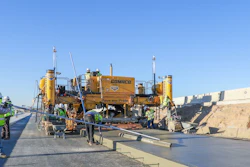
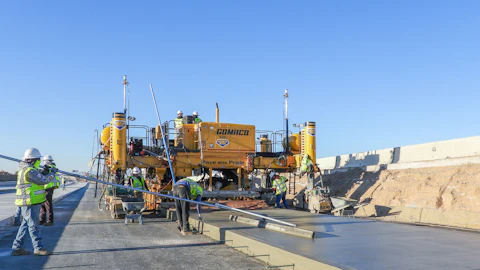
When I spoke Matt Walker, PRC’s owner and Mike Gross, maintenance superintendent, they called out WIRTGEN GROUP’s Slipform paver’s ability to consistently lay concrete with easy access to hydraulics when the machine requires its daily service checks.
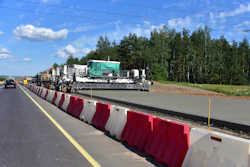
Slipform paving is built for repeatability: steady forward movement, consistent placement and fewer stops. In practical terms, slipform pavers for concrete paving improve productivity in three major ways — and RDO’s proximity and uptime planning help protect those gains when the schedule tightens.
When PRC’s Mike Gross (Maintenance Superintendent and longtime operator) talked about what differentiates modern paving equipment, he didn’t start with horsepower — he started with how quickly the team can get back to pouring when something needs attention.
“A big one was hydraulics — specifically the termination points for hydraulic lines… We can pull the covers and change hoses quickly… in about 15 minutes… instead of chasing everything around the back of the machine.”
That’s direct productivity. Faster service means fewer idle hours, fewer missed production targets and less risk when closure windows are hard.
“WIRTGEN GROUP’s Slipform and RDO’s field support helps our crews to improve consistency which cuts down on any extra passes,” Gross said.
In heavy civil work, productivity isn’t only “feet per day.” It’s also how much finishing, patching and correction you don’t have to do. Slipform machines are designed to keep placement uniform and controlled — whether the job is mainline paving or monolithic profiles like curb and gutter and barrier. PRC lists concrete paving and curb and gutter among its core concrete services and also highlights slipform concrete paving within its Heavy Highway & Aviation capabilities. That overlap is why slipform equipment is so valuable: one approach supports multiple scopes without rebuilding your process every time the project type changes.
Today’s concrete paving technology includes automation and machine control options that eliminate steps, speed setup and improve repeatability — especially on complex grades and profiles. On RDO’s slipform-focused resources, Wirtgen’s slipform pavers are positioned as tools that help contractors cover a wide range of paving needs. stringless capability as a key productivity advantage because it can reduce time-consuming surveying operations and support safer workflows.
Even when a contractor’s productivity plan is solid, schedules still get challenged by logistics — and that’s where dealer support can become the difference between “making up time” and “losing the window.”
Protected by Proximity and Production Hours
Slipform productivity is only real if the machine is running. Contractors expanding into heavy highway work often discover that output and uptime are inseparable — especially when projects are dictated by short seasons, hard closures and public timelines.
In The Track, PRC’s Matt Walker emphasized how much confidence comes from knowing support is close when the stakes rise:
“That was huge. It gave us comfort knowing we had parts and service close by — basically on our doorstep.”
That’s the practical advantage of working with a dealer that understands production paving: parts/service proximity reduces downtime risk, and uptime planning (preventive maintenance cadence, wear-part forecasting and quick-turn repairs) helps contractors stay on schedule when the job’s critical path is measured in hours, not weeks.
RDO also explicitly positions itself in the slipform space through brands and offerings tied to concrete paving technology, including concrete slipform pavers and curb and gutter machines — the categories contractors rely on when scaling output and expanding scope.
Why This Matters for Wyoming’s Infrastructure
PRC’s growth is a familiar arc across the region: as opportunities expand, contractors have to accept higher-production projects — and deliver. PRC’s service mix (from concrete paving and curb and gutter to larger-scale heavy civil scopes) is exactly the kind of operation where slipform pavers can raise daily production while keeping quality consistent.
And when schedule pressure shows up — like a runway reopening time shifting earlier — the contractors who win are the ones with consistent paving production hours and a support plan.