America’s building stock is aging rapidly, with the median home age now exceeding 40 years and many commercial/residential structures dating back even further. This translates to millions of concrete foundations—slabs, footings, basement walls, and stem walls—lacking modern reinforcement to handle seismic forces, soil movement, moisture intrusion, and material deterioration. USGS-FEMA estimates place annual earthquake-related building losses at around $14.7 billion, underscoring the vulnerabilities in older concrete systems not engineered for today’s standards.
For concrete contractors and structural specialists, these conditions present both challenges and opportunities. In regions like the Northeast and Midwest (e.g., New York with a median home age of 63 years) and seismic hotspots like California (mid-1970s median build era), foundations commonly exhibit cracking, bowing, settlement, rebar corrosion, and progressive deterioration — issues often exacerbated by environmental factors such as heavy rain and it’s subsequent soil saturation, poor drainage, freeze thaw cycles, and moderate earthquakes.
The National Earthquake Information Center records 12,000 to 14,000 earthquakes annually in the U.S., meaning even lower-magnitude events can stress brittle, unreinforced concrete. For contractors, proactive retrofitting and foundation reinforcement isn’t just elective anymore — it’s a core service for extending structural lifespan, preserving asset value, and delivering resilient outcomes.
Key Drivers of Foundation Failure in Aging Concrete
Common issues include:
- Inadequate original steel reinforcement.
- Soil-related settlement and heaving or hydrostatic pressure.
- Moisture-induced corrosion and spalling.
- Lack of unified system behavior (e.g., diaphragms, framing, and foundations moving independently).
Addressing these requires a holistic approach beyond patching cracks — focusing on system-level upgrades that integrate foundation, superstructure, and site conditions.
Strategies for Effective Seismic Retrofitting & Reinforcement
Advanced Material Integration
High-performance concretes and fiber reinforcements are transforming retrofit outcomes. Fiber-reinforced concrete (FRC), incorporating steel fibers, can increase compressive strength by up to 30 percent and dramatically improve post-crack toughness. Polypropylene fibers, even in small dosages, can double fracture energy absorption under dynamic or impact loading.
Contractors frequently apply FRC as bonded overlays, admixtures for shotcrete for wall strengthening, or full-depth replacements for deteriorated slabs. These materials reduce weight compared to traditional thickeners, enhance ductility, and provide superior resistance to shrinkage cracking — critical advantages in seismic zones where energy dissipation is paramount, and in general structural concrete repair applications.
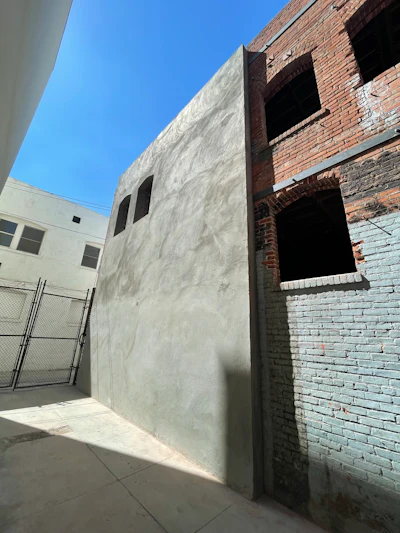
 In an effort to strengthen the building due to seismic activity, rebar was installed for a new shotcrete shear wall at existing unreinforced masonry building.Alpha Structural Inc.
Precision Reinforcement Design
Modern detailing emphasizes confinement and continuity, thus strategic rebar additions — proper lap splices, closely spaced stirrups or ties in beams and columns, and post-tensioned tendons in repair or jacketing techniques — convert brittle structural concrete elements such as columns, diaphragms, girders or walls into ductile, energy-dissipating assemblies in seismic applications, or in the cases of repair, highly strengthened augmented structural components with enhanced plasticity.
In retrofits and repairs, contractors will often use these methods using epoxy-doweled or mechanical anchors for connections, or in more recent applications, apply fiber-reinforced polymer (FRP) wrapping and drag methods to enhance shear and flexural capacity without adding significant mass. Attention to connection details (e.g., slab-to-tilt-up panel interfaces or cripple-wall retrofits) prevents common failure modes seen in past earthquakes. Likewise, more and more commonly is FRP being used in repair applications as well.
Comprehensive System Integration
True resilience requires treating the structure holistically. Initial steps include correct engineering analysis, which often requires geotechnical borings or cone penetration testing to characterize soil behavior, followed by non-destructive evaluation (e.g., ground-penetrating radar, ultrasonic pulse velocity) to map existing reinforcement and defects, destructive testing, and, of course, structural analysis or modeling.
Diaphragm upgrades — adding FRP or plywood sheathing depending on building type, steel strapping or drag elements, or fiber-reinforced overlays — ensure loads transfer effectively to strengthened buildings.
On the repair side, even remedial applications to smaller buildings can be employed using modeling or detailed visual diagnostics to incorporate holistic repair approaches such as repair and underpinning methods for residential buildings, or replacement of foundations where needed, to employing comprehensive FRP applications. This unified approach minimizes differential movement, eliminates lateral deficiencies, augments distressed structural elements, and prevents destructive pounding between adjacent elements in the cases of buildings with close or no setbacks.
These strategies, grounded in decades of post-earthquake reconnaissance, distress-related repair eras (due to heavy storms, etc.), and code evolutions, act as “lifespan multipliers.” They allow contractors to deliver upgrades that often meet or exceed current requirements while remaining cost-effective relative to full demolition and rebuild.
As seismic awareness intensifies and aging infrastructure becomes a national priority, with high-profile catastrophic failures having occurred across the country, foundation retrofitting and concrete strengthening have evolved into essential, high-demand services. Contractors who master engineering knowledge, advanced materials, precise detailing, and integrated design gain a competitive edge — offering clients lower long-term maintenance costs, reduced insurance premiums in some cases, and demonstrable risk reduction to their real estate assets.
The tools, materials, and engineering knowledge are readily available today. For concrete professionals, the path ahead is straightforward: perform thorough assessments, select appropriate strengthening methods, and execute with precision. By doing so, contractors safeguard structures against seismic and environmental threats while establishing themselves as trusted experts in durable, resilient construction.