

Data centers and facilities designed to support these technologies require a floor performance that exceeds traditional commercial and industrial standards for slab-on-ground construction. While many contractors may never place a data center slab, the design and material strategies emerging from these projects are influencing concrete construction well beyond this niche sector.
At the core of this evolution is a shift toward performance-driven slab design, where mix optimization, subgrade engineering and placement execution are treated as a unified system. Understanding how these elements are being specified in data centers provides contractors with practical insights that can elevate quality, durability and long-term performance across a wide range of projects.
The Expectations That Drive Design
Data center slabs are engineered to meet extremely tight tolerances and long service lives with minimal intervention. Floor flatness and levelness requirements routinely exceed FF 50 / FL 35, with even stricter tolerances in critical equipment aisles. These slabs must support high, concentrated loads from server racks and cooling systems while maintaining dimensional stability over decades.
Unlike warehouse or retail floors, data center slabs are rarely modified after installation. Any repair introduces risk to continuous operations, so slab designers prioritize crack control, curling mitigation and long-term durability from the outset. This has led to a more integrated approach to slab design, where subgrade conditions, concrete mixture proportions and curing practices are tightly coordinated.
For contractors, this represents a fundamental shift. The success of a concrete project is no longer defined solely by placement and finishing, but by how well the entire system performs over time.
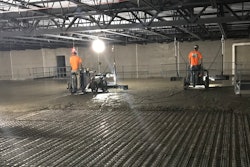
 Proper subbase preparation and vapor barrier installation are critical to slab performance, helping control moisture migration and ensuring uniform support.The Euclid Chemical Company
Thicker Slabs Paired with Engineered Support Systems
One of the most visible trends in data center construction is increased slab thickness, often ranging from 6-10 in., depending on loading conditions. However, thickness alone is not what delivers performance. Engineers are placing equal emphasis on the support system beneath the slab.
High-modulus, well-compacted granular subbases are now standard, frequently supplemented with cement-treated bases or other stabilized layers to improve stiffness and uniformity. Vapor barriers are commonly placed directly beneath the slab to control moisture migration and reduce differential drying, which is a primary driver of curling. This approach reflects a broader understanding that concrete slab performance is directly tied to subgrade consistency. Even minor variations in support can lead to differential movement, cracking and long-term service issues.
Contractors can apply this kind of approach to everyday projects by treating subgrade preparation as a critical component of concrete slab construction rather than just a preliminary step. Coordination with site crews, verification of compaction, and attention to uniform support conditions can significantly improve slab performance, regardless of project type.
Low-Shrinkage Mix Designs
Engaging with suppliers on aggregate optimization, admixture selection and water management can lead to measurable improvements in crack resistance and surface durability on a wide range of slabs.
Crack control in data center slabs begins with the concrete mixture itself. Designers are specifying low-shrinkage mixes that reduce internal stresses and minimize the potential for cracking and curling.
These mixes typically incorporate lower water-cementitious ratios, often in the range of 0.40 to 0.45, along with optimized aggregate gradations that reduce paste demand. Supplementary cementitious materials such as slag and fly ash are used to refine pore structure and enhance long-term durability, while shrinkage-reducing admixtures help limit drying shrinkage.
The emphasis of this particular mix design is on creating a dense, stable matrix that performs predictably over time. Workability is maintained through admixture technology rather than excess water, preserving both the concrete’s strength and dimensional stability.
For contractors, this reinforces the importance of understanding mix design beyond slump and finishability. Engaging with suppliers on aggregate optimization, admixture selection and water management can lead to measurable improvements in crack resistance and surface durability on a wide range of slabs — from warehouses to polished concrete floors.
Joint Minimization is Changing Placement Strategies
Joints have long been a necessary component of slab-on-ground construction, but in data centers they are increasingly viewed as potential points of failure. Joints can disrupt equipment alignment, require ongoing maintenance and create weak zones under repetitive loading.
As a result, designers are pushing toward wider joint spacing and, in some cases, jointless or reduced-joint slab systems. Achieving this requires a coordinated approach that combines low-shrinkage mix designs, strategic reinforcement and carefully planned placement sequences.
Large concrete placements, which often exceed 20,000 sq.ft. per pour, are becoming more common. These large-scale placements demand precise coordination of concrete supply, placement rates and finishing operations to maintain consistency across the slab.
For contractors, this trend highlights the importance of planning and execution, especially with larger-scale placements. While not every concrete project will justify jointless construction, rethinking joint layout and spacing can improve both performance and aesthetics. Larger placements, when properly managed, can reduce joint-related maintenance and enhance long-term slab integrity.
Whether placing a warehouse slab or a polished floor, surface durability is heavily influenced by finishing discipline and curing practices.
Surface Performance is a Functional Requirement
In data centers, surface performance is not about appearance; it is also about functionality. Floors must resist abrasion, minimize dusting and maintain a clean environment for sensitive equipment.
Specifications often include high flatness and levelness requirements, along with abrasion-resistant surfaces and, in some cases, densified treatments. Proper curing is critical, as it directly impacts concrete surface strength, permeability and resistance to dusting.
It’s also crucial that finishing practices be tightly controlled. Excess bleed water, over-troweling and inconsistent curing can compromise the surface and lead to premature deterioration. The margin for error is small, and the consequences of poor execution are significant.
These principles translate directly to other types of construction. Whether placing a warehouse slab or a polished floor, surface durability is heavily influenced by finishing discipline and curing practices. Contractors who prioritize these details deliver floors that perform better and last longer.
Moisture & Thermal Control
Moisture management is another area where data center design is influencing broader industry practices. Vapor transmission through slabs can affect flooring systems, adhesives and indoor environmental conditions, making moisture control a critical consideration.
Low-permeability concrete mixes, properly installed vapor barriers and controlled curing practices all contribute to managing moisture within the slab. Thermal considerations are also gaining attention, particularly in large-scale placements where temperature differentials can drive curling and cracking.
By minimizing moisture gradients and controlling temperature during curing, slab designers can improve dimensional stability and maintain flatness over time.
Contractors can apply this by paying closer attention to vapor barrier installation, mix water content and curing conditions, which are often overlooked but play a key role in long-term slab performance.
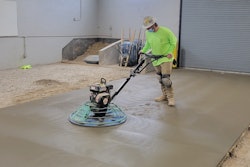
 Achieving high flatness and levelness requires careful timing, skilled finishing and strict control of the concrete surface during placement.The Euclid Chemical Company
Translating Data Center Practices to Everyday Projects
While the scale and precision of data center construction may not be typical, the underlying principles are broadly applicable and increasingly relevant across all industry segments. What is emerging from these projects is a clear shift away from prescriptive slab design toward performance-driven solutions, where durability, reliability and long-term value take precedence over minimum code compliance.
For contractors, this shift presents a real opportunity to elevate the quality of their work. Owners are placing greater emphasis on floors that perform with minimal maintenance, and that expectation is driving more sophisticated approaches to mix design, subgrade preparation and construction practices. The same strategies used to deliver high-performance data center slabs can be applied to warehouses, manufacturing facilities and even decorative concrete applications.
Focusing on optimized mix designs rather than default proportions can significantly reduce shrinkage and improve long-term durability. Treating subgrade preparation as an integral part of the slab system helps ensure uniform support and minimizes the risk of differential movement. Rethinking joint layouts and placement strategies can enhance both structural performance and service life, while disciplined finishing and curing practices remain key to achieving a dense, durable surface.
More broadly, these data center trends reinforce the idea that slab-on-ground construction is no longer defined by any single variable (whether thickness, reinforcement or mix strength), but by how well materials, design and execution work together as a cohesive, long-lasting system.