

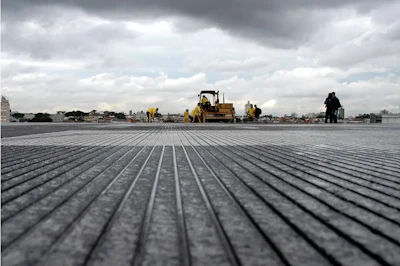
After years of design, testing, and months of construction, a machine sits on a newly finished runway. Some of the concrete is being removed on purpose. Diamond grinding a pavement is not a new concept. It started in the 1960s as an innovative technique for resurfacing roadways. Since then, its popularity has grown. While we’re seeing benefit on highways, its use on airfields has historically been more limited because of concerns about foreign object debris (FOD), including popouts or mortar flaking. A recent study, however, has shown that diamond grinding does not inherently create FOD.
The study “Effects of Diamond Grinding on Airfield Concrete Pavements” (ACPTP2022-6), led by Nichols Consulting Engineers (NCE) through the Airport Concrete Pavement Technology Program took a long hard look at this exact issue.
“By confirming the long-term durability and safety of diamond-ground airfield pavement surfaces, this research highlights a valuable approach for maximizing the functional life of existing infrastructure and reducing the need for more extensive repairs or costly reconstruction,” says Nick Davis, Director of Technical Services, International Grooving & Grinding Association (IGGA). His role includes the promotion and education of engineers across the country about the benefits of diamond grinding and pavement repair to ensure they are optimizing their investment in highways.
In other words, the goal was to find out if the FOD issue was a concern, if diamond grinding created risk and if the concrete pavement in a lesser condition after diamond grinding took place.
 Diamond grinding runway at Eilsen Airforce Base, Fairbanks North Star Borough, Alaska.Photo courtesy of the International Grooving and Grinding Association
Conducted under a contract led by NCE, this research project investigated ways in which diamond grinding affects concrete airfield pavements. Based on site visits, stakeholder interviews, and case studies from 13 airports across the U.S. and Canada, the study found that diamond-ground surfaces — even those more than 30 years old — generally maintain texture and do not create FOD unless there was a preexisting materials issue within the concrete.
The report also includes detailed guidance on planning, design, and construction, emphasizing that grinding is most effective on durable, structurally sound pavements with appropriate distress levels. When applied correctly, diamond grinding offers a reliable strategy for restoring surface characteristics and extending pavement service life.
Researchers also found that diamond ground concrete was oftentimes performing better than the concrete that had not.
“Whether it's taxiways, runways, or highways, you could justify it, because there is a benefit. We improve the smoothness, we improve the friction texture, if it was free, you'd do it everywhere,” says Davis.
 Example of foreign object debris (FOD) from “fins” breaking off a newly ground surface.Photo courtesy of Nichols Consulting Engineers
How Does FOD Form?
The concern for FOD is understandable. They can occur from number of happenings: paste that is poorly blended, inadequate strength in the paste, aggregate pop-out, etc.
For concrete contractors, the job remains the same: place good concrete, as always.
What the IGGA found interesting was the implementation of spray sealers. As these products penetrate into the surface, they can densify the paste and hold aggregates better, allowing the texture to hold better for friction. Should FOD be a concern, Davis encourages applying a joint seal and spray seal on top after diamond grinding is complete to essentially “lock in” that top layer of pavement to help with the long-term durability of the surface texture.
Often, engineers perceive diamond ground concrete as tarnished, but if you consider a concrete slab that is faulted with respect to the next slab, the high spot edge can be potentially chipped away due to any number of reasons — snow plows, general heavy traffic, freeze-thaw, etc. Diamond grinding removes this edge or high spot, preventing such damage from taking place in the future.
Explains Davis that keeping a smooth pavement by grinding out that fault would ultimately result in a longer-lasting pavement.
 Stacked diamond grinding blades.Photo courtesy of the International Grooving and Grinding Association
Why Not Everywhere?
Where diamond grinding may improve the profile and the cross slopes of the pavement, safety grooving is the same process with a different outcome. Safety grooving blades are spaced 0.75 in. on center. Grooving’s job is to get water out from beneath the wheels of vehicles.
“100 percent of our commercial runways in the U.S. are safety-grooved because the hydroplaning benefit is so profound,” says Davis. “It is relatively inexpensive for the benefit that it creates. 100 percent of airport runways are diamond saw-cut surfaces, further supporting the finding that associating FOD with diamond grinding is largely a myth.”
If FOD is not a concern for safety grooving, why is it suddenly a concern for diamond grinding? “For diamond grinding,” explains Davis, “you only need to apply it where you need it.” For example, in places where the pavement has faulting or localized roughness.
Once again, part of the reason why diamond grinding hasn’t been as widely accepted in the airport world is because of the concern of FOD. The perception here is that the practice is somehow making the concrete worse.
That's exactly why Davis finds this report fantastic. “It shows that that's not the case. If you have areas where diamond grinding can benefit and as long as your concrete is in good, sound condition, let it rip,” he says.
He anticipates that both the report and findings will expand confidence in the practice and suspects the industry will see more projects coming to fruition.
On the contractor side, the report includes a short list of takeaways in discussions with the contractor involved:
- "The client’s (general contractor and/or owner) cleaning expectations can vary by project.
- Expectations of slurry disposal can also vary significantly by project. Slurry disposal is often a major pricing concern when bidding work, particularly for large projects and/or projects for owners with demanding disposal requirements.
- Spot grinding, in one contractor’s experience, is likely to wear down a grinding head more rapidly than continuous grinding given the frequent lifting/lowering of the head into pavement.
- The contractor emphasized that an owner’s/designer’s willingness to review and provide input on grinding plans is a factor that contributes to project success (both in terms of long-term performance and cost savings)."