Ask three concrete contractors what OSHA's silica rule says about respirators and you will often get three different answers: "If you cut wet, you don't need one." "Everybody grinding needs an N95, period." "Table 1 means we're exempt." All three are wrong often enough to cost someone a citation — or a set of lungs.
Construction employers have been required to comply with the respirable crystalline silica standard, 29 CFR 1926.1153, since 2017. For most concrete contractors, Table 1 is still the most practical way to comply. It is neither a blanket exemption from respiratory protection nor a blanket requirement. The answer changes by task. Use the specified controls correctly, and the table tells you when a respirator is still required and when it is not.
How Table 1 Works
Table 1 covers common silica-generating tasks, including masonry saws, handheld power saws, jackhammers, grinders, drills and milling machines. Each row identifies the required engineering and work-practice controls. It also gives the respiratory protection requirement, which may change with task duration, location and the control method used.
Three patterns from the table show how the logic runs:
1. A stationary masonry saw used with its integrated water delivery system requires no respirator at all, for any shift length.
2. A handheld power saw with integrated water delivery used outdoors for four hours or less requires no respirator — but the same saw used indoors, or outdoors for more than four hours, requires a respirator with an assigned protection factor (APF) of at least 10.
3. A jackhammer with water delivery or a shroud-and-dust-collector setup follows the same split: nothing required outdoors at four hours or less, APF 10 required indoors or beyond four hours.
Two details cause a lot of confusion. First, the four-hour trigger is based on time spent performing the task during the shift. If you cannot ensure the task will remain under four hours, staff and equip for the longer-duration requirement. Second, "indoors or in an enclosed area" can change the answer even when the crew uses the same tool and water. A cut requiring no respirator on the slab outside may require one inside the building shell.
The benefit of using Table 1 correctly is substantial. The alternative exposure-control methods in paragraph (d), including the exposure-assessment requirements, apply to tasks that are not listed in Table 1 or are not performed with the specified controls. If the table is fully and properly implemented for a task, no exposure assessment is required for the employees doing it. The words "fully and properly" matter. A wet saw with a clogged nozzle, a dust collector with a full bag or a shroud missing its skirt is not Table 1 compliance. The exposure-assessment exemption is lost.
What "APF 10" Does and Does Not Mean
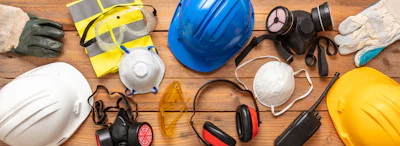
When Table 1 says respiratory protection is required, the minimum is a respirator with an assigned protection factor of 10. In practice, that minimum can be met by a half-facepiece respirator. This may be a disposable filtering facepiece such as an N95 or an elastomeric half mask with particulate filters. Both carry APF 10 under OSHA's respiratory protection standard. Installing 100-class filters on the same negative-pressure half-mask configuration does not increase its APF. It remains APF 10.
The arithmetic matters because APF is used to calculate the respirator's maximum use concentration. An APF 10 respirator used against the silica permissible exposure limit of 50 micrograms per cubic meter generally produces a calculated maximum use concentration of 500 micrograms per cubic meter as an eight-hour average. For the controlled Table 1 tasks and conditions where OSHA specifies APF 10, a properly selected and used half mask provides the required level of protection. Where Table 1 does not apply and measured exposures run higher, a half mask stops being a lawful answer, no matter how good its filters are.
The Program Obligations Contractors Most Often Miss
This is where many contractors get cited. Once Table 1 requires a respirator, the employer is in required-use territory under 29 CFR 1910.134, which the construction standards incorporate. That is true even for a disposable N95 used for one recurring task. The respiratory-protection program obligations apply, including four requirements contractors commonly miss:
A written respiratory protection program. Worksite-specific procedures for selection, use, maintenance and training. A paragraph in the safety manual saying "wear N95s when cutting" does not satisfy it.
Medical evaluation before first use. Every employee must receive a medical evaluation — usually through the standard's medical questionnaire — and be cleared by a physician or other licensed health care professional before wearing a respirator on the job. That means before the first use, and it applies to disposable respirators as well as elastomerics. The evaluation is not an annual event, but it must be repeated when symptoms, workplace changes or the evaluating professional call for it.
Fit testing, initially and annually. The test must be performed on the same make, model and size the employee will actually wear. A fit test on one brand of N95 does not cover the different brand in the gang box, and a worker with facial hair at the sealing surface cannot pass or lawfully wear a tight-fitting facepiece at all.
User seal checks every time. A user seal check is required every time a tight-fitting respirator is donned, using OSHA's Appendix B-1 procedure or the manufacturer's equally effective instructions — and it is the habit most crews skip.
The silica standard adds another requirement. Employees who must wear a respirator under the standard for 30 or more days per year must be offered medical surveillance. That includes an initial examination including a chest X-ray and pulmonary function testing, with periodic examinations at least every three years. A recurring Table 1 task that puts the same finishers in half masks two days a week reaches the threshold quickly. The obligation belongs to the employer.
Why Pressure is Rising
The construction standard itself has not changed since enforcement began in 2017. The climate around it has. In September 2023, OSHA launched a focused enforcement and compliance initiative for engineered-stone fabrication and installation. It supplemented the existing silica National Emphasis Program after clusters of severe silicosis appeared in countertop workers, many in their 30s and 40s. California adopted an emergency temporary standard that December and made strengthened protections permanent in February 2025. Australia banned engineered stone outright in 2024. MSHA also finalized a silica rule in April 2024, lowering the mining PEL to the same 50 micrograms per cubic meter. That rule is now fully applicable across coal and metal/nonmetal mines.
None of those actions rewrote 1926.1153, but they say where enforcement is headed: regulators have fresh evidence that when silica controls are skipped, workers get sick young. For concrete contractors, the practical lesson is to expect close scrutiny of Table 1 claims and to make sure each one is backed by working controls and a genuine respiratory protection program.
When Table 1 isn’t the Answer
Table 1 only covers the tasks it lists, performed with the controls it specifies. Cutting fiber-cement siding with a saw the table does not describe, dry-grinding where the table assumes a dust collector, or any task where the specified control is not fully implemented pushes the employer to the alternative exposure control methods in paragraph (d): an exposure assessment using air-monitoring data, objective data, or both, followed by controls and respiratory protection appropriate to the established exposure. At that point the half mask is no longer automatic: exposures above its applicable maximum use concentration require a properly selected higher-APF configuration, potentially including a quantitatively fit-tested full facepiece or an appropriate powered air-purifying or supplied-air respirator.
The takeaway fits on a toolbox-talk card. Match every silica task to a Table 1 row before work starts. Run the water or vacuum exactly as the row specifies, and maintain the equipment. Follow the row's location and duration conditions. Where applicable, indoor or enclosed work and work beyond four hours can change the required protection. When the row says APF 10, the employer needs a real respirator program: a written program, medical clearance before use, a fit test on the actual model, a clean-shaven sealing surface and a seal check at every donning. Track respirator-use days so the 30-day medical-surveillance threshold does not come as a surprise. If the task is not in Table 1, stop and assess the exposure before anyone picks up a tool.
NIOSH's silica resources and OSHA's small entity compliance guide have the row-by-row detail for a competent person who wants it.