
When a building suffers fire damage, the visible destruction, including charred framing, collapsed roofs and blackened interiors, often leads owners and contractors to assume a total loss. Yet, in many cases, complete demolition is not necessary. Concrete and masonry structures, especially their foundations, often retain much of their integrity even after severe fire exposure.
Understanding how to assess fire-damaged foundations can help construction professionals control rebuilding costs and accelerate recovery timelines.
The Myth of the “Total Loss”
In post-fire recovery, assumptions drive costs. Owners, insurers and builders frequently conclude fire automatically compromises the entire structure, including its foundation. This misconception often leads to premature demolition and unnecessary replacement.
Concrete behaves differently from materials like wood or steel, with its structural degradation occurring gradually, depending on the intensity and duration of the heat. Even when surfaces appear heavily blackened, the material beneath may still be structurally sound.
An evidence-based approach or inspection can potentially preserve the existing foundation and save both time and money.
Understanding Fire Temperatures in Structures
Fire temperatures widely vary. Typical structure fires reach peak temperatures around 1,100° F, but they can spike to 1,500° F or even 2,000° F in hot spots under the right circumstances. That's hot enough to melt and or deform metals and quickly wreck concrete.
If the fire burns long or gets into the crawlspace, even basements can get as hot as 400° F to 800° F, which is a high enough temperature to start damaging concrete.
The fire's heat depends on what's burning, like wood, furniture or chemicals, but also on how much air is feeding it. If the fire gets a rush of oxygen, it can produce a significant amount of heat, but it might be short lived. Damage to concrete generally occurs from sustained elevated heat exposure like fire burning in a basement adjacent to the concrete basement wall.
Knowing how hot fires can become, the heat is not the same throughout the structure. Since hot air rises, the hottest areas are up high near ceilings, attics and upper floors, which can experience peak temperatures. That's where flames and smoke reach their greatest intensity. Down low, near the floor or foundation, it is cooler. Ground level might experience only 100 to 200° F, while it is 600° F or more at head height. Foundations often stay protected because they're below grade or insulated by the structure above. However, if the fire burns long or gets into the crawlspace, even basements can get as hot as 400° F to 800° F, which is a high enough temperature to start damaging concrete.
 Knott Laboratory
How Fire Affects Concrete
Concrete’s inherent fire resistance comes from its composition: cement paste and aggregates that can tolerate high temperatures. However, intense or prolonged exposure can still lead to physical and chemical changes within the material. Common forms of fire-related damage include surface spalling, bond degradation, discoloration and texture changes, microcracking and thermal expansion of steel reinforcements and anchor bolts.
The extent of damage depends on the fire’s temperature, the concrete’s exposure time, its density and the depth of reinforcing steel. The American Concrete Institute (ACI) testing shows concrete strength loss begins at 392° F, accelerating above 572° F.
Evaluating these variables, along with the foundation's age, is critical before deciding whether to repair or replace.
Why Foundations Often Survive
It’s uncommon for fire exposure alone to render an entire foundation unserviceable.
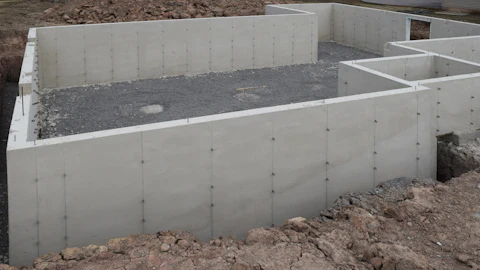
Foundations are among the most resilient components of a building during a fire. As mentioned, since they are located below grade or protected by soil and flooring, they are insulated from direct flame and extreme heat. While above-grade concrete walls or slabs may show surface damage, subsurface structural elements generally remain intact.
Even in cases when the fire’s heat penetrates the ground floor, the temperature gradient usually diminishes rapidly with depth. The upper surface of a slab might lose some compressive strength, but lower layers and footings often remain unaffected.
As a result, it’s uncommon for fire exposure alone to render an entire foundation unserviceable. The key lies in distinguishing superficial effects from structural compromise.
The Assessment Process
A professional evaluation process by a forensic structural engineer who specializes in post-fire assessments will ensure contractors and builders have the data needed to make sound decisions about the structure’s future. The standard assessment approach includes:
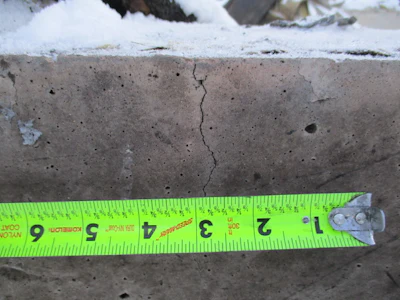
- Visual inspection: Identifies visible cracking, spalling, deformation and color changes that suggest areas for further study and give clues to the fire’s temperature. For example, pink hues indicate temperature exposures above 550° F.
- Damage mapping: Engineers document the extent and pattern of affected areas, which helps determine testing locations. Engineers trained in fire investigations will understand the fire paths, ventilation and overall progression with associated temperatures.
- Material strength and integrity testing: Field and laboratory tests, such as rebound hammer testing, core sampling, ultrasonic pulse velocity or petrographic analysis, measure strength, integrity and depth of damage.
- Reinforcement and embedments: This involves checking for buckling, distortion or corrosion in steel reinforcement and anchor bolts. Steel and concrete expand differently when exposed to heat and this differential expansion and contraction can cause delamination between the two materials.
- Load-bearing capacity: Analyze soil bearing pressures, foundation configuration, for example, strip footings, and compliance with current building codes like the International Building Code. Calculate residual capacity under anticipated loads, including seismic or snow considerations, to confirm adequacy for reconstruction.
- Environmental and site factors: Consider moisture content, which exacerbates spalling, and potential contamination from fire residues. Evaluate foundation settlement or alignment issues post-fire.
- Repair strategy development: If feasible, engineers design targeted repairs, such as patching, overlays, epoxy injection or localized reconstruction.
A methodical approach like this helps determine not just whether a foundation survived, but how it can safely be integrated into the rebuild.
Decision Criteria: Keep, Repair or Replace
Keep It
Retain the foundation if the damage is minor and testing confirms residual strength of the specified design value, thereby permitting reuse. According to the ACI, retention is appropriate if the element can accommodate current International Building Code loads comparable to those in a similar structure. The age of the concrete is not a disqualifying factor, as well-maintained concrete can achieve significant service life through measures such as low water-cement ratios and proper placement and curing (ACI 201.2R-16). For instance, a 90-year-old element without fire exposure may be retained, provided testing does not reveal corrosion or differential settlement that would compromise its ability to achieve a service life of 75 to 100 years consistent with the new construction.
Repair It
Fix minor defects, such as cracks via epoxy injection or spalls through grouting. If settlement has occurred, install supplemental supports, such as helical piers. When making repairs, all repairs must be performed under the supervision and approval of a licensed structural engineer to ensure compatibility with factors, including thermal expansion coefficients.
Replace It
Replace the concrete if it has been exposed to temperatures exceeding 600° F for a duration sufficient to reduce its strength below applicable code requirements, or if the proposed new construction imposes loads beyond the element's residual capacity. It is important to note that structures designed to older codes may not comply with contemporary seismic or snow load provisions in the jurisdiction. Additionally, environmental exposures, such as freeze-thaw cycles or chemical attack (as classified in ACI 318), can significantly diminish long-term durability. Replacement is also warranted if carbonation has progressed to the reinforcement level, which increases the risk of corrosion.
A resilient structure does not avoid all damage, but one that can be efficiently repaired and reoccupied after an event.
Choosing repair over replacement offers several advantages that extend beyond immediate cost savings. When choosing to repair an existing foundation, it can reduce reconstruction costs by 10 to 30 percent, depending on the extent of damage. Builders also avoid demolition and new excavation, which can exponentially accelerate the rebuilding schedule. Finally, when you have a forensic engineering assessment, insurers receive technical justification for repair feasibility. This documentation will support any claims and help with cost allocation.
Collaboration & Timing
Early coordination between contractors, engineers, and insurers is essential for effective post-fire recovery. Once damaged concrete is removed, the opportunity for proper testing is lost. For this reason, contractors should preserve fire-exposed areas until a structural engineer conducts an evaluation. This proactive approach minimizes delays, prevents unnecessary material loss and ensures safety-driven decisions.
As fire risk increases across many regions, especially in the West, the construction industry is focusing more on resilience and recovery. A resilient structure does not avoid all damage, but one that can be efficiently repaired and reoccupied after an event.
Understanding how concrete behaves under fire exposure is part of that resilience mindset. By treating each fire-damaged site as a candidate for recovery rather than an automatic replacement, contractors and engineers contribute to a more sustainable, cost-conscious rebuilding process.









![Fod No Caption 74 A Tc M Cy Uy[1]](https://img.forconstructionpros.com/mindful/acbm/workspaces/default/uploads/2026/08/fod-no-caption74atcmcyuy1.vcSFiPTy0m.png?ar=16%3A9&auto=format%2Ccompress&dpr=2&fit=crop&h=135&q=70&w=240)