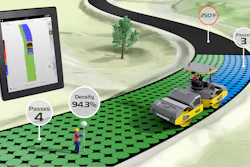
How IoT Helps Synchronize People and Machines on the Jobsite
As technology moves away from isolated smart machines toward synchronized sites, digitized workflows are helping contractors remove many of the risks that have traditionally hampered safety and productivity.
Modern telematics provides a clear view of individual machine location and health, tracking everything from fuel burn to engine hours. But all too often, that data is siloed within individual cabs, leaving fleet managers without a real-time, unified view of how all machines are interacting with each other across a busy site.
Meanwhile, details of a machine’s specific tasks like current load weights or exact cycle times often remain trapped in manual logs or verbal radio updates. This creates a reliance on paper tickets and manual tallies — processes that are slow, prone to error and impossible to manage in real time.
Today, the evolution of the Internet of Things (IoT) is closing that gap. Technology is moving away from isolated smart machines toward synchronized sites where every asset, vehicle and person is a live data point on a digital map. By digitizing workflows like load ticketing and site mapping, contractors are removing many of the risks that have traditionally hampered safety and productivity.
Total Jobsite VisibilityVolvo Construction Equipment
The most immediate challenge on any high-production site is visibility. Some site managers rely on verbal updates and gut instinct to manage traffic flow on a busy site. Connected mapping technology changes that by providing a real-time visual overview of the position of every machine, vehicle and visitor on a site.
This intelligent positioning service is accessible to all site personnel, whether they’re operating a machine or working in the office. For a fleet manager, this level of visibility solves two primary headaches:
Proactive safety — Instead of relying on a driver to watch their speedometer in a high-traffic area, managers can implement automatic speed zones. These zones can automatically reduce a machine’s speed when it enters a preset area, significantly mitigating the risk of accidents in blind corners or congested loading zones.
Operational flow — With total visibility via an office portal, management can identify bottlenecks in real time. They can see if transport operations are stalling, allowing them to optimize traffic flow, cut travel times and lower fuel consumption.
By digitizing the site map, managers can move away from reactive troubleshooting and actively direct the flow of the entire project.
The Death of the Paper Ticket
If mapping handles the where, digital ticketing handles the what. In many operations, the load-out process still relies on physical paperwork. It involves drivers handling paper slips, manual tallying at the end of a shift and a significant amount of administrative lag.
Volvo Construction EquipmentToday's modern IoT solutions are designed to digitize the entire flow from the loading unit to the site office. This eliminates the need for paper tickets and the manual tracking that often leads to errors.
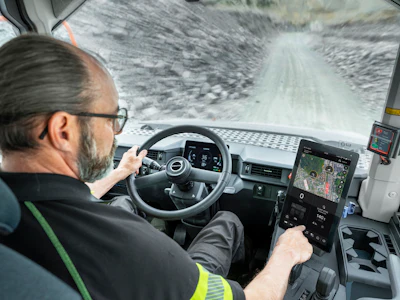
The benefit here is a direct increase in work efficiency. Because the loading tool (an excavator or wheel loader, for example) is digitally connected to the site office, data is shared instantly. This minimizes the time supervisors spend on administrative tasks and ensures that the utilization of every machine is tracked accurately. Digital tickets are sent between the machine’s in-cab display and the office, where the data can be filtered by material type, project or machine.
Data-Driven Performance Indicators
Moving beyond location and logistics, digital services now allow managers to monitor key operational metrics across the entire fleet. This provides a real-time dashboard to track production data, fuel efficiency and cycle times.
This level of insight allows site management to slice and filter data to see exactly how a project is performing against its bid. If fuel efficiency is dropping or production is lagging on a specific material type, they can take immediate action rather than waiting for a weekly or monthly report.
With some original equipment manufacturers (OEMs), all this data can be fed into a central digital hub that acts as a simple one-stop shop for telematics, machine productivity and asset management.
A Foundation for Future Growth
The adoption of these connected tools transforms the jobsite into a single, responsive unit where the office and the field share a constant stream of operational data. This high-precision tracking reduces administrative overhead and establishes the digital infrastructure necessary for the industry’s shift toward advanced automation.
Beyond preparing for future autonomy, these technologies provide an immediate solution to today’s ongoing skills gap. With real-time visual guidance and automated safety boundaries, connected systems help less experienced operators perform with the precision of a veteran.
A machine cannot be truly autonomous, and an operator cannot be truly efficient, if the jobsite around them is still managed on paper and radio. By adopting these IoT solutions today, contractors are boosting their current profitability while preparing their business for a future where the mechanical and the digital are one and the same.

 Volvo Construction Equipment
 Volvo Construction Equipment

 Volvo Construction Equipment