

NOTE: If you are here but didn't reap Part 1: Paving & Compaction, click here, to read that now.
Production: Two Futures For Asphalt Plants
Production technologies were another major focus across the show floor, particularly systems designed to reduce hauling distances and maximize material utilization. There appeared to be two distinct pathways that asphalt production innovation is headed long-term.
The first was that stationary, permanent plants are becoming technological hot-zones. The future for plants is centered on a producers data, capturing it, and having the technology to utilize that data effectively.
The second future is that of mobility and flexibility. More types of mobile/batch plants with an increased focus on meeting producer demand when and where it's needed.

On the crushing and aggregate side of the quarry was a new, highly portable, dual-power ready crushing plant on display from Eagle Crusher called the TalonTrax. And they indicated that this is just the first in a whole new line of forthcoming products.
"The TalonTrax also features our new TalonMax impactor, which is an sort of open rotor design," said Daniel Friedman, VP of marketing for Eagle Crusher. "It is lighter weight, but still as high performance as our UltraMax impactors, which are on every other crushing plant that we currently manufacture."
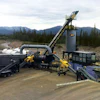
One of the most interesting concepts came from Bergkamp, which showcased a mobile recycling plant known as the Journeyman Mobile Mix Plant. The system is designed to allow contractors to produce structural asphalt pavement directly at remote project sites using RAP and locally sourced aggregates.

By bringing the production capability to the project rather than hauling mix long distances from a central plant, contractors can build roads in locations where traditional hot-mix logistics might not be feasible.
"There's lots of roads out there that are outside the radius of a hot mix plant," said Scott Bergkamp, president at Bergkamp. "You take the journeyman to the project site, or wherever you need, to build structural pavement. It allows you to build a road where there otherwise might not be a good option because it's outside the reach of a hot mix plant."
This type of portable production approach could become increasingly valuable as agencies continue pushing for higher RAP utilization and more sustainable construction practices.
When it comes to your more traditional asphalt plants, things don't often change in leaps or bounds, but there was plenty to take in this year. For strarters, Asphalt Drum Mixers (ADM) which became apart of the FAYAT Group between CONEXPOs.

Their legacy EX Series was getting a lot of attention, sporting upgrades and new design elements from their international partnership, including: Improved drum insulation, "air blade" technology, as well as new control software elements.

Along those same lines, ALmix demoed some new features for their INSIGNIA asphalt plant control platform. Most prominently was the Loadout and Silo Sentinel, which can control plant operations from any computer anywhere. The cloud based platform allows for ultra flexibility. The system is fully customizable for any workflow.
When it comes to technology, Astec came with every barrel loaded. Trevor Wagoner, Astec's product director of asphalt and sustainability, walked me through the company’s flagship plant configuration.
“This is called the DBX HR,” Wagoner explained. “It’s a variation on the Double Barrel, which is our bread-and-butter.”
One of the most impressive aspects of the system is its increased RAP capability.
“This plant is good for up to about sixty-five percent RAP up to six hundred tons per hour,” Wagoner said. “At up to six hundred tons per hour. This plant will chew through RAP if you’ve got the supply."
But there's one really important reason why this plant and it's RAP capabilities that are not equal to previous iterations produced by Astec. And it's this detail that makes all the difference.

"The reason it's able to do that is because the drum is a little bit longer than a standard drum," explained Wagoner. "It lets you get better heat transfer into the aggregates. This is slower, more gentle heating, which then gives you better heat transfer into your RAP. It's important that you're not aggressively or overheating the RAP, because that damages the residual AC."
Astec was also demonstrating its Signal connectivity platform.
“Signal is Astec’s connectivity suite,” Wagoner said. “It takes telematics from our entire rock-to-road portfolio and ties it together.”
The system allows plant operators to monitor equipment remotely.
“People can see the data coming back from the equipment and make operational decisions,” Wagoner explained.
They also had a really interesting burner on display which exclusive burns hydrogen fuel. Now, this is not a product yet on the market, since hydrogen is still not as readily available as it needs to be before going fully mainstream. However, it was a good indication that Astec is staying out ahead of the curve, as to be ready for any curves the industry my throw at it.
Technology and Connectivity: The Rise of the Connected Jobsite
Perhaps, the most transformative trend on display at CONEXPO was the rapid expansion of connected jobsite technologies. This wasn't exclusively about AI or AI related products, though those were in abundance.
Across multiple booths, manufacturers demonstrated systems that collect machine data, jobsite measurements, and quality control metrics and transmit them directly to the cloud.

One example was the PQI 380+ Non-nuclear density guage from Transtech Systems. The platform allows field technicians to upload compaction measurements in real time using a simple hot spot, like a smart phone connection. Once the gauge connects to Wi-Fi, the readings are instantly available to quality control managers back in the office.
This allows project supervisors to detect compaction issues immediately and make adjustments before the problem spreads across the jobsite.
"We had one customer doing an FAA job. The ambient temperature outside was cooler than they expected when they were paving," said Jacob Szwarcberg, principal product manager at Tanstech. "The QC manager caught it in real-time, a dip in compaction. He called to the site and had them adjust the rolling pattern in real time, and it saved them a day or two in joint penalties. That's that's real world results."
These platforms are also becoming more sophisticated. Some systems now analyze laboratory core data and automatically calculate offsets between field measurements and lab results, reducing the manual spreadsheet work traditionally required to calibrate testing equipment.
The result is a quality control process that is faster, more accurate, and easier to manage across large projects.

Topcon was also demonstrating improvements to its 3D paving and other machine control systems.
“We’ve upgraded our IMU and our sensors are faster,” Evan Spencer, Topcon's 3D Paving Specialst, explained. “We also have a full constellation head so we get more satellites."
That expanded satellite access improves performance in denser city environments. Anyone who has tried to use these types of systems knows that in crowded settings, the technology can sometimes be finicky. Topcon has worked hard to reduce that scenario, which is especially good for road builders who often work in such settings.
“We’re getting tighter to buildings and tighter in urban areas, and our stacks are modular,” Spencer said. “Contractors can move between GPS jobs and total station setups [much more easily].”
The Bigger Picture
Taken together, the technologies on display at CONEXPO 2026 point toward an asphalt industry that is becoming increasingly data-driven and automated.
Pavers are becoming smarter. Rollers are becoming more efficient. Production equipment is becoming more flexible. And the entire jobsite is gradually becoming connected through cloud-based data systems.

For contractors, these changes are not just about adopting new equipment. They represent a shift in how asphalt paving operations are managed, monitored, and optimized.
The companies that embrace these tools will likely gain advantages in productivity, quality control, and workforce efficiency. And judging by what was on display across the show floor, that future may be arriving sooner rather than later.