

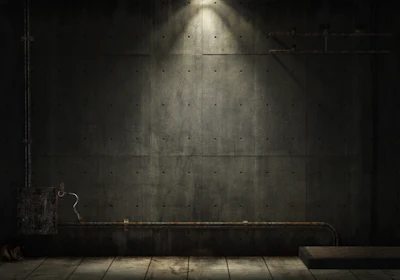
It’s well known that concrete is the most used building material. Full stop. From structural walls to driveways, the material is everywhere. It’s strong. It’s durable. It’s recognizable. But is it warm? Cozy? Is it comforting?
Picture a dark space or a long hallway. Picture the concrete blocks crumbling. Picture the broken nooks and crannies within and about the walls hiding all sorts of who-knows-what. Picture a post-apocalyptic city of an abandoned concrete jungle giving nothing but more emptiness. Queue the sounds of any atypical scene trying to convey unease. We’re exploring what’s going on here and what concrete’s role may be in this potentially creepy moment.
The spaces that inspire creepiness and horror use ideas that we’re accustomed to — concepts to trigger that fight or fright. In “The Psychology, Geography, and Architecture of Horror: How Places Creep Us Out,” Frank McAndrew, Ph.D., Psychology Professor at Knox College, writes, “Places that inspire feelings of creepiness and horror possess combinations of features that humans have evolved to regard with caution, either because such features were associated with the presence of predators or other natural hazards, or because they confront us with limited sensory information and a lack of freedom of movement and control which would impair our ability to deal with an emergent threat.” His work has been used to help influence the construction and design of commercial haunted houses as well as authors seeking help with environmental descriptions.
- Limited sensory information
- Lack of freedom of movement
- Lack of control
I don’t know about you, but I would think an enclosed space made out of concrete checks those boxes. To further explore this, we need to understand what being “creeped out” means and how the immediate environment psychologically affects the people within.
First, “being creeped out” isn’t exactly the same as being afraid, nor is it being disgusted. Investigating this, McAndrew found little scientific literature on the subject and started his research on the characteristics of creepy people and what gave others the wrong vibes.
Whether people or places, he says, psychologically, it’s the same thing — an uncertainty on if there’s something to be feared or not.
For many, movies are the most straightforward example. A good horror flick moves the viewer through three stages. At first, the characters are set up knowing something is out of place. They’re uncomfortable and not sure what to be afraid of, if anything. Eventually, there is, and they may not know what or how to deal with it. Finally, the fear stage when they figure out the problem.
“If you’re talking about physical spaces,” explains McAndrew, “we’re programmed through evolution to like some kinds of spaces a lot more than we like others. There’s two concepts that are important here: prospect and refuge.” Prospect relates to visibility and how many hiding places are available for things to sneak up. Refuge is the sense of being protected or hidden. Spaces can have both or, in other words, a way to see without being seen or eat without being eaten.
Uncomfortable places offer us limited prospect. They don’t offer much visibility or information. They’re confusing. A lack of refuge can make people feel exposed and at mercy of the things hidden. Returning to the horror movie example, these stories are often set in old houses — big, dark, a confusing layout, basements, and hidden rooms. These are places that make people feel they can get lost and make it difficult to escape.
McAndrew points to the evolutionary origins with our ancestors walking through a forest, handling the encroaching darkness and remaining hyper-vigilant for what could be hiding anywhere. “Spaces around us can creep us out and create a sense of horror, because they put us in this position where we feel vulnerable, isolated. We may not know that there’s anything there threatening us, but even if we [did], we can’t tell where it is. That’s how spaces creep us out,” he explains.
In his original study on people, McAndrew’s research rated characteristics, occupations, and various qualities with slides of pictures of places, objects, and people. The research group evaluated various qualities like how disturbing, how confusing, how pleasant, etc. They then looked at what commonalities read “creepy” and found that uncertainty was the key. “When it looks like you can’t make sense of [it]…those are the places that really creep us out the most,” he says.
To start to figure out when the concrete environment starts affecting people this way depends on prospect and refuge. Is the concrete keeping you in, or keeping something else out?
“Concrete may give you the idea that it’s harder to get out…and make the whole experience even more horrifying. On the other hand, if the threat that you’re worried about is potentially outside, the concrete may be reassuring in protecting you from whatever it is you’re worried about. It could cut either way,” says McAndrew.
Stereotypically, people are horrified by places that include certain associations. Horror movies use tropes like the haunted asylum, hospital, or an abandoned prison full of ghosts. In these places, concrete naturally — almost by definition — is institutional. It makes sense that it would come to mind as part of the picture. In effect, the building material provides a sense of what’s happening in the space.
The condition of concrete may play a part. Is it crumbling? Will it fall? Then there’s the designed intention of the architecture: is the space one of safety and security; will the space protect or trap?
Still, McAndrew calls the actual concrete neutral. If we’re looking for points of horror, the features of the space itself will be more important. He explains, “A wide-open concrete space that’s well-lit,” for example, “gives us the sense of being able to see what’s going on around us and put us at ease, but exposed concrete walls that are in narrow hallways with a lot of turns and dark corners provide [the opposite], so it’s not really the concrete per se — that’s just the material that’s being used to construct the more psychological aspects of the space.”
So, if we’re using the horror genre and films, are elements from that fiction affecting how we perceive our built environment? In fact, it’s actually the reverse. The fiction exists because we bring in experiences from our lives.
For those designing spaces, to those affecting how the built environment will be experienced long after the concrete cures: “From a concrete contractor’s point of view, if you’re putting a space together, you want it to be inviting and not threatening. You want people to want to walk around in it and not feel ill at ease while doing that,” says McAndrew.
Acoustics is another element that can creep people out. A space can instill the same unease if it’s difficult to determine the direction and identify the source of a sound. To the extent that concrete lets things echo, it could make it more difficult to not only tell what it is, but how far away as well.
The decorative and functional elements of a room have a major part in providing comfort. Consider where people may sit, sight lines, vegetation placement, color, the reflection of light, etc. Quality of finish may also play a role in telling the story of a space’s intention. “If I’m in a place with concrete walls and they’re smooth – it’s communicating to me that this is a space where people are going to be spending time…human activity is going to happen here,” says McAndrew.
“Whereas if it’s this rough, unfinished surface…it’s probably just a storage area or a passageway, not a place where people are going to be spending time doing stuff. It’s communicating something about what this space is supposed to be for.”
Admittedly, McAndrew tells us that he did not consider concrete in his original research. After bringing this up to him, it will be interesting to find out what he researches next.






![Adobe Stock 350182902 1 6759c43d679ca[1]](https://img.forconstructionpros.com/files/base/acbm/fcp/image/2025/02/AdobeStock_350182902__1_.6759c43d679ca_1_.67b78c75671e9.png?ar=16%3A9&auto=format%2Ccompress&dpr=2&fit=crop&h=135&q=70&w=240)


