
Executing a high-quality asphalt paving project is challenging under the best conditions. Doing so beneath more than 100,000 square feet of low-clearance solar canopies — without disrupting daily site operations — requires a different level of planning, coordination and adaptability.
That level of execution earned Howard Companies the 2026 Paving: Parking Lot award for its work at Capital Group’s service center in Carmel, Indiana. The award recognizes the best asphalt paving job, overlay or new construction completed on a parking lot during the year, regardless of size.
A Company Built on Integration and Execution
Howard Company is a vertically integrated contractor providing asphalt and concrete services across Indiana. Over time, the company has expanded well beyond traditional paving into maintenance, repair and rehabilitation, sealcoating, site and structural concrete construction, materials production and construction trucking.
“Howard Companies has grown while staying focused on the fundamentals that built the business — quality workmanship, customer service and doing what we say we’re going to do,” said Tommy Johnson, paving division manager.
That approach applies across all market segments, from municipal and state roadway work to commercial parking lots and materials supply.
“No matter the size or scope of the project, our focus remains the same,” Johnson said. “Delivering consistent, high-quality asphalt and concrete solutions while building long-term relationships based on integrity, trust and value.”
A Sustainable Site with Uncommon Constraints
Capital Group’s Carmel service center had previously installed a large solar canopy spanning its parking areas. The system features 4,230 individual solar panels and is part of a 2.5-megawatt installation designed to offset approximately 50% of the site’s annual electrical load. Covering more than 100,000 square feet, the project aligns with the city of Carmel’s climate action plan, which targets net-zero emissions by 2050.
While the solar infrastructure provides long-term sustainability benefits, it also created unique challenges for pavement work. Low-clearance canopies restricted vertical access, limiting truck movement and preventing standard asphalt delivery methods.
Howard Companie’s plan included drainage improvements, curb and sidewalk replacement, base repairs and placement of nearly 4,900 tons of surface asphalt across approximately 49,300 square yards. The project also incorporated electric vehicle charging station stalls, new signage, parking bumpers and full striping to a new site layout.
Years in the Making
The Capital Group parking lot project was not an overnight effort. According to Charlie Moore, sales representative at Howard Companies, they got involved several years before construction started.
“Capital Group first began evaluating the paving of their parking lot in 2018, at which time Howard Companies provided initial budget estimates,” Moore said. “These estimates were updated annually until the project was ready to move forward in 2024.”
After the project was put out to bid, it was awarded to Howard Companies. Because the solar canopies were not completed until late 2024, paving operations began in spring 2025.
Drainage and Base Work Under the Canopies
Before surface paving could begin, crews addressed extensive subsurface work beneath the solar structures. The project included installation of 3,980 linear feet of drainage pipe under the canopies, along with approximately 280 tons of trench base. Crews also completed about 250 tons of base repair to correct distressed areas and support the new asphalt surface.
Working under the canopies required careful and creative equipment selection and precise execution to avoid damaging existing infrastructure while maintaining productivity. Limited space for staging and maneuvering added to the challenge.
Rethinking Asphalt Placement
The most significant challenge emerged during surface paving. Since their dump trucks could not raise their beds high enough under the canopies, traditional asphalt delivery methods were not possible.
“From the outset, the solar canopies presented unique challenges that required extensive planning and collaboration,” Johnson said. “During preconstruction, the team worked through multiple scenarios, down to the specifics of how material would be shuttled to the pavers.”
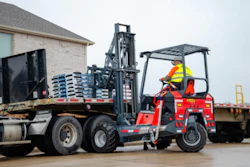
Trucks could raise their beds to about a 25-degree angle — roughly half of what is typically required to unload hot mix asphalt. To keep the material workable, crews dumped asphalt onto the ground in controlled areas and used multiple skid steers and loaders to transfer it into the pavers.
This process required constant coordination to prevent temperature loss and maintain production. In especially tight areas, timing was critical, with crews working quickly to keep material moving before it cooled.
“Through huddles and open communication, lessons learned were applied immediately,” Johnson said. “The willingness to adapt played a major role in delivering the project on time and on budget.”
Echelon Paving for Quality Control
To improve efficiency and mat quality, Howard Company implemented echelon paving, running two pavers side by side and feeding them simultaneously with skid steers and loaders.
This approach helped crews unload trucks faster and place asphalt before temperatures dropped. It also contributed to tighter longitudinal joints and a more uniform mat — a critical factor on a high-visibility commercial site.
A fine-graded asphalt mix design was used to reduce segregation and maintain consistency throughout placement. Despite the nontraditional delivery process, the finished surface met both requirements and quality expectations.
The project was completed while the Capital Group facility remained operational. To maintain safety and access, work was divided into three asphalt phases and three pipe phases, each isolated with temporary fencing. This allowed crews to focus on specific areas while minimizing disruption to daily operations.
Despite the unusual conditions, the project stayed on schedule.
Communication as a Project Driver
Consistent communication was key throughout the project. Moore said coordination was especially important because work was being done during normal operating hours for the Capital Group.
“We held daily coordination meetings with the on-site engineering team, along with weekly Microsoft Teams meetings involving four members of the management team,” Moore said. “These regular check-ins ensured all stakeholders were informed of completed work and upcoming activities.”
The contractor also stayed in close contact with Capital Group and property management firm Cushman & Wakefield, adjusting phasing and schedules as needed to address site conditions and minimize disruption.
A Standout Project
Howard Companies selected the Capital Group project for award consideration because of its technical difficulty and a more difficult execution.
“This project represents one of the most technically challenging paving jobs Howard Companies has completed,” said Mike Isaacs, quality control director. “Paving beneath these low solar canopies required strong leadership, detailed planning and constant adaptability, along with nontraditional methods and exceptional coordination.”
The finished parking lot addressed drainage issues, improved accessibility and enhanced overall safety and appearance. Fresh striping, new signage and clearly labeled electric vehicle charging stations reflect the site’s updated design and sustainability goals.
The client provided a letter of appreciation recognizing the contractor’s dedication and workmanship, noting the project was completed ahead of schedule despite its complexity.
Raising the Standard
Looking ahead, Howard Companies views projects like this as examples of how the company can continue to evolve.
“Simply, raising the standard,” said Sean Rizer. “We are a problem-solving company and expect to tackle any and all challenges that come our way. It is a true testament to our team and our commitment to quality."
As solar infrastructure becomes more common in parking facilities, projects like the Capital Group site may offer a glimpse into future paving challenges. For Howard Companies, the award-winning project demonstrates how planning, adaptability and teamwork can turn constraints into a successful — and recognized — outcome.