On a construction site, some of the most dangerous moments happen when a worker’s body is still on the job, but their mind has already moved somewhere else.
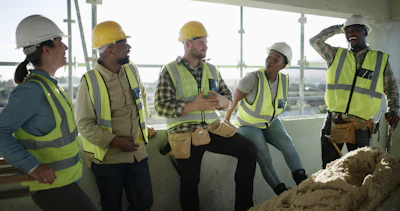
That can happen at the end of a shift, during a break, while finishing one last task or around lunch. A worker may be gathering tools, walking back to a ladder, stepping around materials, or heading toward a break area. The work may feel temporarily over, but the hazard has not gone anywhere.
That is why lunch itself is not the hazard. The transition is.
The Rush Vs. The Return
Before lunch or any break, the danger is often the rush. After lunch or a break, the danger is often the return.
Before a break, workers may be focused on getting to a stopping point. They may want to finish one more detail, grab one more tool, move one more piece of material or get back across the platform before the crew stops. That “almost done” mindset can be dangerous because fall hazards do not become less serious just because the task feels nearly complete.
After a break, the challenge is different. Workers have stepped away. They have eaten, cooled down, checked their phones, called home, talked with the crew or simply let their minds leave the work for a few minutes. That is normal. People are not machines. But when the break ends, the jobsite requires their attention to return immediately.
Fall hazards do not allow much margin for a slow mental reset.
The Data Points to Midday Risk
The data gives us reason to pay attention to this window. Falls remain the leading cause of death in construction. The Center for Construction Research and Training, found that from 2011 to 2022, the time period with the largest number of fatal falls per hour was 10 a.m. to 12:59 p.m. An AGC/Virginia Tech report found that 52% of construction fatalities occurred between 10 a.m. and 3 p.m., with fatalities peaking around noon.
That does not prove lunch causes falls. It does suggest that midday and other transition periods deserve more attention.
Safety Has to Account for Real People
The construction industry talks a lot about training, and it should. Workers need to understand the hazards around them and the practices that keep them safe.
But we also need to be honest about human attention.
People get tired. They get hot. They fall into routines. They think about the next task, the next break or the problem waiting for them at home. They carry tools, talk to co-workers and look ahead instead of looking down. None of that makes them careless. It makes them human.
Good fall protection must account for that reality.
Make Protection the Default
One way to do that is to use as much passive fall protection as possible. Active fall protection requires the worker to take an action every time: put on the harness, connect the lanyard, tie off to the anchor point and remember to stay connected.
Those systems are important, but they depend on behavior.
Passive fall protection helps protect workers even when attention shifts. Guardrails, hatch protection, skylight protection and ladder access systems can reduce risk without requiring a perfect decision in every moment. The more a jobsite can make protection the default, the less it depends on every worker being perfectly focused every second of the day.
Contractors should also think about protecting the path, not just the task. Where are the ladders, hatches, openings, skylights, trenches and roof edges? Are there designated routes? Are break areas located in safe zones? Are workers being asked, directly or indirectly, to pass through unnecessary hazards during transitions?
Build In A 60-Second Reset
The other step is simpler, cheaper and available to every crew immediately: build in a 60-second reset before and after breaks.
Before lunch, the reset is about leaving the work safely. What hazards are still around us as we stop this task? Where are the edges, openings, ladders, hatches or trenches? Are we staying tied off until we are fully out of the hazard area? Are we taking the protected path back?
After lunch, the reset is about returning safely. What changed while we were away? Has material been moved? Have other workers entered the area? Are warning lines, guardrails or access points still where they need to be? Is everyone mentally back in the task before physically stepping back into the hazard?
This does not need to become a long meeting. In fact, it should not. The value is in making it short, repeatable and practical. Sixty seconds is enough time to interrupt the rush, refocus the return and remind everyone that the hazard is still present.
Before we move, we look. Before we restart, we reset.
The Edge Does Not Take a Lunch Break
This is not about blaming workers. It is about designing jobsites and safety practices around real people. The goal is not only to prevent injuries, reduce claims or avoid citations. The goal is to make sure every worker goes home at the end of the day.
Lunch takes a break. The edge does not.