

A general contractor can invest heavily in the latest project management software, estimating platforms, and field technology. But if no one understands the workflows, role responsibilities, jobsite coordination requirements, or how the field and office communicate, the project still struggles.
The technology may function perfectly. The business does not. That distinction increasingly defines what is happening across construction technology implementations today.
Construction firms continue investing aggressively in project management systems, ERP platforms, AI-driven scheduling tools, analytics dashboards and field automation technology. Yet despite those investments, most implementations still fail to deliver the operational or financial outcomes leadership expected when the initiative was approved.
Recent industry findings reveal that only 12.1% of logistics technology programs ultimately delivered on time, on budget and achieved their expected business outcomes. More than 91% experienced budget overruns, while nearly 89% realized less than 76% of projected ROI. While these figures originate in logistics technology, the implementation dynamics mirror what construction leaders encounter repeatedly on their own technology initiatives.
The reason is straightforward: most companies are executing systems integration when what they actually need is business integration.
Technology Isn't the Problem. Operational Readiness Is.
The construction industry has spent years assuming implementation struggles are primarily technology problems. Increasingly, the data suggests otherwise.
Systems integration focuses on getting the platform technically operational: configuring the software, migrating project data, testing workflows and connecting systems. Business integration focuses on whether the organization itself is operationally prepared to absorb the technology through governance structures, workflow redesign, operational readiness, change management, adoption planning and decision authority.
One installs the system. The other enables the business to function through it. Too many construction firms complete the first while assuming the second will happen organically.
One of the clearest examples appears in how construction organizations handle data. Recent industry polling identified data quality and system integration as the single largest operational challenge facing supply chain organizations, impacting 32% of respondents. The same dynamic plays out on construction projects, where inconsistent data across estimating, scheduling, procurement and field operations creates compounding problems that no software can resolve on its own.
Organizations often attempt to layer sophisticated planning tools, optimization engines, or AI capabilities onto operational environments where workflows, ownership structures, business rules and reporting standards remain inconsistent across departments and project teams. The software becomes the visible failure point, but the underlying issue existed long before implementation began.
Technology amplifies organizational discipline. It does not replace it.
Most Implementations Fail Before Go-Live
One of the strongest patterns emerging from technology implementations is that most failures begin during the transition between vendor selection and operational execution.
When leaders were asked what would have reduced the need for mid-project correction, 61.4% identified one issue above all others: a structured transition from vendor contracting into implementation. Yet fewer than 10% reported actually having that discipline in place.
Construction organizations spend enormous time evaluating software capabilities but comparatively little time designing the operational framework required to support the implementation itself. Readiness assessments are incomplete, governance structures are introduced too late, timelines are driven by vendor availability rather than project operational readiness, and authority structures across field, office and ownership teams remain ambiguous.
The downstream financial consequences are substantial.
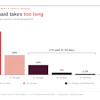
Industry findings show that 82.6% of organizations required more than six months to reach full operational adoption, while 11.6% took more than a full year. More concerning, 5.8% had still not fully adopted the system at all. For construction firms managing tight margins and fast-moving project timelines, delayed adoption translates directly into cost exposure.
A software vendor may successfully complete the implementation statement of work while the construction organization itself remains operationally unprepared to use the system effectively across the full project lifecycle. From a technical standpoint, the project succeeded. From a financial standpoint, it failed.
The same pattern is now emerging with AI adoption. Industry polling shows that 37% of organizations are still exploring where AI could provide operational value, while another 29% remain stuck in pilots. For construction, AI holds significant promise across scheduling optimization, cost forecasting and risk management. But those capabilities depend on clean workflows, integrated operational data and clearly defined decision structures — not software features alone.
Without those foundations, AI remains trapped in experimentation because the organization itself is not prepared to operationalize the technology at scale.
Adoption Is the Real ROI Metric
One of the most overlooked realities in enterprise technology deployment is that go-live is not the finish line. Adoption is.
Yet many organizations still approach training primarily as a software orientation exercise rather than a workforce enablement strategy. Only 8.2% of organizations reported providing role-specific, workflow-based training tailored to how employees actually perform their jobs. In construction, that means field crews, project managers, estimators and executives each need training specific to how their role interacts with the system, not a single generic walkthrough.
The issue is not whether employees understand the software. It is whether they understand how the business now operates through the software.
That distinction defines business integration.
Construction firms that consistently outperform their peers do not treat technology implementation as an IT event. They treat it as an enterprise operational transformation initiative involving governance, workflows, accountability, process enablement, finance and organizational readiness.
As construction operations become more automated, interconnected, and AI-enabled, the firms that separate themselves will not simply be the ones buying more advanced technology. They will be the ones integrating their businesses more effectively around that technology.
The companies that win will not just install the tools. They will know how to run the project.