
If you have driven through a short-term work zone recently, you have likely encountered equipment such as automated flagger assistance devices, portable temporary rumble strips, dynamic message boards or advanced warning systems. While these devices are not new, they are becoming more common and can provide meaningful safety benefits when applied thoughtfully and in the right environments.
In more than 20 years leading Flagger Force and growing into a national operation with over 3,000 employees across 15 states, I’ve seen significant advances in technology designed to enhance safety. Manufacturers have introduced important innovations, including connected arrow panels, variable message boards, truck-mounted attenuators and enhanced communications technology. Innovation matters. But in live traffic environments, every new tool must ultimately be judged by one standard: does it reduce risk for the men and women who carry the responsibility of safely guiding traffic through work zones? It’s critical to understand the operational impacts and limitations of every tool before widespread use.
Balancing Technology with the Realities of Risk & the Human Factor
The effective use of technology in short-term traffic control depends on a balanced approach that accounts for the unique risks and challenges of working in live traffic environments. While technology can enhance safety in certain situations, it must be implemented in ways that support the trained professionals responsible for managing dynamic and continually changing conditions.
Every day, traffic control professionals set up, manage and remove work zones in all weather conditions and at all hours. Years of field operations and safety analysis show the greatest risk for these individuals occurs during initial setup and final teardown, when advanced warning signs are being placed or removed, and drivers are least aware that crews are present.
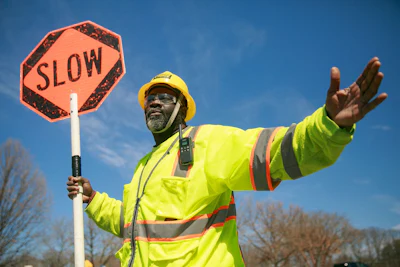
Protecting workers during these dangerous phases requires a combination of industry-leading training, full-body and high-visibility yellow personal protective equipment, high-intensity amber strobe lights on vehicles and strategically deployed technologies designed to reduce risk and increase safety. Yet the true strength of any work zone operation remains the people managing it.
Beyond directing traffic, these highly trained professionals monitor motorists, pedestrians, bicyclists, client movements and changing weather conditions. They make hundreds of decisions daily, applying training experience, judgment and situational awareness. Their ability to read driver behavior, anticipate risks, and adapt instantly protects themselves and others in ways technology can’t replicate. Through eye contact, hand signals and communication, traffic control personnel help drivers navigate work zones safely while maintaining traffic flow and reducing driver frustration.
As new technologies emerge, they must be evaluated through this reality: technology can support work zone safety but can’t replace the human factor. Any innovation that increases employee exposure to live traffic can create unintended risks, even when developed with good intentions. Effective technologies reduce exposure, increase awareness, and strengthen traffic control professionals' ability to manage dynamic work zones. Automated flagger assistance devices, portable temporary rumble strips, and video monitoring systems can achieve these goals, but only when used strategically and in the right environments.
- Automated Flagger Assistance Devices (AFADs) - The Manual on Uniform Traffic Control Devices (MUTCD), the national standard for establishing consistent work zones and equipment, recognizes AFADs as an effective solution in specific circumstances. These devices are designed for single-lane, low-speed, low-volume environments and are particularly useful in locations where there may be no safe escape route for a trained professional, such as bridges, steep embankments and along guardrails.
By allowing remote operation of the mechanical arm, stop/slow sign and warning lights, traffic control personnel can manage traffic flow from a nearby, safe location. While AFADs can automate certain functions, they can’t replace the expertise and judgment that trained traffic control professionals bring to a work zone. The technology relies on a skilled operator to assess conditions, respond to unexpected situations and keep traffic moving safely. Rather than replacing people, AFADs provide another layer of protection that helps them work more safely.
- Portable Temporary Rumble Strips (PTRS) - Like traffic-calming measures used near shopping centers and pedestrian crossings, PTRS are designed to prompt drivers to reduce speed. Yet driver behavior doesn’t always follow the script. When motorists steer around the strips to avoid vibration, new hazards emerge, and the safety benefits diminish. Additionally, the weight of these devices and the exposure required during setup and removal can introduce risks for traffic control professionals.
Together, these realities underscore an important point: new technologies must be evaluated for both their benefits and operational impacts. Even as technology evolves, the expertise, judgment and presence of trained traffic control professionals remain essential to work zone safety.
- Video Technology - Video technology offers organizations a clearer view of day-to-day operations, helping identify risks, reinforce best practices and support ongoing safety improvements. At Flagger Force, our vehicles are equipped with forward- and in-cab-facing cameras that allow us to review work zone activity and driving behaviors throughout the day. Combined with vehicle telematics and GPS data, these tools help us identify trends, uncover opportunities for improvement and provide coaching before incidents occur.
The value of this technology lies not in the cameras themselves, but in how the information is used. Data can highlight risks and reveal patterns, but it takes experienced professionals to interpret that information, make informed decisions and apply lessons learned in the field. When paired with training, accountability and human judgment, video technology becomes a powerful tool for continuous improvement, helping create safer outcomes for employees, clients and communities.
Throughout the industry, new technologies are being introduced with the promise of safer work zones. The greatest opportunities, however, are not found in replacing people, but in better protecting them. Whether through automation, data, video monitoring or other innovations, technology is most effective when it reduces risk and supports informed decision-making. At the end of the day, work zone safety still relies on highly trained professionals who apply experience, judgment and expertise in real-time. Their role can’t be automated. It can only be strengthened by the thoughtful application of technology.