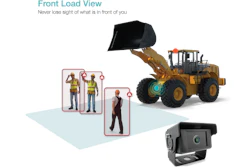

The construction industry sees about 150 to 170 struck-by incidents per year, accumulating up to 20,000 cases of days away from work annually. In an effort to “save lives, protect vulnerable road users and assist drivers,” Brigade Electronics developed its Front Load View a dual-camera system featuring an advanced AI human form recognition software.
Recognized as one of the 2026 Rental Editor’s Choice Award winners, we connected with the company to learn more about the system and the key elements pushing working around equipment that much safer.
Watch FCP is a video-first content and sponsorship program designed to connect advertisers with highly engaged construction professionals across YouTube, social media, email, and more.
Subscribe to our newsletters to have the latest insights delivered to your inbox.
Jonathan Kozlowski, Editor-in-Chief, Rental: Hi, I'm Jon, editor in chief of Rental. The construction industry sees about 150 to 170 struck by incidents per year. That accumulates to 20,000 cases of days away from work annually. In an effort to save lives, protect vulnerable road users, and assist drivers, Brigade Electronics developed their Front Load View, a dual camera system featuring an advanced AI human form recognition software.
Recognized as one of 2026 Rental Editors Choice Award winners. We connected with the company to learn more about the system and the key elements pushing working around that equipment that much safer.
Find out more about the Front Load View system and other Rental Editors' Choice Award winners through the links below.
Corey Heniser, CEO, Brigade Electronics Inc.: My name is Corey Heniser. I'm the CEO of Brigade Electronics Incorporated here in the U.S. we're the subsidiary of our parent company based in the U.K. I've actually been with Brigade for I'm in my 17th year now, so worked worked my way up when we were a very small company up to to today, where we have over 40 employees throughout the U.S.
Mike Hardman, Engineering & Technical Services Manager, Brigade Electronics Inc.: I am Mike Hardman. I am the engineer and technical services manager for Brigade Electronics here in the U.S. and I've been with the company for 13 years now.
Rental: We are here to celebrate the front-load view system. Can you walk me through what's going on?
Hardman: Okay, so the the front-load view system is designed to help operators with visibility when vehicles implement obstructs view. Looking at the front wheel loader, a bucket can create quite a blind spot directly in front of the machine under normal operation. By utilizing multiple cameras, we can create an automatic change in a monitor to allow improved visibility while the bucket is loaded and in a raised position. Couple this technology with AI human form recognition, and the system allows for enhanced pedestrian protection, creating a safer workplace.
Rental: Cool, cool. How is this being implemented in the equipment rental space?
Hardman: So, there are a couple of ways that this product can be implemented. One is a full-on installation, which is you know hardwired into the machine as well as as bolted on, and then we have applications where we can take and use magnets and additional battery power to supply the system into operating mode without being invasive into the machinery.
Rental: And you brought up that it's using AI, and we're seeing a lot of AI-based solutions being embraced more and more throughout the industry, in rental, OEM, equipment space, construction, everywhere. My inbox is full of AI-based stuff. What sets the front load view system apart from other enhanced situational awareness technologies?
Hardman: So, I think most technologies are restricted by the machine implements and require additional technology to be worn by the pedestrian or the workers. Okay, and these technology require a very controlled area to allow the system to work correctly. With our system, the implement does not affect the performance, nor does the system require additional devices or controlled areas. The ability to change the view automatically, depending on the height of the bucket, allows the operator to have added visibility when necessary, and when the the load is raised approximately 40 inches above the ground, the camera system will change the available view to the the camera located below the bucket, providing excellent visibility. And the AI technology will identify a pedestrian or worker within the camera camera's predetermined detection area.
Rental: What actually happens in the cab itself?
Hardman: Okay, in the cab itself, it looks very much just like a normal camera system. The operator has a single point of interface with the the system, and it's added visibility. Then the human form recognition kicks in to actually box pedestrians or workers that are within that predefined area of the camera system, that way they get a audible alert notification as well as a visual alert.
Rental: Sure, and you guys explained that you are working with full system integration and kind of aftermarket a little bit, if I'm understanding correctly, and equipment rentals have a ton of different equipment type. It's in their fleet. Is this is there a type of equipment the system is available for something specific? And are you expanding?
Hardman: Yeah. So so this system was developed mainly with the the front wheel loader in mind, as that bucket implement has quite a footprint and can block visibility, but the system can be adapted for any machine that has some sort of implement that that blocks visibility under certain conditions, and that way the camera system can change automatically to give added visibility when necessary.
Rental: Sure. Well. Why? Why the front loader? Why that specific equipment to start with?
Hardman: Because we've seen a need in the workplace to alleviate an issue that we're seeing, and it was front-end collisions. I mean, front-end collisions with pedestrians, or or even you know other machines and things like that, or they create downtime, cost customers money, and so we wanted to create a safer workplace and improve performance and efficiency.
Rental: Sure, and what about expanding it to other equipment types? Can you get the system on to something else? Like if your mom and pop rental business, can I get this equipment and put it onto my own asset at the at the shop?
Hardman: Absolutely, absolutely. I mean, we you know we really like to make things that can apply to many different situations. I mean, you know, each customer has their own problems that they they encounter running their machines, and we just want to be able to supply solutions to create a safer work environment.
Rental: And what kind of equipment brands have integrated front load view? Where can we see this technology right now?
Heniser: As far as how it's been implemented, it's on a variety of different makes and models across the board, primarily in the aftermarket spectrum right now. But other OEs are looking to implement this down the road as well as more customers adapt to this new technology.
Rental: Sure. Is there a brand that they can kind of start searching the internet for?
Heniser: No, it's not specific to any one make. We do supply OEMs across the board in many different markets, but also a number of the aftermarket solutions in various fleets implement these. Typically, to start with, with this newer technology, then you'll see it filter up through the OEM market.
Rental: Sure. How do you get from a fully integrated into the equipment, and then that aftermarket. What is the what's involved in attaching the camera system to, you know, their you know a rentals equipment fleet?
Heniser: I think Mike touched on that a little earlier, where it it can be fixed permanently to the vehicle, as well as there are magnet applications that can be for more of a temporary type installation. So it really depends on the vehicle usage. I would assume in a rental fleet where it's always rented out to individuals maybe that are unfamiliar with that piece of equipment, it would be best to make it a permanent fixed addition to that asset to just ensure the safety.
Rental: Yeah, yeah. I understand the system was developed from input from customers about that forward blind spot you guys are talking about, and then that issue is being compounded by newer operators. What is the forward blind spot for those who might not be familiar. How much of an issue is this?
Hardman: Okay, so the front load visibility is a serious struck by hazard, especially when raised or fully loaded bucket blocks the operator's direct view of people, vehicles, and/or obstacles immediately ahead. You know, in this construction industry, we see annually 150 to 170 struck by deaths per year, and we're also looking at 15 to 20 $1,000 or 20 15 to 20 1000 cases of days away from work go into the mining industry, and we see similar numbers. So you know, obviously there is a need for technology to help aid operators. I think when you get newer operators in, obviously experience is a key factor as well. So when we have less experienced operators, we need technology to step in, not only to help them, you know, with visibility around the vehicle, but to in essence tap them on the shoulder and say, hey, there's a pedestrian or worker nearby. Please be aware.
Rental: Yeah, especially since like most of construction is dealing with skilled labor challenges. All of these, not all, but so many more new operators are coming on into into the cab. Let alone in the rental space, those are probably going to be very inexperienced drivers because they're-I mean-they're renting it, right?
Hardman: Right, right.
Rental: So, how do you guys see modern construction equipment technologies such as the front-load view system help these inexperienced or transition that good operator into someone great.
Hardman: Well, I think the key factor is is just added visibility and and awareness of proximity of pedestrians or workers. We know that a lot of times on construction sites, there's a necessity for a worker to work in close proximity to a vehicle, and operators understand that. Typically, it's the. Ones that sneak up from behind or beside, or shouldn't be there at all, that really cause the the issues, and that's where this system can really step up and give you that awareness that something that you didn't realize was in your path is there.
Rental: What do you think this means for the future of equipment operators? How is this going to change tomorrow's construction equipment?
Hardman: Well, I think the the key factor is is as technology grows, the integration into vehicles gets gets more and more in depth. That you know potentially you know manipulating the vehicle to to to help curb incidences, I think, is a key factor moving forward. So this system is a is a level one step. It gives you the awareness. It gives you notifications when things are there. Progression says that eventually we're going to be you know helping to manipulate the machine to to to miss these incidents and and and you know could be auto braking, could be you know limiting the the accelerator, things like that. This technology, as it progresses, will give you more instances to help stop incidents and not just give you awareness of things around you.
Rental: Pretty cool, Corey. Any comment?
Heniser: No, I think the important part to add to what Mike was saying there, especially in the rental fleet industry, is having something that's intuitive enough that it doesn't really require the instructions or or learning by the new user that may be hopping into that seat for the very first time. If it's something that's just natural to them, it definitely makes it safer. They can they can adapt to that technology, and I think that's one thing Brigade attempts to do is try to add a safer envelope around the vehicle without the operator's awareness, but at least they're aware of any danger that's present, where otherwise they wouldn't be.
Rental: That's great. Is there is there anything other anything else for equipment rental operations that they should know about the front load view systems and brigade electronics?
Heniser: Well, again, going back to kind of how we started this discussion. Brigade's been around for 50 years, so we have a long history of creating a safer work environment around mobile equipment. With that, we've sold these types of pieces of equipment that create that safer environment on seven different continents all around the world. So not only are we a sales organization, but we're a service and installation operation as well. And we look to provide solutions for the various markets that are out there. We we know the technology. We don't know the issues that exist in every market until they come to us, and then we can provide a solution.
Rental: And where can equipment rental operations find Brigade Electronics and the front load view system?
Heniser: Yes, Brigade Electronics can be found on the web our website www.brigade-inc.com. That's our local U.S. operation. With that, you'll find our contact information for our offices as well as any distributors across the U.S.
Rental: Very cool. Well, thank you very much.
Heniser: Thank you.
Rental: Thank you again to Corey and Mike for walking us through the Rental Editor's Choice Award winner Front Load View System by Brigade Electronics.
Find more information on the system and additional award winners through the link below.