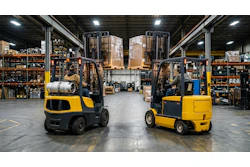

The American Rental Association released standardized carbon reporting guidance to help equipment rental companies measure and report their greenhouse gas emissions. The guidance includes a step-by-step methodology for calculating Scope 1, 2, and 3 emissions, plus a benchmarking database with equipment-specific emissions data to support accurate reporting.
- Two-part solution: ARA provides both a detailed carbon reporting methodology and a GHG estimation database tailored to the rental industry's unique value chain
- Scope coverage: Guidance addresses Scope 1 (direct emissions), Scope 2 (purchased energy), and Scope 3 (value-chain emissions), with equipment lifecycle accounting for roughly 80% of typical rental company carbon footprint
- Industry collaboration: Developed with rental companies, manufacturers, ERA, and other associations to ensure consistency and credibility across North America
- Accessible for all sizes: Resources designed for rental companies of any size to respond to customer, investor, and regulatory carbon data requests without building approaches from scratch
- Multiple formats available: Guidance published in English (imperial and metric versions) and French to serve North American rental market
Increasingly, more and more construction customers, investors and regulators have been requesting carbon footprint data. While equipment rental has been widely regarded as a sustainable model, it's been lacking as a resource to help quantify and explain its weight of the footprint.
That is, until now. The American Rental Association (ARA) has tailored carbon reporting guidance for the North American market. The guidance is available now to help rental companies of all sizes meet sustainability and carbon reporting expectations in a clear, consistent manner.
Equipment rental is widely regarded as a sustainable model. But a common resource to help quantify and explain the industry’s carbon footprint — for the benefit of stakeholders like customers, investors and regulators — has been lacking. Until now.
Recognizing the need for the industry to have a consistent methodology for carbon guidance, ARA worked with rental companies, manufacturers, ERA, and other associations.
Douglas McLuckie, managing director of ESG, Sunbelt Rentals, Fort Mill, S.C.:
“The equipment rental industry plays a crucial role in the construction and other sectors, which is why it needs to be able to deliver the data on carbon footprint to customers and public authorities alike. This guidance helps rental companies do that in a way that is transparent and agreed upon by the whole industry."
Katie Leone, sustainability and social impact senior director, Herc Rentals, Bonita Springs, Fla.:
“Rental companies have lacked a fit-for-purpose way to calculate their carbon footprint. While the GHG [greenhouse gas] Protocol serves as the global standard for emissions accounting, it does not speak directly to how our industry works. In fact, the GHG Protocol’s Scope 3 standard suggests that sector-specific guidance can improve the consistency and quality of emissions reporting within an industry. This new guidance fills that need for North American rental companies.”
Grant Zoldowski, PE, director, environmental management, United Rentals, Stamford, Conn.:
“The ARA carbon reporting guidance provides rental companies with a practical roadmap for estimating and reporting greenhouse gas emissions. United Rentals is proud to have contributed to its development and to support the industry’s transparency efforts, helping stakeholders meet their operational and sustainability objectives."
Mike Wijayasundar, director of rental equipment at Cooper Equipment Rentals, Mississauga, Ontario, Canada:
“We see this initiative as a practical way to help Canadian rental companies respond to growing customer expectations around sustainability. For a midsized company like ours, a common, rental-specific resource can help us provide consistent, credible information without having to build an approach from scratch. It reflects the realities of our industry and supports more informed conversations about equipment choices and environmental impact.”
The New Guidance
The new guidance is built around two essential components:
1. Carbon Reporting Guidance for the Equipment Rental Industry
This methodological report provides concrete and actionable steps for companies embarking on their carbon reporting journey or those seeking to align with industry best practices.
The report lays out a step-by-step method for calculating corporate CO2e emissions in Scope 1 (direct emissions), Scope 2 (indirect emissions from purchased energy) and Scope 3 (other indirect value-chain emissions). The methodology offers detailed guidance, data sources and specific formulas for GHG emission calculations — all designed to specifically address the rental industry’s unique value chain.
“Every industry has its own idiosyncrasies to consider when it comes to GHG reporting, and the rental industry is no different,” Leone says. “The rental value chain is closely tied to the full equipment life cycle: equipment moves from production by OEMs to the rental company, where it may cycle on and off various customers’ job sites, and often has a second life with one or more subsequent owners after resale. These equipment lifecycle stages account for roughly 80 percent of a typical rental company’s carbon footprint, yet they are also the hardest to measure since so much of that usage and end-of-life activity happens outside the rental company’s direct view. This lack of visibility underscores the need for guidance like this, so that rental companies can reasonably estimate their entire emissions profile.”
Access Carbon Reporting Guidance for the Equipment Rental Industry in:
2. GHG estimation database
The project also introduces the ARA benchmark of rental equipment — a database built to provide rental companies with a tool to better estimate GHG emissions from their own equipment when primary data is not available.
The database is built on data provided by rental companies, OEMs (original equipment manufacturers) and environmental analyses detailing emissions data for the most representative equipment in their fleets. “This gives rental companies a baseline for average daily utilization and energy use of their equipment,” says Robert H. Pedersen, president and CEO of A Tool Shed, Inc., in Santa Cruz, Calif., and current ARA board chair.
Pedersen adds that the benchmarking database can benefit rental companies of any size. “As government agencies continue to expand their strict carbon accounting rules, the smaller and mid-sized rental companies will be able to use this tool to accurately answer their customers’ requests for project-specific emissions,” he says.
Leone at Herc Rentals agrees, adding that the guidance supports companies subject to new GHG reporting requirements “like California’s SB 253 and Canada’s CSDS2. For smaller companies currently out of scope, it offers a head start to prepare for future reporting expectations. Beyond compliance, it equips rental companies to have more informed, strategic conversations with customers looking to cut emissions on their job sites.”
“As accurate emission estimation relies on specific equipment data, which today remains elusive, rental companies turn to approximations with a lack of relevant sources. This database addresses this matter by serving as a reference,” McLuckie says.
ARA’s Standard Equipment Taxonomy (SET) schema for categorizing assets for equipment rental companies with a logical product classification system was also used in the development of the new benchmarking tool. ARA SET’s structure for enabling rental companies to share data and make comparisons to like products across the industry helps deliver a benchmark that ensures consistency.
Download the ARA benchmark of rental equipment/GHG estimation database here.
“The benchmarking data published alongside the guidance fills gaps in a rental company’s own data, enabling more comprehensive and accurate disclosures,” Leone says. “For an industry where equipment-specific emissions data has always been hard to come by, having a shared, credible reference point means companies don't need perfect data to start reporting with confidence.”
“By embracing a standardized methodology and leveraging the equipment database, the industry can collectively advance toward supporting and showcasing its sustainability objectives,” McLuckie says. “The guidance outlines clear methodologies for measuring and reporting emissions, thereby encouraging consistency and comparability across the industry. It is designed to be accessible for all rental companies, regardless of size or experience with carbon accounting.”
“We encourage members of the Canadian rental community to use this resource to strengthen customer relationships, support efforts to reduce carbon footprints and help build a more sustainable future for our industry,” Cooper Equipment Rentals’ Wijayasundar says.
Pedersen says the bottom line is that, when used together, Carbon Reporting Guidance for the Equipment Rental Industry and the ARA benchmark of rental equipment can help rental companies respond to carbon data requests and remain competitive. “This establishes voluntary industry guidance that equipment rental companies can use to calculate the emissions of their equipment quickly and accurately, helping them secure bids when asked for their carbon data,” he says.
By combining the carbon reporting guidance with emissions benchmarking, ARA has created a foundation for a transparent and standardized approach toward sustainability reporting within the rental industry.