

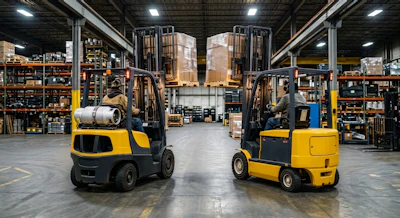
A practical guide to moving a rental or contractor-owned fleet of lift trucks and telehandlers from propane to electric: the benefits of switching and the four variables that determine what size battery the job requires.
So, why switch?
Maintenance. An internal combustion engine needs oil changes, filters, spark plugs, belts, hoses, a cooling system, and exhaust work. An electric drivetrain has none of these components. Electric trucks require less scheduled service and fewer unplanned repairs. In rental service, engine work is also the largest single driver of uptime.
Fuel. Electricity costs less than propane per unit of work performed. On a truck running full shifts, the difference is a measurable cost item in the annual operating budget. On rental units where fuel is billed back to the customer, the same saving shows up as a lower all-in day rate you can quote against competitors.
Downtime. Propane trucks typically need a tank change sometime during a shift. Lithium batteries charge during breaks, so the truck stays in service. On a jobsite, a tank swap also depends on someone having stocked full cylinders that morning.
Infrastructure. Charger upgrades are often funded by various utility, state and federal electrification programs. A construction job site can be served by a mobile energy storage unit.
Safety. Propane-powered engine exhaust gas contains carbon monoxide, which is why indoor work requires ventilation and CO monitoring. Electric trucks remove both requirements.
Sustainability. An electric truck produces no exhaust emissions at the point of use, which improves indoor air quality and removes a direct emissions source from the operation. Depending on the grid mix, it is also a likely way to reduce the CO2 emissions of your operation. Urban jobsites, hospital and school work, and public projects with emissions or noise restrictions increasingly make this a bidding requirement.
None of these arguments are new. What changed is the answer to the next question.
Why Now
Lead-acid technology limits what electric trucks could do. A lead-acid battery has much lower energy density, storing much less energy than Li-ion, and loses cycle life if it is regularly discharged below 40 percent of its rated capacity. Lead-acid batteries were not made to match a propane forklift in energy capacity.
LFP lithium removes that limit. The battery stores more energy, can be safely discharged to 80 percent DOD, close to its full rated capacity, accepts a top-off charge during a break, and is not damaged by multiple partial charging events. One battery covers the truck for its service life.
Cost has also moved. Lithium was a premium product when it entered this market. The first-cost difference against lead-acid is now small enough that lower energy and maintenance costs generally cover it within the first year of operation. For the past two years, lithium batteries have become the best technology at a competitive price. That is the definition of a new default.
Matching Lithium to a Propane Lift Truck
An undersized battery leaves the truck out of service before the shift ends, and an oversized battery adds expense for capacity that is never used. Four key variables determine the right number.
Energy per hour. Manufacturers publish energy consumption for both propane and electric trucks under ISO 23308, the international standard for measuring energy use in industrial trucks. The standard defines a fixed test cycle: the truck lifts its rated load, travels a set distance, lowers the load, and repeats that cycle a set number of times per hour. Because both trucks run the identical cycle under the same conditions, a propane truck and an electric truck of the same rated capacity can be compared directly. Based on advertised OEM specifications, one gallon of propane performs the same work as approximately 4.85 kWh of electricity. That ratio converts propane consumption rate into the electrical energy hourly consumption rate of the replacement truck.
The ratio is derived from counterbalance lift trucks. ISO 23308 also covers variable-reach rough-terrain trucks, so telehandlers sit inside the same framework.
Working hours. Size the battery on hour-meter hours, not shift length. A truck assigned to an eight-hour shift typically records five to six hours of operation. The remainder is idle time, waiting, and breaks. We are basing the calculations on 65 percent of actual working time. To size a battery, work forward from shift length: 8-hour shift × 0.65 = 5.2 hours of metered operation. Rental fleets should size to the hardest job the unit will see, not the average across the fleet. You do not control the duty cycle once the machine leaves the yard, and a unit that fails on a heavy-use rental costs more than the capacity you saved.
Battery age. Capacity declines over the life of the battery. A new battery pack sized to cover a shift on the day it is delivered can fall short later during its warranty period. Sizing to end-of-life capacity ensures the truck is operating reliably during the full shift for the full term of service. For rental, this also protects residual value. A unit that still runs a full shift in year five holds its resale price and stays rentable.
Operating conditions. Most construction work is outdoors, so treat the cold allowance as standard rather than an exception. Cold reduces both the capacity available from a battery and the rate at which it accepts charge, so trucks working open sites in cold climates, refrigerated warehouses, or exposed docks need to add another 15 percent to their battery capacity. Ramp grade and hydraulic attachments raise demand further. Clamps, rotators, and push-pulls draw power on every cycle, and a truck climbing a ramp uses more energy per trip than one working level floor. On construction sites, add unimproved ground and site grades to that list. Both raise rolling resistance and both push consumption above the published figure.
The Conversion Figures
Each row below pairs a propane truck and an electric truck of identical rated capacity from the same forklift manufacturer under ISO 23308, the international standard for measuring energy consumption of industrial trucks.
 ENEROC USA
For example: 5K lb. load capacity, 80V electric sit-down forklift, planned for 5.2 hours metered operation, and warranted end-of-life battery capacity of 70 percent.
5.2 hours × 6.3 kWh/hr (line 2 in the table above) = 32.8 kWh per day
32.8 kWh ÷ 0.70 end-of-life capacity × 1,000 ÷ 80 V = 585 Ah, round up to 600 Ah
What This Means for a Rental Fleet
Charging has to travel with the machine. Every rental agreement needs to state who supplies power and what the site has. A unit rented to a site with no temporary service is a unit that comes back early.
Train the crew, not just the driver. Operators used to swapping a cylinder need to know the charging routine, what state of charge to return the unit at, and who to call. Most early electric rental problems are procedural rather than technical.
There are calculator tools online that help turn these four variables into a battery specification. They'll ask for the truck rated capacity and shift length to return the required battery size in kWh and the equivalent amp-hour rating at your truck voltage.
These online calculators can also estimate annual energy cost before and after the switch. Note: propane and electricity prices default to California averages, so replace them with your own rates for an accurate comparison.
The results are estimates. Attachments, ramp grade, travel distance, and charging setup all affect the final number, so it’s always best to collect real-life data on energy use to size a lithium battery that will reliably power your machines any given day of operation.