
When it comes to commercial flooring, needs are wide and varied depending on the application and location. Durability and aesthetic requirements, application-specific demands, safety contributions and other factors dictate what the final floor must provide. Getting any of those specifics wrong can lead to unwanted consequences: premature repair needs, unexpected operational downtime, and excessive costs are all on the line.
Here’s a look at how a system-based approach, which utilizes the right combination of individual, high-performance flooring components, can have a positive impact on project timelines, flooring performance over time, and overall business outcomes.
Examining Common Polymer Coating Technologies
Before diving deeper into a system-based approach, it can be helpful to understand some of the common polymer coating technologies that are commonly deployed in industrial and commercial environments.
Epoxy systems are often used in manufacturing, warehouses, food processing, and maintenance spaces.
Epoxy Coatings
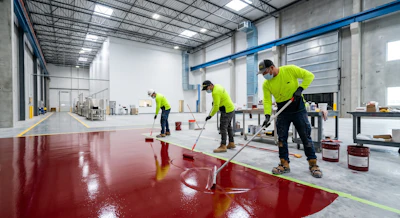
Epoxy coatings are typically two-component thermoset resin systems applied to prepared concrete. They are often used as primers, body coats, high-build coatings, mortar systems, or decorative flake/quartz systems. Epoxy is widely used where the coating needs to bond strongly to concrete and create a relatively thick protective layer. This makes it useful for worn slabs, industrial spaces, and floors that need a seamless, dense surface.
Epoxy systems are often used in manufacturing, warehouses, food processing, and maintenance spaces because they can resist many oils, fuels, cleaners, salts, and process chemicals, depending on formulation. Industrial coating suppliers commonly position epoxy and epoxy-hybrid systems around durability, chemical resistance, and long-term protection. They also typically provide high-impact resistance, making them idea for environments where pallet jacks, forklifts, tool drops, carts, and heavy loads are part of daily operations.
Epoxies have some drawbacks, however. Standard epoxies can yellow, amber, or chalk when exposed to sunlight or strong UV, and for this reason, are often paired with a UV-stable urethane or topcoat in visible or sunlit spaces. Concrete moisture, surface contamination, inadequate profile, or poor mixing can also lead to adhesion failure, bubbles, fisheyes, or peeling.
Many epoxy systems need longer cure windows than acrylics, MMA, polyaspartics, or some urethane systems. Return-to-service timing depends heavily on temperature, film thickness, and formulation.
Like epoxy, urethane performance depends on proper concrete preparation, moisture evaluation, and compatible primers.
Polyurethane Coatings
These are another resinous system, but they are usually used as thinner, flexible, abrasion-resistant topcoats. Polyurethane topcoats generally hold color and gloss better in spaces with sunlight or glass exposure compared with epoxies and are often used as protective wear coats over epoxy because they can improve scuff resistance, gloss retention, and cleanability.
Compared with standard epoxy, polyurethane can also better tolerate minor substrate movement, thermal expansion, and vibration. Finish quality is another plus, as polyurethane topcoats can provide matte, satin, or gloss finishes and often improve stain resistance and ease of cleaning.
Polyurethanes are often not the best standalone build coat because they are applied thinner than epoxy and are commonly used as topcoats rather than the main body of the flooring system. Like epoxy, urethane performance depends on proper concrete preparation, moisture evaluation, and compatible primers. Elsewhere, the chemical resistance profile of polyurethanes may differ from epoxy. While good performance is possible, it typically depends on the specific project conditions.
Acrylic coatings generally do not provide the same abrasion, impact, or chemical resistance as epoxy or polyurethane systems, making them better suited for lighter-duty application.
Acrylic Coatings
Acrylic coatings are usually water-based or solvent-based single-component coatings. They form a protective film faster and more simply than two-component resinous systems, but they typically do not match epoxy or polyurethane for heavy industrial durability.
Acrylics are generally easier to install, often with less specialized labor and shorter downtime. They can improve color, dust control, cleanability, and visual appeal on concrete surfaces. Meanwhile, many acrylics handle sunlight better than standard epoxy, especially in decorative or exterior-adjacent applications.
However, acrylic coatings generally do not provide the same abrasion, impact, or chemical resistance as epoxy or polyurethane systems, making them better suited for lighter-duty application. They may also require more frequent recoating, especially in high-traffic commercial or industrial areas.
 APF Polymer
Meeting The Varied Needs of Commercial Flooring
A system approach begins with clearly defining the optimal end-user outcome and experience, rather than shoehorning in a specific product technology before those needs have been established. And to understand some of those varied needs, it can be helpful to explore some examples.
Consider: Many critical industrial environments require the deployment of flooring with optimized electrostatic properties. These applications might include electronics and manufacturing spaces, environments with dust or explosion hazards, clean rooms, pharmaceutical facilities, and others where incidental electrostatic discharge can cause catastrophic damage to infrastructure and products, or worse, a major safety hazard to staff and personnel.
These needs must also be balanced with other critical attributes including abrasion and scratch resistance, ease of cleaning, and chemical resistance. Oftentimes, balancing each of these requirements necessitates a system-based approach, as opposed to a single general-purpose floor coating.
For commercial and industrial flooring projects, a system-based approach...can help professionals best meet the needs of demanding flooring applications.
These outcomes aren’t the only thing that matters when it comes to specifying the right commercial flooring system. Operational considerations will also influence which system components will be deployed. For example, some operations can’t be shut down for several days while the flooring project is complete. A hospital, for instance, with its critical operational nature and highly trafficked environment, will require a fast-curing system with low-lingering odors to enable a fast return to service. Many commercial food and beverage operations come with similar considerations and concerns.
At the other end of the spectrum, many commercial and residential architectural applications (consider casinos, hotels, multifamily housing and high-rises) prioritize aesthetic styling to differentiate these interiors from the competition. Here, for example, an architect may specify an epoxy terrazzo coating for its aesthetic appeal. This must be combined with a compatible sealer to retain gloss and provide optimal wear protection.
A System-Based Approach in Action
What does a system-based approach to commercial floor projects look like in practice? In many commercial and industrial projects, the best system is not just one resin. Some potential system combinations can include the following.
- Epoxy primer/Body coat + Broadcast aggregate + Polyurethane topcoat = This system offers the concrete bond and build of epoxy, the slip resistance of aggregate, and the UV/scratch/gloss performance of urethane. It’s a common combination found in warehouses, corridors, labs, schools, health care support spaces, and manufacturing areas.
- Cementitious urethane base + Optional epoxy/urethane finish = This system is better for wet processing, food/beverage, hot washdown, thermal shock, or slabs with elevated moisture vapor.
- Acrylic sealer or acrylic coating = This system can be ideal for light-duty or budget-sensitive applications, when the goal is dust control, easier cleaning, and improved appearance rather than heavy industrial protection.
For commercial and industrial flooring projects, a system-based approach, taking into account the end-use requirements and outcomes before choosing a specific product, can help professionals best meet the needs of demanding flooring applications.
What’s more, working with a collaborative supplier to source high-performance coating technologies can deliver greater benefits over the long run. For professionals, it’s an approach that can pay.