Water is one of the concrete industry's most valuable resources. Whether driven by rising utility costs, sustainability initiatives or local water restrictions, concrete producers are under increasing pressure to evaluate how water is consumed across their operations. Usually, water management efforts focus on obvious areas of consumption such as aggregate washing, truck washout, equipment cleaning or water recycling programs. These consume significant amounts of water and often represent the first opportunities for conservation. As a result, many producers have already invested considerable time and resources on improving water efficiency within these areas.
However, one area that is frequently underestimated is the relationship between dust collection and water management. Dry dust collection technologies can significantly reduce water usage at concrete operations by minimizing the need for water-based dust suppression while also recovering valuable materials that would otherwise become waste. The opportunity to rethink how water is used for dust control extends beyond traditional concrete plants. Mobile and portable plants operating at jobsites face the same dust control and water management questions, often without reliable access to plant infrastructure. Many of these sites rely on wells or hauled water, which means every gallon used for dust control is a gallon drawn from a limited, harder-to-replenish supply. By looking beyond traditional water management strategies, producers may discover an opportunity to conserve one of their most valuable resources while strengthening overall plant performance.
Comparing Wet Suppression to Dry Dust Collection
Dry dust collection systems capture airborne dust before it can escape into the environment. Using strategically placed pickup points, ductwork and engineered airflow, these systems collect particles as small as 0.5 microns at key points throughout the production process, such as material transfer points and loadout areas, and transport it to a centralized dust collector.
Inside the collector, contaminated air passes through filter media (cartridges or bags) that remove dust from the airstream. Then, clean air is returned to the facility while dust accumulates on the filter media. An automated cleaning system periodically removes dust from the filter media, allowing it to fall into a hopper for disposal or recovery. Some materials can be recovered and returned to the production process, helping improve efficiency.
Properly engineered dry dust collection systems are particularly effective in enclosed processing areas, where they can capture very fine airborne particles without the need for water-based dust suppression. This drastically reduces the amount of water associated with dust control, especially with typical water spray rates reaching anywhere between two and eight liters per minute per nozzle, according to the National Institute for Occupational Safety and Health.
 C&W DustTech
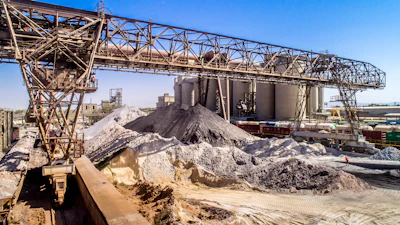
Wet dust suppression, by contrast, is a dust control method that uses water (typically applied as a fine spray or mist) to help prevent dust from becoming airborne and to knock down any airborne particles. Across concrete operations, it can be an effective solution for open, exposed or mobile areas where dust is generated over a broad footprint rather than at a defined process point. Common applications include aggregate stockpiles, unpaved roadways, truck traffic areas and outdoor material-handling zones. Wet suppression is particularly effective for larger dust particles, generally in the 30 to 200 micron range.
Wet suppression has an important place in many operations, particularly in open areas where a dry collection system isn't practical. At stationary concrete plants, this can mean stockpiles and roadways where wind, vehicle traffic and material movement generate diffuse dust across a wide area. The same holds true for mobile and portable operations, where temporary stockpiles, shifting traffic patterns and exposed material-handling activities can make fixed dust collection difficult to justify.
Beyond a straight water spray, some producers also use foam-based suppression or chemical binding agents that help fine particles adhere to larger ones, which can reduce the volume of water needed to get the same result. The right choice still comes down to matching the method to the application.
Rather than viewing dry dust collection and wet dust suppression as competing technologies, the most effective concrete operations often use each where it delivers the greatest value.
Impacts of Wet Suppression Systems
Wet dust suppression may not be ideal for every environment, especially as restrictions related to water usage continue tightening. Because these systems rely on a continuous flow of water through pumps, piping and nozzles, they introduce unwanted moisture throughout the production process.
In production areas where raw materials and finished product are designed to remain dry until batching, excess moisture creates real operational problems. Water introduced into aggregates can alter moisture content, making it more difficult to accurately proportion mix designs and maintain consistent concrete quality. In more extreme cases, such as water reaching a cement storage silo, the material can't be recovered, and the cleanup that follows can take a line out of service for days.
Use of wet suppression methods may also contribute to valuable materials becoming waste. When water is sprayed on concrete or other fine powders, it can no longer be recovered for reuse.
Regulatory exposure is often less about how much water a site draws than about where that water ends up. Many concrete operations run on well water, which typically isn't metered the way municipal supply is. This means intake draws less scrutiny. What regulators do track is how water leaves the site — either through surface runoff or seepage into groundwater. Evaporation is usually the simplest way to keep that in check. Adding more water for dust suppression means managing that much more water on the way out. At sites already working to limit runoff or seepage, wet suppression can create as many compliance headaches as it solves.
A Smarter Approach to Water Conservation
As concrete producers continue looking for ways to reduce water consumption, dust control deserves a place in the conversation. The right strategy isn't simply choosing wet suppression or dry dust collection. It's understanding where each technology delivers the greatest value. That comes down to how a given product and process interact with water. Concrete makes the case well: cement and aggregate need to stay dry until they're mixed for delivery, so any moisture introduced upstream is a liability, not an asset. Compare that to an industry like metal mining, where crushing and conveying exist specifically to reduce ore to a size that can be mixed into a slurry for chemical separation. There, water is part of the process, not a threat to it. That difference is exactly why dry collection deserves the bigger role in concrete operations.
By engineering dry dust collection systems to contain dust where it can be captured and reserving wet suppression for the open, exposed applications where it's most effective, producers can reduce water usage, recover valuable materials and improve overall plant performance. Viewed as part of a broader operational strategy, dust collection becomes more than an environmental investment. It becomes an opportunity to increase efficiency, reduce waste and strengthen the long-term sustainability of the entire operation.