Rental companies have traditionally been seen mainly as temporary equipment providers. This perception has changed as leading vendors position themselves as technology partners that help contractors manage risk, reduce costs, and improve performance across fleets and projects.
Through offerings such as digital worksite management platforms and connected jobsite solutions, these providers stay engaged with customers from preplanning to project closeout. That ongoing involvement creates opportunities to deliver measurable value at a time when skilled labor shortages, increasing project complexity, and tighter timelines are driving the need to maximize productivity and efficiency.
The result for vendors is expanded revenue streams, broader and deeper relationships with customers, and more repeat business.
Telematics as a Gateway to Premium Services
Telematics is the entry point for many rental companies looking to modernize their value proposition.
Data points make it easier for customers to right-size and right-type their fleets and make smarter rent vs. buy decisions.
By renting telematics-enabled equipment, vendors give customers the ability to track real-time location, engine status, fuel or battery status, equipment health and utilization. Managers can open a single dashboard and instantly see which machines are working, which are sitting idle, and where high-value assets are located across multiple jobsites. These data points make it easier for customers to right-size and right-type their fleets and make smarter rent vs. buy decisions.
Telematics also lets customers create geofences around equipment to enhance safety and security. Geofencing alerts notify managers when equipment moves outside a designated area or off the jobsite. Low-fuel alerts help prevent unexpected downtime.
With sizable capital and extensive fleets, rental providers can standardize telematics across hundreds of thousands of mobile assets. Installing after-market telematics devices on customer-owned equipment lets them extend connectivity so customers can track owned and rented equipment from multiple manufacturers using one fleet management platform.
Cloud-based Platforms as a Sticky Service
Large vendors have the scale to build or license robust worksite management platforms that serve as the digital front door for customers. These platforms typically combine ordering, off-renting, cost allocation, telematics insights and custom reports in one system.
When rental platforms share data seamlessly with third-party tools, they function as extensions of the contractor’s existing tech stack, improving data consistency and reducing double entry.
Contractors benefit from increased visibility, fewer logins, and streamlined workflows for their field teams and back office. For rental providers, the platform becomes a revenue generator when it supports connected jobsite solutions and managed-service offerings such as utilization benchmarking and environmental monitoring.
Cloud-based fleet management platforms with open architectures and application programming interfaces (APIs) provide even more value by giving customers the option of exporting data to the software platforms they already rely on, such as project management software, fleet management software, enterprise resource planning (ERP) systems, maintenance software and accounting platforms. When rental platforms share data seamlessly with third-party tools, they function as extensions of the contractor’s existing tech stack, improving data consistency and reducing double entry.
 Remote environmental monitoring and control systems help contractors reduce manual oversight of climate control equipment.United Rentals
Connected Jobsite Solutions, Improved Outcomes
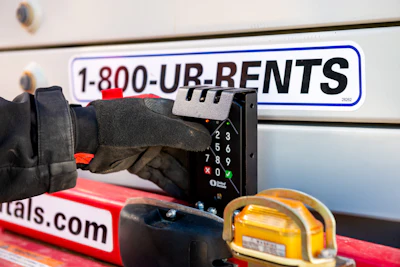
Rental companies can leverage their scale to offer connected jobsite solutions that increase visibility, automate tasks and solve emerging customer needs. Examples of innovative solutions include smart turnstiles for jobsite access control, badge-based equipment access management, automated tool tracking and inventory management systems, AI-powered visual intelligence systems and remote fuel tank and load bank monitoring.
These solutions, supported by a robust software platform, reduce repetitive manual labor and deliver other measurable outcomes that customers are willing to pay for, such as fewer safety and security incidents, curtailed tool loss, reduced downtime and less rework.
Remote environmental monitoring and control systems that include sensors, add-on devices and customizable dashboards help contractors reduce manual oversight of climate control equipment and slash fuel costs.
Data-driven Maintenance for Increased Uptime
Rental providers of telematics-enabled equipment are in a strong position to use their fleet management platforms to protect uptime for key customers. Access to engine hours, run time, fault codes and alert histories enables targeted preventive maintenance and more efficient dispatching of technicians. Customers see fewer surprises on critical work and can plan outages rather than react to breakdowns.
Rental providers can also leverage telematics data and preventive maintenance experience to offer managed maintenance and inspection programs for customer-owned equipment. These programs help prevent untimely equipment failure and improve maintenance cost control.
Some rental providers are layering generative AI applications on top of telematics data to help diagnose issues more quickly and shorten repair cycles.
 AI tools can reduce the complexity of renting equipment and improve equipment planning.United Rentals
AI for Stronger Customer Service
Artificial intelligence is becoming another important differentiator for rental providers. Some rental companies are investing in AI tools that reduce the complexity of renting equipment and improve equipment planning.
Well-trained AI-powered customer service agents simplify the selection process.
Customers often struggle to identify the exact type or model of equipment needed to perform a task. Inadvertently renting a machine that can’t reach required heights, dig to required depths, fit through jobsite doorways or function safely on jobsite terrain can reduce safety and productivity, create delays and generate extra charges if equipment exchanges are necessary.
Well-trained AI-powered customer service agents simplify the selection process by answering detailed equipment questions, comparing models and recommending equipment based on project requirements and jobsite conditions. These systems can provide around-the-clock assistance while freeing rental specialists to focus on more complex customer needs.
AI tools can also uncover patterns in customer requests that inform new services. Over time, these digital assistants become a core part of a scalable customer experience that supports retention, cross-sell opportunities and revenue growth.
Technology as the New Competitive Edge
Contractors facing tight schedules, thin margins and labor shortages increasingly value partners who can help them see more, plan better, decide faster, reduce waste and improve project outcomes. By layering technology solutions and services onto their core offerings, rental providers can strengthen customer relationships, create new revenue streams and compete on value rather than price alone.
As construction and industrial companies advance their own digital transformations, expectations for rental providers will continue to evolve. Vendors that invest in technology-enabled offerings can position themselves not just as equipment providers but also as trusted advisors who help customers run leaner fleets and get jobs done more safely and profitably. Over time, the return on these investments can far exceed what a rental fleet alone could deliver.