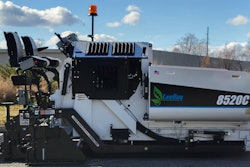


During CONEXPO/CON-AGG 2023, I had the chance to sit down for a one-on-one interview with the head of one of the largest heavy-equipment manufacturers on the international stage for construction, and more specifically, for the road building industry: the Fayat Group. The company wields the collective paving power of two well-known, established brands — Dynapac and BOMAG. Each had their own standalone booths at CONEXPO, across an aisle, distinct in branding and in offerings, with an impressive show collective of construction machine muscle.
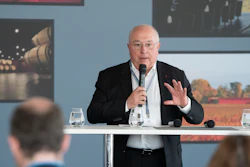
When I was introduced to Mr. Fayat for the first time, it was midway through the tradeshow an dhe was friendly and seemingly in high spirits. We went to a conference room at the BOMAG booth, and sat down at the end of a long table. Here is a glimpse of our conversation about the future of the industry:
Interview
Brandon Noel, Editor, Asphalt Contractor Magazine
Mr. Fayat, it's so nice to meet you today. I was wondering if you could talk to me about the future of the Fayat group? What do you see as the next 10 years?
Jean-Claude Fayat, CEO, Fayat Group
This is difficult this question because you know that the economy is changing so fast. You rarely know what the next year's going to be, because at the end, you always depend on the economy. You can have your own strategy, but for growth, it depends on the economy. So, it's difficult to answer to this question. What I can tell you is that in the group, we have two big types of businesses. The first is equipment, that's why we are here [at CONEXPO / CON-AGG 2023]. But we were born like this contracting company, in France. So, we're here to speak more about equipment, and present worldwide our strategies to expand our markets. As you know, we have two big bases in our equipment network: Europe and the United States.
Noel
I'm always curious, because I don't have a lot of insight into the Euro market; what do you see as the biggest differences between the American market and the euro market?
Fayat
It depends on the equipment, so on some equipment there are big differences. And you cannot sell the same equipment in Europe as you're selling in the U.S. and I'm talking about road building. If I take the case, for example, of milling machines, or even single drums, they are nearly the same as the products that we're selling in Europe that we're sitting in the U.S., but if I take the case of pavers, for example, it's quite different.
But to come back to your first question. Our intention is really to expand our business in the U.S., because we think that we have a product range, and, now we see our sales network has to increase in this market. Before, we weren't ready to expand our business in the U.S.
You asked me, "What is my vision of the next 10 years?", and I told you , "I don't know," because I am not so sure that even economists can tell you with much to an extent, but my intention is to balance better our business between Europe and the U.S. Because normally in our business, the two economies are often not doing the same thing at the same time. So, it makes sense to balance a bit more as a business.
Noel
I saw the RoboMag the other day, it caught my eye. It's a striking design. It made me think about how gradual change is hard to notice, and most of the things in the construction world, the gradual changes, are little improvements on this machine, or a little upgrade on that machine. It's hard to really notice as you're working in the industry, where those changes are and how they are coming. What do you think is the next big leap for road building? Is it pure automation? Is it electrification? Or what else might be the next evolution?
Fayat
Today, we will have two big evolutions, or, perhaps, even revolutions in the road building equipment business. One will touch decarbonization, and the other one will touch digitalization. We will have to answer these two big questions, and we are working on these two big questions. The machine that you mentioned, it's still a proof, a concept. I mean, it's not a machine that we're sending out to them right now. It works, but first of all, it's costly, and secondly, it will not be accepted on the jobsite today. So, it's just to show that we can do it.
For example, when you are in the Formula One (industry), you wouldn't sell a Formula One to just normal drivers, right? No. But you use techniques that you develop at that level, like for the Formula One, and then it makes its way down to the normal cars. That's what we have to do on our in our business. We will use some techniques that we are using on these machines to create more digitalization on our equipment, and to help the operators at the end.
What will happen in the future is that, first of all, it's difficult to drive these types of machines. It's many things to control. It's so many different areas demanding the drivers attention, so we want to decrease that, in order to make the life of the operator easier. And this is also because the contractors, the employers, have more and more difficulties finding qualified drivers.
Noel
There's always the workforce shortage problems. We hear about it all the time. I think that having the "proofs of concept" will drive demand for these types of advances, because the contractors will see it and they'll want to have access to things that will help them overcome those shortages in different ways.
You brought up decarbonization, and it made me think about the National Asphalt Pavement Association's (NAPA) huge push to decarbonize the industry by 2050. And the initiative has lots of partners with the private sector trying to make this happen. However, I keep coming back to a really central question.
OEMs in the road construction business have historically been tied to the petroleum industry, yet must also serve the interests of the corporation and, perhaps, even shareholders, while also wanting to be green and sustainable, even if only by perception. What responsibility does Bomag and other manufacturers in our industry have towards environmental justice?
Fayat
I think that this is a responsibility of the industry to answer these questions, and to be better on the governmental aspects. Of course, we have to follow the rules, that are different in every state. The requirements are not the same in California and Illinois, for example. First, we have also to follow these rules, but this is for me, a real duty to be involved for the climate, and to bring a greener product to the markets. We've been working on that a long time, because I see this as, also, our duty as a company to work like this.
Noel
I think that's right, but governments are often a lot slower than business. Technology outpaces our ability to really grasp it, and it often outpaces a government's ability to legislate and regulate to it. What I would love to see is business, outpacing the laws, too, and be ahead of the requirements.
Fayat
When it comes to decarbonization, our business is sometimes ahead of the requirements of the politics. Many people inside our industry feel responsible to be in front of that, and also, we see that as an opportunity. Because you have two choices: You resist and say, "I don't agree, I deny it exists," and so on. Or you say, "We have a problem, and this is my responsibility, at my level, to solve the problem." And then it is no longer a problem, at all. Now, we see it as an opportunity.
Making The Future Make Sense
The big takeaways from this conversation boil down to two things. The first is how cautious the industry remains following the early years of the pandemic. In many ways, the governments of the world have publicly moved on, encouraging their people to do the same. However, the real indicator is how the "money" acts in a given time. Industry is still acting with this great deal of reserve, being extra careful and deliberate in their moves. To a certain extent this tells us that they aren't ready to rule out any sort of regressive periods that could spring up suddenly. No one wants to be the company that gets caught unprepared.
Another aspect of this caution comes from the way that the global supply chain weakness was exposed during the same period. For example, during AEM's CONEXPO press conference about the state of the organization, I asked the association leadership about what lessons were learned from the COVID-19 pandemic, that have directly led to changes in preparedness for its members.
Rod Schrader, Chairman & CEO Komatsu North America, responded, "Before the pandemic we didn't really consider the supply chain as a risk factor," he said. "Now we do."
Secondly, the industry leaders see that sustainable endeavors are meaningful, but that doesn't mean they are ready to commit. The technology has come far enough to mass produce alternative fuel versions of their popular machines, however, it isn't at the state where anyone is ready to commit to stop production on traditionally fueled vehicles.
That may sound too radical a move, but given the current state of the international scientific community's outlook on global warming, the free-market's gradual transitions may be too slow. Though construction vehicles only account for about 7% of carbon emissions in the United States, it's really about a game of idealogical "chicken". Some states like California and New York have already set deadlines where traditional vehicle sales will be prohibited. As Mr. Fayat indicated, the law is still leading the way for business. What could prove an effective shift, would be a large industry leading OEM stepping forward and drawing a bold line in the sand, announcing the end of their development of what is "old tech".
The burden is on OEMs to show that sustainably fueled machines are a better option for their consumers. Not just a better option for the environment, but that, dollar-for-dollar, contractors will save money. The burden of evidence rests on the manufacturers. Of course, the pessimistic outlook of this situation would be that chaining existentially necessary change to bottom lines might ensure no change happens at all.
If someone came to market today arguing for the return of animal based lubricants or fuels, no one would take them seriously. We need to consider what the real motivations are at the center of our loyalty to diesel. Familiarity? Sure. Reliability? It's a century-plus old technology, yes. But who would be caught running their business on 20-year-old computers, much less 100-year-old technologies? The biggest hurdles for adoption are two-fold: cost and uncertainty.
Business owners may want to adopt alternative fuel vehicles, but the cost is prohibitive. At the end of the day, they have to make decisions for the survival of their company and the employees, as well as their families, that they take care of.