

The AI boom is framed as a race for chips, power and land. On the ground, it’s a construction problem.
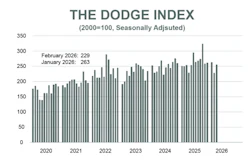
Data centers have become one of the fastest-growing construction categories, fueled by hyperscaler expansion, AI infrastructure investment and a project pipeline of unusual scale and urgency. U.S. data center construction starts reached $77 billion in 2025, up 190% year over year. In AGC's 2026 outlook, data centers ranked as the fastest-growing construction category, with a net 57% of contractors expecting spending to rise.
Contractors are feeling that pop. The question is whether the construction industry can absorb it.
Most of the conversation about the surge focuses on the obvious constraints: power availability, land, permitting, and skilled labor. The numbers back that hypothesis. JLL reports vacancy has held at 1% for a second consecutive year, with 64% of capacity under construction now in frontier markets. CBRE notes that site selection is increasingly driven by developers' ability to secure 300+ MW of deliveries in under 36 months. But before any of those downstream constraints become a factor, someone has to price the job accurately enough to pursue it. That is where the industry's operating system starts to break down.
The First Chokepoint in the AI Infrastructure Boom Is Preconstruction.
The core issue is one of supply and demand. The volume of data center projects hitting the market simultaneously is unlike anything the construction industry has absorbed before. The firms that do the estimating and bidding for these projects (the preconstruction teams) have not scaled to match that volume. That gap is the problem.
According to JLL's 2026 Global Data Center Outlook, average construction costs hit $10.7 million per MW in 2025 — up from $7.7 million in 2020 — with another 6% increase projected for 2026. As costs climb, so does the penalty for getting the estimate wrong: either you underprice the job and eat the difference, or you overprice it and lose to a competitor who submitted a tighter number. Neither outcome is good. At this scale, the margin for error is essentially zero.
Meanwhile, estimating teams are not growing fast enough to keep up. These are skilled roles that require deep technical knowledge across mechanical, electrical, plumbing, structural, civil and utility scopes. Labor shortages across the construction sector are well-documented and show no near-term signs of easing. The result is a capacity problem: too many high-value, technically demanding bids, and not enough qualified people and time to price them accurately.
When estimating capacity becomes the binding constraint, the market reacts in ways that compound the problem. Contractors who cannot confidently price a complex job on the required timeline pass on the bid entirely — and every firm that walks away removes competitive pressure from the market. Fewer submissions means less price tension, less comparison of assumptions, and ultimately less incentive for costs to stay honest.
The bids that do get submitted carry more embedded risk. Rushed teams working from incomplete scope visibility widen margins to cover what they can't see. At $10.7 million per MW, even a modest contingency buffer represents millions of dollars of embedded cost that has nothing to do with the actual work. That is not recklessness — it is rational self-protection. But rational self-protection, aggregated across dozens of projects, is structural inflation.
And even when a project moves forward, poor visibility at the estimating stage creates downstream friction. Incomplete takeoffs generate rework (revise, clarify, rebid, realign, repeat) before a single foundation is poured. Time lost in preconstruction is time lost on an already compressed schedule. Each of these behaviors is individually defensible, even rational. Taken together, they make the buildout more expensive than it needs to be.
The market's answer to this problem is to move faster. But speed alone does not solve a capacity problem; it just accelerates the errors. What the preconstruction bottleneck actually demands is the ability to absorb larger volumes of work without sacrificing the accuracy that makes a bid credible in the first place.
This is where AI-assisted takeoff and estimating tools change the equation. When a contractor can process more opportunities at the same level of precision — quantifying scope quickly, flagging risk early and producing a credible number without burning the team — the tradeoff between speed and accuracy no longer feels like a tradeoff. Firms can chase every high-value bid they want to pursue. They can compete on complex jobs without over-padding their margins to cover uncertainty. Skilled estimators get redirected from manual quantity extraction to the higher-judgment work that actually requires them.
At Beam.ai, 45% of projects processed on our platform over the past year were in site and structures work: concrete, rebar, civil, and steel, the scopes that form the foundation of every data center build. That volume is not going to decrease. The pipeline is too large, the schedules too compressed, and the stakes too high for the industry to keep relying on manual processes at the top of the funnel.
The data center buildout is exposing a truth the construction industry has understood for years: you cannot scale what still depends on too many manual hours upstream. The irony is not lost — the same technology driving unprecedented demand for physical infrastructure may also be what allows the industry to meet it. The firms that win the bidding competition will be the ones that can understand scope, quantify risk, and submit a confident number before everyone else.