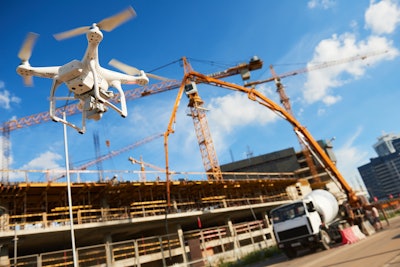
When first introduced, drones or unmanned aerial vehicles (UAVs) were mostly used for capturing photos and video. Today, they have become increasingly popular for everything from surveillance and disaster management to crop monitoring and building inspections.
They can also provide valuable insights for concrete and asphalt applications for commercial and residential jobsites, road work and bridge construction — and improve efficiency.
Drones offer contractors the advantage of cost and time savings compared to manually performing duties involved with concrete and asphalt jobs, such as data capture for prepping and pouring or laying, along with monitoring progress. They can also provide a competitive advantage when it comes to bidding on projects since contractors can complete work faster with the assistance of drones. Manually collecting data could take days to complete, while it can be done in hours with a drone. This technology is also more accurate, since it eliminates human error associated with capturing data, interpreting it and writing field reports.
For contractors new to drones or those who may be reluctant to purchase one, rental solutions providers can assist. Rental allows contractors to try out the latest technology through a business operating expense as opposed to a capital investment. It also places the responsibility of service and maintenance, along with drone registration and compliance, on the rental provider. The rental provider can assist in training concrete and asphalt contractors on proper and safe drone usage and provide guidance and training resources to complete FAA Part 107 Certification Exam. This certification verifies that the contractor understands basic flight operations and has a clear understanding of airspace regulations and emergency procedures.
 Inspection footage from a 3D digital twin. gNext
Putting Drones to Work
For concrete and asphalt applications, drones provide real-time data throughout the process that can also be shared with other stakeholders on the project. Drones equipped for LiDAR (or Light Detection and Ranging) or photogrammetry can accurately collect raw data related to ground conditions during pre-work inspections and surveying, identifying various ground levels, elevations, vegetation and potential worksite hazards.
Using data processing software, concrete and asphalt contractors can transform raw data into valuable and actionable tools such as orthomosaics, 3D models and elevation maps. Combined, this information provides the basis for accurate ground preparation. These insights help contractors identify and correct any mistakes prior to pouring the concrete or laying asphalt, ensuring high-quality results and saving them time and money by avoiding rework later. It also saves labor by minimizing the number of team members required on a jobsite.
 A Skydio X10 UAV.Skydio
Once the correct groundwork has been verified, contractors can rely on drones for pre-pour or pre-lay inspections. Drones can provide survey grade accuracy for measurement and can identify the correct placement of rebar, forms and sleeves prior to concrete pouring. Some data processing software has concrete-specific AI that can identify placement discrepancies prior to pours, providing contractors with detailed reports that allow them to make informed decisions to rectify any problems.
Along with site work and monitoring, contractors can use drones for inventory management, tracking stockpiles to determine the materials available. This can be done with LiDAR or photogrammetry to gather the data, then the contractor can process that to create volumetrics reports to calculate square footage and cost and track changes over time. Consistent and accurate reporting reduces errors from manual estimations and leads to better financial reporting and material tracking.
 Aerial view of a construction site via a Skydio X10 UAV.Skydio
Creating a Safe, Secure Jobsite
While drones offer the advantage of time and cost savings, they also play a vital role in helping create a safe job site. They can provide remote access to potentially hazardous areas so that contractors and their teams can assess and monitor them virtually and minimize the need to work at heights.
Drones can also help maintain a secure jobsite by monitoring activity during off-work hours. Some contractors have begun using drones that are housed and charged on a dock. With the proper waivers, they can remotely fly the drones or the drone can autonomously fly the jobsite. Some drones have unauthorized person detection capabilities that can identify individuals who should not be on the site, which minimizes or even eliminates the need for security personnel to monitor the site. Contractors must obtain a beyond-visual line of sight (BVLOS) waiver to execute these flights, which can be scheduled to fly preprogrammed flight patterns.
The Next Project
Drones are just one tool within the construction process; however, there is significant value that can be gained from them. Understanding and defining the outcomes that the contractors want is the most important way to be successful with this technology. The data obtained from drones can help concrete and asphalt contractors refine project planning in ways that are beneficial to bidding and executing new jobs by applying learnings from previous ones. They have the data and reports to reference digitally to identify where mistakes have been made and to look at the best practices they implemented.
To ensure efficiency when using drones for current and future projects, it is imperative that communication between all parties involved is clear and consistent. The data that a drone captures can be used to inform decision making throughout the project — but only if it is visible to everyone.