Walk onto a modern construction site and you'll still see the familiar sights that have defined the industry for generations — tower cranes stretching across the skyline, skilled trades coordinating complex work, and heavy equipment moving enormous volumes of material. Yet beneath those familiar scenes, a fundamental shift is underway. Construction sites are becoming some of the most data-rich environments in the industrial economy.
Artificial intelligence, connected sensors, drones, robotics and cloud-based software are changing far more than how projects are documented. Together, they are creating jobsites that can monitor themselves, identify inefficiencies in real time, improve safety and help contractors make better decisions while work is still underway. Instead of relying on yesterday's reports or weekly progress meetings, project teams increasingly have access to live operational intelligence that allows them to respond before small issues become major delays.
This evolution couldn't come at a better time. Contractors are being asked to deliver increasingly complex projects while navigating labor shortages, tighter schedules, rising material costs and growing expectations around sustainability. Experience remains invaluable, but it becomes even more powerful when paired with real-time data.
Construction is Finally Becoming a Connected Industry
For years, digital transformation in construction focused primarily on documentation. Paper plans became digital plans, clipboards became tablets, and project files moved into the cloud. Those were meaningful improvements, but they largely digitized existing processes rather than changing how work was performed.
Today's technology is different because it allows the jobsite itself to become connected.
A network of cameras can continuously monitor progress. Drones map large sites in minutes and compare actual construction against BIM models. Equipment telematics report utilization and maintenance needs automatically. Environmental sensors monitor dust, vibration, temperature and air quality. AI-powered software brings all of that information together, identifying trends and highlighting issues that might otherwise go unnoticed.
The real breakthrough isn't any single technology. It's that these systems are beginning to work together. Instead of every superintendent, project manager and subcontractor operating from separate pieces of information, intelligent jobsites create a shared operational picture that allows teams to anticipate problems rather than simply react to them.
Artificial Intelligence is Becoming Construction's Operational Brain
Much of the public conversation around AI focuses on automation and job displacement. On construction sites, the opportunity is far more practical. Artificial intelligence excels at recognizing patterns across enormous amounts of information — something every major construction project generates every day.
Thousands of photographs, equipment readings, delivery records, inspection reports and sensor measurements would overwhelm even the most experienced project team if they had to analyze everything manually. AI can review those inputs continuously, identify anomalies and direct human attention toward the issues that actually require judgment.
Rather than replacing experienced construction professionals, AI allows them to spend less time searching for information and more time solving problems. As labor shortages continue to affect nearly every trade, that may prove to be one of the technology's greatest contributions.
The Biggest Opportunity May Be Hidden Inside the Dumpster
One of the most overlooked examples of the intelligent jobsite is also one of the least glamorous: construction waste.
Historically, waste management has operated almost entirely outside the flow of project intelligence. Materials enter a dumpster, a hauling company removes the container, and very little information exists about what was discarded, whether it could have been recovered or how much value was lost along the way.
Major commercial projects — particularly data centers, manufacturing facilities and distribution hubs — generate enormous quantities of packaging materials before the building is even operational. High-value equipment often arrives on custom hardwood pallets wrapped in cardboard, plastic and metal supports. Much of that material is recyclable or reusable, yet it frequently ends up in landfills simply because no system exists to identify and separate it efficiently.
This is where artificial intelligence is beginning to change the conversation.
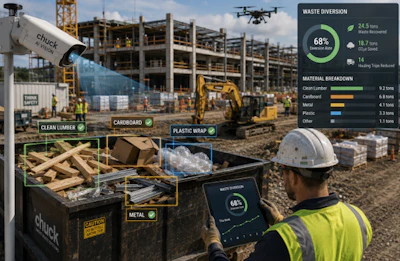
Computer vision systems can identify wood, cardboard, metals and plastics before they enter the waste stream. Smart containers report fill levels automatically, reducing unnecessary hauling trips, while cloud-based dashboards allow contractors and owners to monitor diversion performance across multiple projects.
The benefits extend well beyond sustainability. Better waste visibility reduces hauling costs, improves site logistics, minimizes truck traffic and provides owners with increasingly valuable documentation around embodied carbon and material recovery.
In a recent discussion about large-scale data center construction, I described construction waste as one of the industry's biggest blind spots. While owners are becoming increasingly sophisticated in measuring embodied carbon associated with building materials, far less attention is given to the enormous volume of packaging and construction waste generated throughout the project. Yet today's computer vision and image recognition technologies already provide practical tools for dramatically improving diversion rates.
Intelligence Creates Better Projects
The conversation around intelligent construction often focuses on individual technologies — drones, robotics, AI or sensors — as though each exists independently. In reality, their greatest value comes from integration.
Imagine a drone identifying slower-than-expected progress in one area while equipment data shows excessive idle time, material tracking reveals delayed deliveries, and waste monitoring reports unusually high disposal volumes. AI can connect those independent data points and identify a developing productivity issue long before traditional reporting would reveal it.
The same integrated approach improves safety. Cameras identify hazards, connected equipment reports maintenance concerns before failures occur, and AI helps prioritize risks based on historical patterns.
The goal isn't collecting more data. Construction already generates plenty of information. The goal is turning that information into operational intelligence that helps contractors make better decisions every day.
The Future Belongs to Contractors Who Can See More
Fully autonomous construction sites remain a long-term vision, but the foundation is already being built. Every connected camera, sensor, drone flight and AI-powered inspection contributes to a richer understanding of how projects actually operate. Over time, that accumulated intelligence becomes one of a contractor's greatest competitive advantages.
Construction has always rewarded companies that solve problems faster than their competitors. Tomorrow's contractors will still rely on experience, but they'll supplement it with continuous visibility into every aspect of project performance.
The intelligent jobsite isn't about replacing people with technology. It's about giving field teams the information they need to improve productivity, strengthen safety, reduce waste and consistently deliver better outcomes.
Perhaps most importantly, every connected project becomes a learning opportunity. Every dataset strengthens future decision-making. Every advancement in AI helps contractors recover more materials, reduce more waste and build more efficiently.
Construction has always been an industry built on innovation. Today's intelligent jobsites represent the next chapter in that evolution, proving that better information is becoming just as important as better equipment — and that the contractors embracing connected operations today will define how construction is performed for decades to come.