
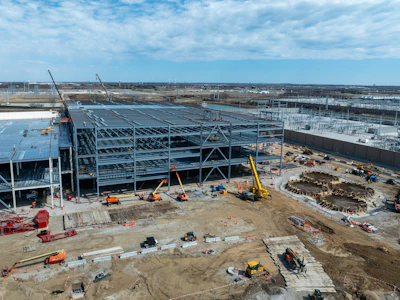
With spending on data centers projected to reach $7 trillion by 2030, the demand for contractors to deliver on aggressive timelines is only growing. But behind the cranes and crews, many of the workflows responsible for keeping materials moving in the construction industry are still handled with human intervention: through email, spreadsheets, PDFs and manual data entry.
Historically, contractors have worked through or around the administrative bottlenecks created by so many conflicting systems, formats, and communication channels, begrudgingly accepting errors, opacity and slowness as the cost of doing business.
The realities of data center construction are pushing these manual processes to a breaking point. While the industrial supply chain has spent years searching for systems that can improve operational efficiencies and better protect thin margins and tight timelines, the technologies available were incomplete. Today’s large, complex data center projects make their search even more urgent.
When electrical, mechanical and cooling systems must be installed in a specific sequence with minimal flexibility, even minor incidents are magnified, causing cascading delays across the entire job site that threaten deadlines and bottom lines. As these inefficiencies compound, contractors are waking up to a new reality. Manual and legacy processes aren't just slowing teams down, they're introducing risk. Meeting the demand for data center construction requires moving faster, with greater clarity and higher accuracy than ever before. Many contractors are discovering that modern AI-powered platforms offer the solutions they need to gain real-time visibility into materials and orders and cut the administrative burden that delays critical decisions and erodes project margins.
Seizing the Data Center Opportunity While Protecting Margins
Tech giants like Amazon, Google and Meta are making massive investments in data center construction to meet the demand for AI computing power, and contractors are optimistic about the opportunity. According to the AGC's 2026 Construction Outlook, 57% of contractors expect data centers to deliver higher dollar value in the year ahead, up sharply from 42% last year. It's the only segment in the survey where revenue expectations climbed by double digits.
Given the amplified challenges of data center construction, however, some contractor firms may hesitate to act on the opportunities in front of them. The construction industry deals with narrow margins for error – in data center construction, those margins are even narrower, meaning it’s imperative that contractors and distributors communicate quickly and accurately to keep pace with the speed and complexity of buildouts.
In a recent survey of 375 engineering and construction leaders, KPMG found that for leadership teams, protecting margin is the top priority. That’s incredibly difficult to do when data center construction:
- Costs over $1,100 per square foot for AI-optimized builds
- Relies on MEP systems that carry 16–52+ week lead times
- Is still new territory for many crews
At an average project cost of $494M, the math on any work stoppage gets uncomfortable fast. While contractors want to seize the opportunity in front of them, caution and risk aversion are holding many back – especially without reliable technology to help mitigate this risk.
Scaling and Expanding through the Talent Gap
Tackling new territory like data center construction is especially daunting for an industry facing a generational cliff. The NCCER projects that 41% of the current construction workforce will retire by 2031, and the pipeline of replacements is thin. The shortages are not limited to skilled tradesmen. Project managers, superintendents and estimators are also facing departmental shortages, and those who remain are being stretched to their limits, forced to manage more projects with fewer supporting staff. That’s a risky proposition when considering expanding into data center projects that are more administratively time intensive.
Construction executives have to find a way to fill this talent pipeline, and fast. The same KPMG survey shows the largest share of transformation investment (25% of spend) is going to People & Workforce Development to ensure workforce readiness to meet existing project demands and to capitalize on the opportunity presented by data center projects.
Retaining institutional knowledge from those soon to retire and moving to systems that enable young hires to get up to speed quickly are key objectives many contractors need to address to feel confident about taking on data center construction. This is one more way AI-powered workflow automation is already making a big impact.
The Administrative Burden of Manual Workflows
With $700 billion flowing into data center construction, contractors handling increased demand using the same spreadsheets and email chains to manage more purchase orders, supplier communications and exceptions are feeling the pain of manual workflows more than ever.
Of all the places complexity shows up on a data center job, material procurement is one of the most consequential and least visible. It sits at the intersection of schedule risk and cost risk, and for most contractors it's still managed manually end to end.
The friction starts at quoting. Contractors send requests to distributors in varying formats (spreadsheets, emails, PDFs, handwritten notes) sometimes with hundreds of line items described in contractor language that doesn't match distributor or manufacturer catalogs. Sales reps interpret those requests manually, match them to products and enter everything into an ERP before a quote can move forward. When inbound volume increases, that process slows proportionally.
Once a quote is approved and an order is placed, acknowledgements come back in similarly inconsistent formats. Ship date changes, quantity discrepancies and substitutions can easily go unnoticed unless someone in purchasing is manually reviewing every supplier communication and reconciling it against the original PO. On a high-volume job, that's rarely a safe assumption.
Invoice processing adds another layer of risk. Manually matching invoices against purchase orders and delivery confirmations increases the likelihood of paying for materials that arrived short, damaged, or not at all, and limits visibility into real-time project costs. In an industry where procurement represents 40 to 70% of total company spend, those errors affect job cost accuracy and carry into future project estimates.
Project managers and purchasers now carry responsibility across multiple systems they don't fully control, absorbing vendor slippage, reporting debt and tooling fragmentation. Older tools were not built for the coordination complexity of a modern construction project, let alone data center projects.
Using AI to Boost Productivity and Workflows
AI solves a problem in the construction sector that traditional software could not: turning messy, inconsistent inputs into structured workflows with speed and accuracy across the supply chain.
Returning to materials, AI can help distribution sales teams respond to incoming contractor requests quickly and accurately. In one case, AI-powered automation enabled one large wholesale distributor to cut order entry times by up to 50%. That speed is vital for contractors when dealing with the material volumes required by a data center build, making suppliers using AI better partners as project complexity scales.
Quicker, more accurate order processing means fewer errors, incorrect shipments and costly returns that slow progress on-site. AI workflow automation can also help bridge the gap for purchase orders, delivery updates and invoices coming from suppliers that live in different systems or arrive through different channels. Most purchasing teams don’t have the bandwidth to comb through their inbox and compare POs to order acknowledgements. AI makes that level of proactive review feasible by automatically analyzing inboxes for supplier updates and matching them against purchase orders, giving contractor teams the ability to track materials through each handoff. It becomes not only possible, but easy to catch errors, changes or uncommunicated delays.
Crews onsite also benefit from automated back-office workflows, as better visibility into orders can make the difference between proactive planning and reactive damage control. If a project manager knows a material package is delayed, they can shift crews to another area or make a substitution decision before the schedule is fully exposed. When that information is buried in an email chain, the team may not find out until the damage is done.
If invoice processing and matching is also automated using AI, connecting the entire material procurement process end-to-end, cashflow visibility improves significantly and allows for more accurate job costing. Just as the burdens of manual workflows carry from one project to the next, the benefits of AI carry from one project to the next.
The Future of the AI Data Center Boom is Automation
When it comes to AI adoption, most contractors overestimate what it requires. The scope feels vast, but the most effective starting point is usually a single workflow where the manual burden is high and the outcome is measurable. Contractors should identify an opportunity where workflow AI automation would make a big impact, run a focused test and then measure results.
The future of data center construction will be defined by contractors, distributors and manufacturers using AI in the places where manual work is preventing them from taking full advantage of the data center boom. By turning fragmented inputs into clear decisions, improving visibility across the supply chain, and reducing administrative workloads, AI automation can be the unlock that keeps projects moving – on schedule and on budget.