The Human Side of Grade Control and How It Addresses the Labor Shortage
By turning the cab into a high-tech office, contractors can attract a new generation of digital natives who are more comfortable with a tablet than a shovel. And for the veterans, it offers a way to extend their careers by reducing the mental and physical toll.
The construction industry is weathering a perfect storm: The demand for infrastructure development is growing and residential development is slowly recovering. About 40% of the workforce is expected to retire in the next five years. And recruiting younger workers remains an uphill battle.
For many contractors, addressing the labor shortage has been framed as “buying your way out of the problem” with machines that are bigger, faster and stronger; or bidding more defensively, which is no simple task.
But the best solution might be something you already have in the cab. The digital display inside nearly every modern machine is a powerful tool you can’t afford to ignore any longer. The people you need in those seats can learn faster and find more reasons to stay if that touchscreen is equipped to support them properly.
It’s time to focus on the human benefits of construction technologies, and one of the best examples is grade control for excavators. It’s not new, but adoption is growing as equipment owners begin to understand its value in training, retention and safety.
Bridging the Skills Gap
Becoming an operator who’s skilled in grading used to take years. It required a feel for the machine that only thousands of hours in the cab could provide. But no one has the luxury of waiting years for a rookie to become profitable anymore.
Excavator grade control systems with 2D and 3D visualization and automation can significantly shorten the learning curve. Real-time visual guidance on digital tablets gives novice operators the same “eyes” as 20-year veterans.
“It’s nothing to be intimidated by,” says Harold Lunnie, who launched Harold’s Concrete Construction in 1995. “And it’s easy to backtrack if you make a mistake.”
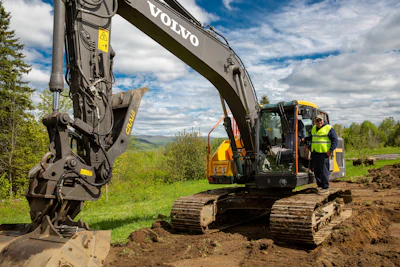
Lunnie expanded his Vermont-based business from concrete pouring into site prep and septic work many years ago, but just recently incorporated grade control. As an owner of multiple mid-size excavators, he an indicating system to his machines and said it only took him about a week to become proficient with it.
Grade assist systems can save up to 35% on time by helping an operator dig to the right grade the first time, and automation features can boost that to 45% or 50%.
A shortened training cycle empowers new hires by helping them easily hit target grades within their first few weeks. Arming operators with the tools to get it right the first time is one of the most effective ways to ensure that they succeed and that you avoid costly rework.
Lunnie finds it reassuring that he can input site data into the grade control system and get an operator started, trusting that the excavator and technology will keep them on track for the rest of the day. As an operator for more than 30 years, he also enjoys using it himself.
Retention Through Reduced Fatigue
Quality of life often factors into veteran operators’ decisions about how long to keep working. The fact that machine control can reduce the physical and mental toll of their job is another way this technology pays off.
Semi-autonomous systems reduce an operator’s cognitive load, using drive-by-wire technology to automate the boom and bucket movements. Once the parameters are set, the excavator takes over the precision-heavy work, preventing over-digging or deviation from the desired slope. Volvo CE
By automating the most tedious and high-pressure parts of the job, contractors are seeing a drop in operator fatigue, which makes workers more likely to return the next morning — and the next year.
Removing the 'Target' from the Trench
Grade control’s most significant human benefit is enhanced worksite safety. Grading used to require two laborers: an operator in the cab and a grade checker on the ground.
The person on the ground is in a vulnerable position, standing near heavy equipment that’s in motion and often inside or at the edge of a trench. But grade control removes the need for someone to spend their day in the danger zone because the operator has highly accurate grade and depth information on a touchscreen in the cab.
Some systems offer the ability to create digital fences, which provides another layer of protection. Operators can set depth limits to avoid underground utilities, height limits to prevent striking overhead power lines, and swing fences to keep the machine from swinging into traffic or nearby structures.
These features protect people, equipment and your profits.
Transformation in Practice
For Lunnie, the decision to adopt machine control was driven by the reality of the labor market. As an owner-operator, he knew the struggle of finding good workers and wanted technology that could help him work faster and smarter without breaking the bank.
Today, his secret weapon is an in-field design function within his grade assist program that allows him to turn paper drawings into digital models directly on the tablet.
On a residential project involving a foundation with 16 corners, Lunnie calculated that a manual layout would have taken him three hours of squaring and staking. With machine control, he had the layout programmed and was moving dirt in less than 15 minutes.
“This system is a game changer,” he says. “If you invest in this technology, you’re investing in production, you’re investing in accuracy, and you’re investing in no callbacks. And that’s what this game is all about.”
Lunnie estimates that the system paid for itself in about four months through reduced labor and fuel costs. Within a couple years of integrating grade assist technology into his excavator fleet, he was able to grow the site prep portion of his business so significantly that he no longer pours concrete.
A Human-Focused FutureVolvo CE
As other industries talk about technology replacing people, it’s only making them more successful in construction. By turning the cab into a high-tech office, contractors can attract a new generation of digital natives who are more comfortable with a tablet than a shovel. And for the veterans, it offers a way to extend their careers by reducing the mental and physical toll.
As the industry moves forward, the most successful contractors won’t be those who just have the latest machines, but the ones who use technology to protect, train and retain their most valuable asset: the humans behind the controls.

 Volvo CE
 Volvo CE
 Volvo CE