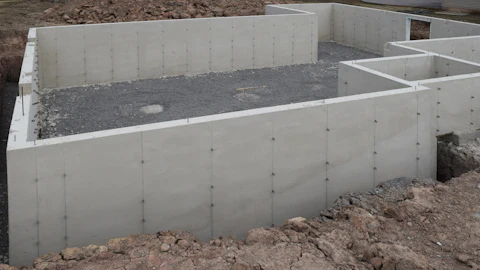
On a lot of old houses, the foundation wall takes the blame for a problem that’s really up in the wood. The stone or block is carrying fine. What failed is the bearing: a sill rotted soft, a stone that dropped out from under a beam, a support post that was always undersized and finally gave up. The floor sags, the doors stick, and everybody points at the foundation. Then you get down there and the wall is dead solid.
I’ve spent my career under old New England homes, and this is the repair people get wrong most often. They underpin a wall that never moved, or they jack a sagging floor without ever fixing what let it sag. Restoring bearing is its own kind of foundation repair, and on an old house it’s usually the one that actually matters. Here’s how I approach it.
First, Make Sure it’s Bearing and Not the Wall
Before you shore anything, figure out what’s actually moving. Three different failures get mixed up on old homes, and each one is a different repair.
The wall is moving. A bowing, leaning, or horizontally cracked foundation wall is a lateral-load problem. That’s carbon fiber, wall anchors, or a rebuild, and it’s not what this article is about.
The footing settled. If the stone or the footing itself dropped, the bearing point is moving with it. Posts and sills won’t hold that. That’s underpinning.
The bearing failed. The wall is solid and the footing is stable, but the wood or the post between the foundation and the floor gave out. That’s the one you fix by restoring the bearing.
The tell is simple: watch the bearing point itself. If the stone under the beam is holding its line and only the wood on top is soft or crushed, you’ve got a bearing repair. If the stone or the slab under the post has dropped, stop and price underpinning instead.
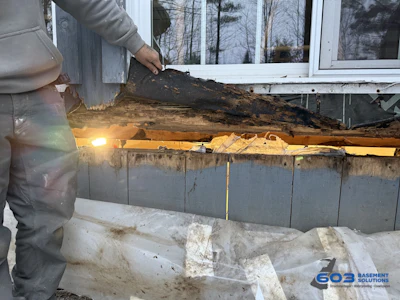
 New pressure-treated sill spliced into sound framing.603 Basement Solutions
Take the Load Before you Touch Anything
Old framing is brittle and the load paths are not always where you’d expect. Get temporary support under it before you cut a single thing.
Crib on something solid. A screw jack sitting on a dirt crawl floor or a thin slab will punch right through under load, and now you’ve made a second problem. Build a proper cribbing stack or a footing pad first, then set the jack or the needle beam. Lift slowly, a little at a time, and watch the structure above you. Plaster cracks, doors that suddenly won’t latch, and fresh gaps at the trim are the house telling you to back off. You’re not trying to make it level in an afternoon, just to take the weight so you can work safely.
Sills & Beam Ends
The sill and the beam ends are where old houses rot, because that’s where the wood meets the masonry and sits in the dampest air in the building. Decades of that and you get punky, crumbling wood right at the bearing. Decay fungi need mild temperature, oxygen and moisture, per the Forest Products Laboratory. Down there the first two are a given, so moisture is the only one you control.
The wood repair and the water repair are the same job. Do one without the other and the customer is calling you back in five years.
Replace what’s gone and splice into what’s sound. Full sill replacement where you can get the run, a scarf or a sister where you can’t. Use pressure-treated stock for anything back in contact with the foundation. And here’s the step people skip: put a capillary break between the new wood and the masonry, a sill gasket or flashing, so the fresh sill isn’t wicking moisture the same way the old one did.
Then fix the water. If you replace a rotted sill and leave the wet basement, the grade, or the bad gutter that soaked it, you’re just scheduling the next rot. The wood repair and the water repair are the same job. Do one without the other and the customer is calling you back in five years.
 Adjustable steel support column set on a poured footing against a fieldstone wall.603 Basement Solutions
Support Posts & Columns
The other common bearing failure is the post under the main beam. On old homes you find rotted wood posts, a stack of shims, or an undersized jack post somebody set as a “temporary” fix a decade ago. Sometimes it’s a steel column sitting right on the slab with no footing under it at all.
Replace it with a properly sized column on a real footing. That means a poured pad under the slab, sized for the load coming down and the soil under it, not a column bearing on four inches of slab over dirt. The adjustable column is the easy part, and the footing is what makes it a repair instead of a patch. Size the pad, pour it, let it cure, then set the column and bring it up slow, same as the jacking.
Know When it’s Underpinning Versus Bearing
The mistake that costs everybody is fixing the bearing when the real failure is below it. If the footing has settled or a foundation stone has dropped, a new sill and a new post just ride the movement down with it. You’ll be back.
The strongest foundation-repair work on an old house starts by separating the three failures: is the wall moving, is the footing settling, or did the bearing between them give out.
So before you commit, confirm the bearing point is stable. Look at whether the stone or the footing under the post and the sill is holding its elevation, or whether the whole thing is going with the soil. Settlement that runs vertical, a footing sitting on disturbed or wet fill, a stone that’s clearly rotated out of the wall, those point to underpinning: helical or push piers to carry the load down to something that won’t move. That’s a different scope and a different quote, and the honest move is to catch it before you shore, not after.
The strongest foundation-repair work on an old house starts by separating the three failures: is the wall moving, is the footing settling, or did the bearing between them give out. Match the repair to the one that’s actually happening. Restore the bearing where the bearing failed, underpin where the footing moved, and stabilize the wall where the wall moved, and don’t sell any of the three as a fix for the other two.
Do that, kill the water that rotted the wood in the first place, and you hand the owner a repair that holds, without tearing out a foundation that was carrying the house just fine.