
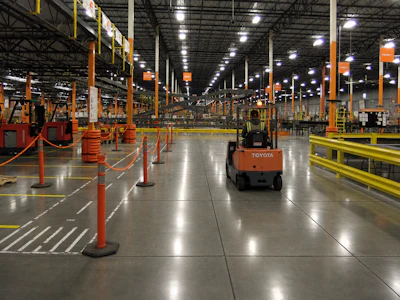
A slab's long-term performance is determined by far more than compressive strength, finish quality or flatness. While much attention is given to mix design, placement, consolidation and curing, one critical component often receives less consideration than it deserves: the joint system. Yet, joints are often where slab deterioration begins, particularly in industrial facilities subjected to heavy wheel traffic.
Spalled joint edges, chipped corners, increased vibration from forklifts and recurring maintenance costs are rarely the result of poor concrete alone. More often, they stem from shortcomings in joint layout, saw-cut timing, material selection or installation practices. A properly designed and protected joint system is fundamental to slab performance because joints must simultaneously control shrinkage cracking, accommodate movement, and protect vulnerable slab edges under repeated loading.
For contractors working across a wide range of applications, understanding the science behind joint performance is increasingly important as owners demand longer-lasting floors, lower maintenance costs and improved lifecycle value.
When joints are treated as engineered components rather than finishing details, concrete floors remain serviceable for decades instead of requiring premature repairs.
It's Strategy: Joints are Designed to Crack
Concrete shrinkage is inevitable. As cement hydrates and moisture leaves the slab, tensile stresses develop that eventually exceed the concrete's relatively low tensile strength. Without planned locations to relieve those stresses, random cracking becomes unavoidable.
Control joints provide predetermined planes of weakness that encourage shrinkage cracks to occur beneath the saw cut rather than randomly across the slab surface. Construction joints allow placement operations to continue while maintaining load transfer between pours. Isolation joints separate the slab from structural elements such as columns, walls and equipment foundations, allowing independent movement without creating restraint stresses.
Each joint type performs a different function, yet all contribute to the long-term durability of the concrete slab. When any part of the joint system is overlooked, the effects often become apparent only after the building is occupied and subjected to traffic.
In industrial facilities, for instance, unsupported joint edges experience concentrated loading every time forklifts, pallet jacks or automated guided vehicles cross the joint. Those repeated impacts progressively damage the concrete, eventually producing spalling, rough ride quality and costly repairs that can disrupt facility operations.
 Unsupported joint edges can quickly deteriorate under hard-wheeled traffic. Semi-rigid joint fillers provide edge support that helps prevent chipping, spalling and costly repairs.The Euclid Chemical Company
Successful Joint Performance Begins During Design
Long before concrete arrives on the project, joint performance is largely determined by thoughtful layout and coordination. Contractors who review joint locations during preconstruction frequently identify opportunities to improve long-term durability while minimizing future maintenance.
Adjusting joint locations to relieve these stress concentrations can significantly improve slab performance.
Joint spacing should be coordinated with slab thickness, reinforcement strategy and anticipated shrinkage characteristics. Panels should also remain as close to square as possible because elongated panels generate greater restraint stresses and increase the potential for uncontrolled cracking.
Re-entrant corners, such as door openings, pits, equipment foundations and irregular slab geometries, naturally concentrate tensile stresses, making them common initiation points for cracking. Adjusting joint locations to relieve these stress concentrations can significantly improve slab performance.
Traffic patterns should also influence joint placement. Retail spaces, parking structures, schools and healthcare facilities often develop predictable circulation paths where carts, vehicles or foot traffic repeatedly cross the same joints throughout each day. Relocating joints outside primary travel paths whenever possible reduces impact loading on vulnerable slab edges and extends service life.
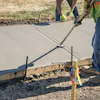
 Timely saw cutting creates controlled planes of weakness that help manage shrinkage cracking and prevent random cracks from developing across the slab.The Euclid Chemical Company
Saw-Cut Timing Requires Precision
Even the best joint layout can fail if saw cutting is performed at the wrong time. The key is to create the weakened plane before shrinkage stresses cause random cracking. Achieving that, however, requires careful judgment because concrete properties continuously evolve during early hydration.
Planning saw-cut operations before placement ensures equipment and personnel are available when conditions indicate the slab is ready.
Cutting too early may result in raveling, aggregate pullout or damaged edges that compromise joint quality. Waiting too long, on the other hand, allows tensile stresses to build until uncontrolled cracking occurs before the saw cut can become effective.
The appropriate timing depends on a number of variables, including cement chemistry, supplementary cementitious materials, ambient temperature, wind conditions, slab thickness, finishing practices and evaporation rate. There is no universal schedule that applies to every placement.
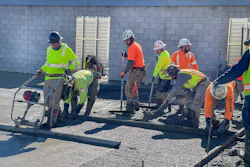
Experienced contractors monitor concrete behavior rather than simply watching the clock. Planning saw-cut operations before placement ensures equipment and personnel are available when conditions indicate the slab is ready. This proactive approach consistently produces better crack control.
 Proper installation starts with clean, prepared joints and complete filler placement. Overfilling and shaving the material flush helps create a smooth, durable crossing point for traffic.The Euclid Chemical Company
Understanding the Difference Between Sealants & Joint Fillers
One of the industry's most common misconceptions is that all joint materials perform the same function — yet joint sealants and semi-rigid joint fillers are engineered for entirely different purposes.
Flexible sealants are intended to prevent intrusion of water, incompressibles, chemicals and debris while accommodating substantial movement. These materials are appropriate for exterior pavements, parking structures and applications exposed to significant thermal expansion and contraction.
Many slab-on-ground applications require a different solution depending on how the floor will be used. In environments where repeated loading from carts, vehicles or equipment is expected, semi-rigid joint fillers are designed primarily to support joint edges rather than accommodate large movement. By distributing loads across the joint shoulders, they help reduce stress concentrations that can lead to edge deterioration over time.
Using a flexible sealant where structural edge support is needed can allow repeated loading to damage the concrete. Conversely, installing a semi-rigid filler in areas where significant joint movement is anticipated may result in debonding or cohesive failure within the filler itself.
Material Properties Matter
The hardness of the filler plays a significant role in protecting joint edges subjected to repetitive loading. Materials that are too soft deform under wheel traffic and fail to adequately support the concrete shoulders. As impacts are transferred directly into the slab edge, spalling accelerates.
Evaluate material performance characteristics instead of focusing solely on initial cost.
On the other hand, excessively rigid materials may not accommodate normal slab movement, increasing the likelihood of adhesive failure or cracking within the filler.
High-performance semi-rigid epoxies and polyureas are widely used across a range of applications — from warehouses and retail spaces to institutional and commercial facilities — because they provide an effective balance between stiffness and flexibility. They help support slab edges while accommodating the limited movement typically expected after the majority of drying shrinkage has occurred.
Contractors should evaluate material performance characteristics instead of focusing solely on initial cost. Premium joint fillers often reduce maintenance requirements, minimize future repairs and significantly extend floor service life, resulting in lower lifecycle costs for owners.
 After curing, semi-rigid joint fillers are typically shaved flush with the slab surface to provide continuous edge support and a smooth transition for traffic.The Euclid Chemical Company
Installation Determines Long-Term Success
Even the highest-performing joint filler cannot compensate for poor installation practices. Surface preparation is among the most critical factors affecting long-term adhesion. Dust, curing compounds, laitance, moisture and loose concrete all interfere with bonding. Joints should be thoroughly cleaned using preparation methods recommended by the manufacturer before filler installation begins.
Contractors should inspect completed joints before the floor is placed into service.
Installation timing is just as important. Most semi-rigid fillers are intended to be placed after the slab has completed the majority of its initial drying shrinkage. Filling joints prematurely increases the likelihood that continued slab movement will separate the material from the joint walls.
Proper placement techniques also influence performance. Voids and trapped air create unsupported areas that concentrate wheel loads and increase the potential for joint deterioration. Fillers should completely occupy the specified depth, providing continuous support along both joint shoulders.
Many contractors intentionally overfill joints slightly before shaving the material flush after curing. This widely accepted practice creates a smooth transition across the slab surface, reducing impact loading from carts, vehicles, equipment or foot traffic. Even minor depressions or raised edges can generate thousands of repetitive impacts over the life of a facility.
Environmental conditions should also be monitored during installation. Ambient temperature, concrete temperature and moisture conditions influence cure rate, adhesion and, ultimately, slab performance. Installing fillers outside the manufacturer's recommended parameters can compromise long-term durability regardless of material quality.
Finally, contractors should inspect completed joints before the floor is placed into service. Identifying incomplete filling, poor adhesion or surface irregularities immediately is far less expensive than returning after the building becomes operational.
Common Mistakes Continue to Shorten Floor Life
Most joint failures can be traced to several preventable mistakes. Delayed saw cutting, poor joint layout, inadequate surface preparation, improper material selection, insufficient filler depth and failure to produce a flush finished surface all contribute to premature deterioration.
Another common mistake is selecting products based solely on purchase price. Material cost represents only a small fraction of the total lifecycle expense associated with industrial floor maintenance. Choosing higher-performing products often eliminates repeated repairs, operational interruptions and equipment damage that far exceed any initial savings.
Perhaps the greatest mistake, however, is viewing joints as secondary details rather than essential structural components of the slab system. Once deterioration begins, repairs frequently become an ongoing maintenance expense throughout the life of the facility.
Building Floors That Perform for Decades
Owners rarely notice a properly engineered joint system because it quietly performs its job. What they do notice are rough floors, recurring repairs and growing maintenance budgets as joints begin to fail.
Contractors who understand the engineering principles behind successful joint systems will be better able to deliver results that meet diverse project demands while reducing callbacks and extending service life.
Long-lasting performance requires a systems-based approach that integrates thoughtful layout, properly timed saw cutting, appropriate material selection and careful installation. Every phase contributes to protecting slab edges, controlling cracking, and maintaining smooth, durable floors.
As buildings and infrastructure are exposed to increased traffic, changing usage patterns and higher durability expectations, joint performance will remain a key factor in overall slab longevity. Contractors who understand the engineering principles behind successful joint systems will be better able to deliver results that meet diverse project demands while reducing callbacks and extending service life.
The concrete itself may receive most of the attention during construction, but it is often the joints that determine whether a slab performs for five years or fifty. Getting them right from the beginning remains one of the highest-value investments any concrete contractor can make.