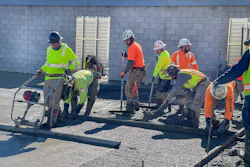


In general, concrete work builds things — even in decorative work. A new foundation is placed for a new home. Slabs are finished. Walls are cast. The structure, the driveway, the decorative elements start to form shape. In a way, the process is similar to starting a new company; you start the hard work and soon enough (with any luck) success begins to materialize.
Led by president and CEO Jeff Price, Texas Slab Guys provides concrete solutions serving both residential and commercial customers across major markets including Houston, Dallas-Fort Worth, Austin, and San Antonio. The company’s work ranges from residential driveways and foundations to commercial and infrastructure projects, including data centers, industrial facilities, roads, sidewalks, and slabs for metal buildings and barndominiums. As young as they are, they're already gaining attention, being recognized as Houston’s Top Residential Concrete Driveway Contractor by the International Association for Business Excellence. Concrete Contractor connected with Price in July 2026 to discuss the company’s rapid growth, operating model, and plans for scaling across Texas.
Concrete Contractor: From what we understand, the company is young. When did Texas Slab Guys start?
Jeff Price: Texas Slab Guys really launched in August of 2025.
 Jeff Price and family.Jeff Price
To be perfectly honest, concrete was probably the category I was least excited about initially. I wasn't anti-concrete; there were just other businesses that interested me more. But the doors kept opening in concrete, and sometimes that's how things work. We ultimately got a business under contract in June 2025.
After some training, testing, and marketing, I went full throttle in August. We launched the Texas Slab Guys brand, built the website, and generated about $176,000 in sales between August and December.
That wasn't bad for the first few months, but it certainly wasn't great financially. We made less than $20,000 in net income. If there was a concrete 101 mistake available to make, I probably made it. I underestimated jobs, failed to account for certain costs, and learned basic lessons like what an extra hour of travel and fuel does to the economics of a project.
Fortunately, we didn't have any catastrophic projects, but there were plenty where I looked back afterward and thought, “That was a lot of work for very little money.”
One of my natural aptitudes is building things, and I get a tremendous amount of fulfillment from it. Buying a business may get you in the door, but building Texas Slab Guys into something bigger, better, and more scalable has been the fun part for me.
Concrete Contractor: What makes Texas Slab Guys unique?
Price: We operate this blue-collar business as a white-collar service. Our goal is to create a process-driven company that isn't reliant on any one person to continue scaling and growing, myself included. We're thoughtful not only about the projects we take on, but also about who we work with.
From a strategic standpoint, what makes us different is that we've been building with scale in mind from the beginning. In our first 12 months, we surpassed a $1.5 million annualized revenue run rate. We've achieved that by incorporating automation and AI throughout the business from day one. Our gross margins typically range from 50 to 60 percent, and we've intentionally built Texas Slab Guys to be an asset-light business with very little fixed overhead and almost no capital investment required to grow.
We function more like a general contractor that specializes exclusively in concrete.
On the delivery side, we're not trying to compete on price. We try to be students of the customers we serve and understand the actual problem they're trying to solve. The concrete work is often just the physical solution to a much more important underlying concern. For example, a customer may tell us they need their driveway leveled. But when you ask why, you may learn that their mother uses a walker and is going to be visiting regularly, and they're worried about her tripping. At that point, we're not just solving a concrete problem. We're solving a safety problem.
Understanding that “why” is how we operate differently from a lot of our peers. A lot of contractors want to compete on price. I don't. I want to understand the problem, solve it well, and create an experience that makes the customer feel like they made the right decision.
Concrete Contractor: Where do you think you learned this service-first mindset?
Price: I think it comes from a strong business-process mindset and a belief that the customer should be at the center of how a company operates. That doesn’t mean the customer is always right — it means we build our processes around clear communication, accountability, consistency, and delivering an excellent outcome. We pursue excellence in everything we do, because great service is usually the result of great execution.
Concrete Contractor: What does the rest of 2026 look like?
Price: We hit a million run-rate revenue faster than I thought we would. I originally had a goal of being at $2 million by the end of 2026, and we're flirting with that. As I look forward, my goal is figure out how we can go from $2 million (rounding up) to $10 million. What sort of people, processes, and adjustments to the business are required?
There's more than $10 billion of budget that's already guaranteed of concrete work alone that's needed. How can you not even get a half a percent of that?
There's a number of verticals that I anticipate we could grow in. Part of entrepreneurship is throwing spaghetti at a wall to see what sticks. You're not just throwing it randomly, blindfolded, and aimlessly — you want to be intentional. Consider how you cook the noodles, where you throw it, and make sure you're getting a good test in to see if the noodles are cooked.
Golf courses are interesting because they have miles of cart paths, sidewalks, patios and hardscape. They're highly sensitive to aesthetics and customer experience, and repairing or leveling existing concrete can often be substantially less disruptive than tearing it out.
There's local government work where municipal utility districts have huge budgets, and in Houston plus 100 miles in any direction, there are roads, bridges, and street budgets of $11.2 billion or just new construction in government-issued bonds. They're also tacking on additional stuff with the county, the city, and the state. There are a number of angles that we can target.
I want to go from $2 million to $10 million. The knee-jerk reaction is “That's a huge jump, how are you going to do that?” But as I've studied the market and the opportunities that exist, I think the more realistic response from somebody who has looked at the data is that there's more than $10 billion of budget that's already guaranteed of concrete work alone that's needed. How can you not even get a half a percent of that?
That's how I'm thinking about it. We have some fun stuff in the pipeline that we're working on. I'm very optimistic about what the future holds, and I'm really excited for what I think we can accomplish.
Data shows that we (Houston) have more concrete per capita being poured on an annualized basis than any other metro in the United States. We don't build up, we build out. The second biggest market is the DFW market – 20 percent of all new concrete is being poured on an annualized basis in Texas relative to the rest of the United States.
Concrete Contractor: Before this interview, you told us that you ‘vibe-coded’ a tool to help customers receive an instant quote. Can you elaborate on this development process?
Price: Vibe-coding is using a tool like Replit (a personal preference), Base44, or Lovable. These tools enable a non-technical person to clearly articulate an idea, whether it's in a website, a form, or a tool, that creates automation and function for a very specific use. If you clearly articulate inputs, the desired output, and all the variables that go into that, then using plain-speak prompts you can create that. The only requirement is just clear communication with a chat interface. That’s vibe coding.
If you want to learn about it, there's no shortage of content and information on YouTube.
I took the same approach on the website and landed on this workflow that's mobile-first and allows anybody to get an estimate. It comes with a qualification like, “This is an estimate based on a tool that uses AI — one of our team members is going to review it and get back with you as soon as possible.” We called it LevelEstimate. It was slow to adopt, but by Q2 we saw about 70+ estimates come through. The noise is a lot higher than your average inbound lead flow. I have competitors shopping our pricing, folks trying to see if it works, spamming it for whatever reason.
Of that fully automated process, it generated nearly 6 figures of revenue. Was it an overwhelming success? I think yes, but at the same time, there are areas for improvement.
I spent 8 hours from having the idea to putting it out. That time has multiplied to nearly 6 figures of sales. I think that's a great multiplier.
We have some folks who are implementing it on their own website, in their markets. We can help other concrete leveling folks to better scale and maximize their reach. It's not for everyone. It doesn't capture every prospect, but it's one channel in which no one else is offering that type of visibility, or workflow, or throughput.
(Editor's Note: They also recently launched a second tool, NewDriveway, which allows homeowners to see their future driveway via an AI-generated photo.)
Concrete Contractor: How do you think concrete contractors who may not be so tech-savvy could start adapting this idea into their business and work? How do you think they can grab your mindset and make it work for them?
Price: I have other contractors who just completely copy-paste my entire business model in their market, and that comes with a fee, like a subscription as a service. This is not a promotion for that. If you want to learn about it, there's no shortage of content and information on YouTube. Shout out to a guy named Chris Koerner, I was on his podcast. His angle is blue-collar service businesses, AI applications, and how the two overlap. He does a deep dive on what those technologies are, whether it's his CRM or how he sends out his newsletters. There's no shortage of information on YouTube.
Concrete Contractor: What have been some of the challenges you've had? How have you overcome them?
Price: The biggest skill I've had to sharpen is discernment—specifically, evaluating the quality of the people who are doing the work and representing Texas Slab Guys.
The biggest skill I've had to sharpen is discernment—specifically, evaluating the quality of the people who are doing the work and representing Texas Slab Guys.
The easy mistakes are financial. You forget to account for additional fuel on a job that's farther away. You underestimate how much sealant you'll need. You don't build enough buffer into an estimate. Those mistakes cost you money, but they're relatively easy to diagnose. You learn the lesson, change the process, and hopefully don't make the same mistake twice.
The people side is much harder. You can have someone who's technically capable of doing excellent concrete work, but that doesn't necessarily mean they're reliable, communicate well, treat the customer's property with respect, or represent your company the way you expect them to.
That's where I've probably grown the most. I'm learning that the quality of the people you surround yourself with ultimately puts a ceiling on the quality of the company you can build.
Losing some margin on a job never took much of an emotional toll on me. Choosing the wrong person and having that decision affect a customer's experience—that bothers me a lot more.
Concrete Contractor: Care to elaborate? What qualities of an employee do you look for?
Price: The best thing is just doing. If you watch how somebody conducts themselves, then they show you everything that you need to know about them. Some key traits that I really pay attention to are honesty and integrity. Do you show up on time and when you say you're going to?
There's a mutual respect. I think that's always a requirement. First impressions matter. I believe that most folks understand that.
Concrete Contractor: What do you love about the concrete industry, now that you've been in it for a year?
Price: I love that concrete is relatively resilient to the technological disruption that's reshaping the working world. I'm extremely bullish on AI and what it's going to do to knowledge work, but somebody still has to show up and physically build, repair, and maintain the world around us. Concrete is a layer of the economy that's going to be much harder to disrupt.
Concrete is a layer of the economy that's going to be much harder to disrupt.
I also love the people. I meet customers at completely different stages of life, with different careers, backgrounds and reasons for calling us. My goal is to be a student of our customers, and I try to approach every conversation believing there's something I can learn from the person on the other side of it.
On a personal level, this business has also allowed me to be much more involved with my family, and I'm incredibly grateful for that. I can coach my kids' baseball teams and make it home for dinner. That doesn't mean the business isn't demanding — sometimes you're pouring concrete at 3 a.m. to beat the Houston heat or work around the weather — but I have more control over where I allocate my time.
For me, that's one of the best parts of entrepreneurship. I can work incredibly hard while still protecting the areas of my life that matter most.
Concrete Contractor: Is there anything you would change?
Price: I'm just a small fish in a small pond and realistic about the change that I can have. The way that I'm trying to enact change is how we approach things on the service front. How we build with transparency in mind. The model that I'm creating is infinitely scalable, and so how we start to incorporate new markets is a fun thing to think through. That will require change not only to our technological infrastructure, but also to general processes and procedures of the business as well.
One change that I'm wrestling with internally is to buy my own mixing plants to own the entire value chain. That creates maybe a little more complexity, but it gives absolute control of the final product. That's opened up a whole ‘nother case of worms.
Concrete Contractor: As president and CEO of Texas Slab Guys, what would you say your leadership style would be? Where does that come from?
Price: Leadership is probably one of the areas where I still have the most room to improve.
To lead somebody well, you need to understand what they want for their own life.
One idea that has really stuck with me is that, to lead somebody well, you need to understand what they want for their own life. Your vision for the company has to be big enough that their goals can fit inside of it. If there's no alignment between where they want to go and where the business is going, eventually one side is going to hit a ceiling.
That's something I'm trying to be much more intentional about as we grow.
I'm also learning how to delegate. In the early stages of a company, you touch almost everything yourself. But if Texas Slab Guys is going to become the company I believe it can become, I can't continue being the best person for every decision or every function.
I'm 34, and one of the interesting challenges is that I'm often leading people who have significantly more years of experience than I do. I've learned that leadership doesn't require pretending to know more than everybody else. My responsibility is to provide clarity, be transparent, set expectations, hold people accountable, and be consistent in how I operate.
My hiring philosophy is similar. I want to surround myself with people who are better than I am at the things they're responsible for. The person leading sales should eventually know more about sales than I do. The person responsible for operations should be stronger than me operationally. You don't build a great company by needing to be the smartest person in every room.
At the foundation of all of it are transparency, consistency, and respect. I think you have to get those basics right before any leadership framework or hiring strategy really matters.
Concrete Contractor: What was the best advice you've ever received? How has that affected you and your leadership?
Price: Be hopelessly and romantically optimistic. I think you have to be outrageously optimistic about what you're capable of figuring out.
The question is, “What's the problem, and how do we solve it?”
I try to teach that to my children. If they say, “I can't do it” or “I don't know how,” I try to redirect that to, “I haven't figured it out yet.” Those are completely different mindsets. One closes the door and the other assumes there's still an answer.
I try to bring that same mentality into Texas Slab Guys. When something goes wrong on a project, I don't want the first reaction to be, “We can't do that,” or “That's just the way it is.” The question is, “What's the problem, and how do we solve it?”
That doesn't mean being blindly positive or pretending problems don't exist. Accountability still matters. But I want the people around me to believe that all problems are solvable if we're willing to communicate, take ownership, and keep working at them.
That mindset has probably affected my leadership more than anything else. I don't expect us to know every answer immediately. I do expect us to believe we can figure it out.
“Be hopelessly optimistic” is probably the best advice I've received, and I try to apply it across every part of my life.
Concrete Contractor: What advice would have for fellow concrete contractors?
Price: I'd love to connect with other people in the industry. I'm far from an expert and still very much a student of concrete, so whether you're operating in Texas or somewhere else, I'd be happy to hop on the phone and compare notes.
My goal is to continue growing, learning, and becoming a better student of the market. I genuinely believe I can learn just as much — if not more — from the people reading this than I could ever teach them.
If you'd like to connect, visit TexasSlabGuys and reach out. I'd be glad to hear from you.
Share your story with fellow concrete contractors. Email us at [email protected].